Quantum Computers Are Learning to Correct Their Own Mistakes
The next useful milestone is not simply a machine with more qubits. It is a machine that can protect fragile quantum information long enough to do meaningful work.
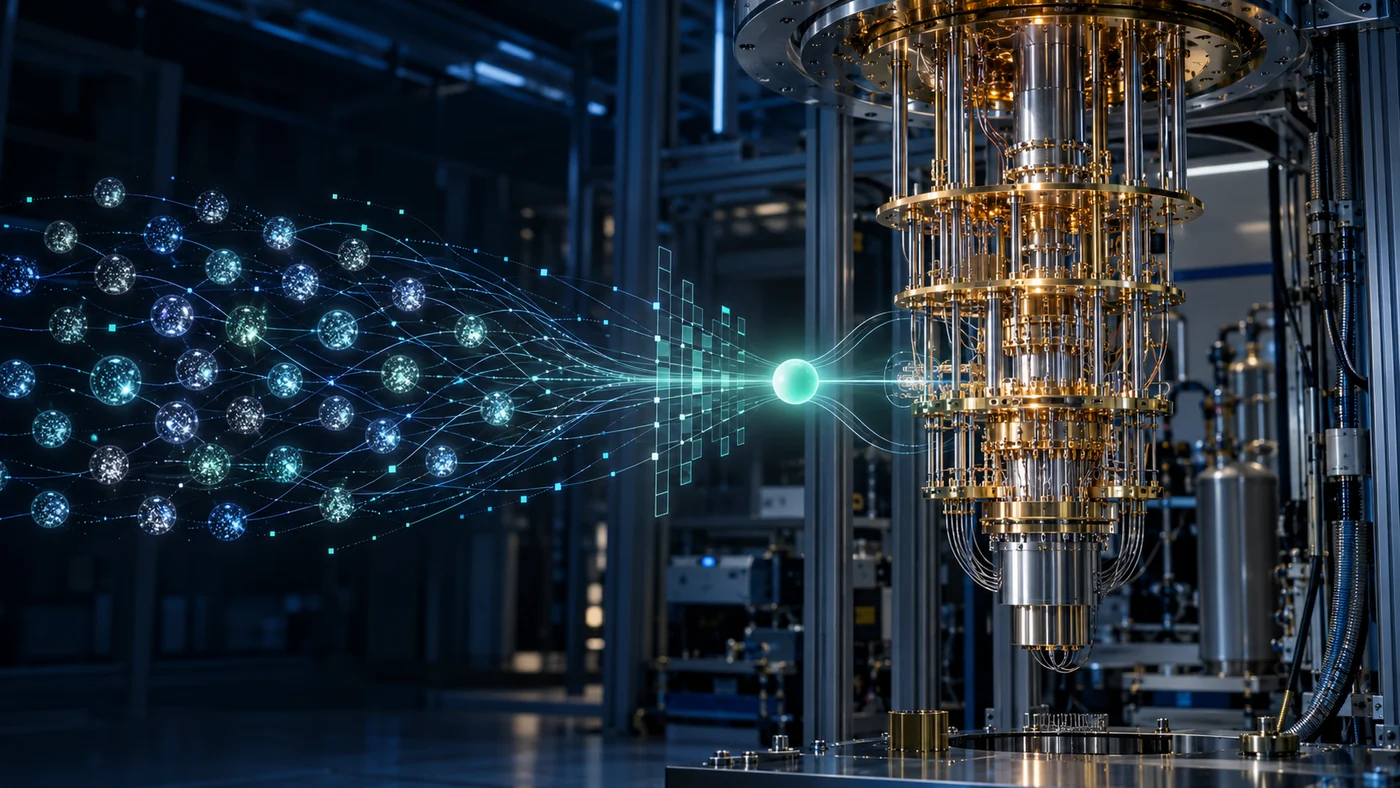
For years, quantum-computing announcements were easy to reduce to one number: how many qubits does the new chip have? That number still matters, but on its own it says surprisingly little about what a machine can calculate.
A qubit is exceptionally sensitive. Heat, vibration, stray electromagnetic fields and imperfect control pulses can disturb it. Even when the hardware is kept close to absolute zero, operations introduce errors. Add more qubits without controlling those errors and a larger machine can become a larger source of unreliable results.
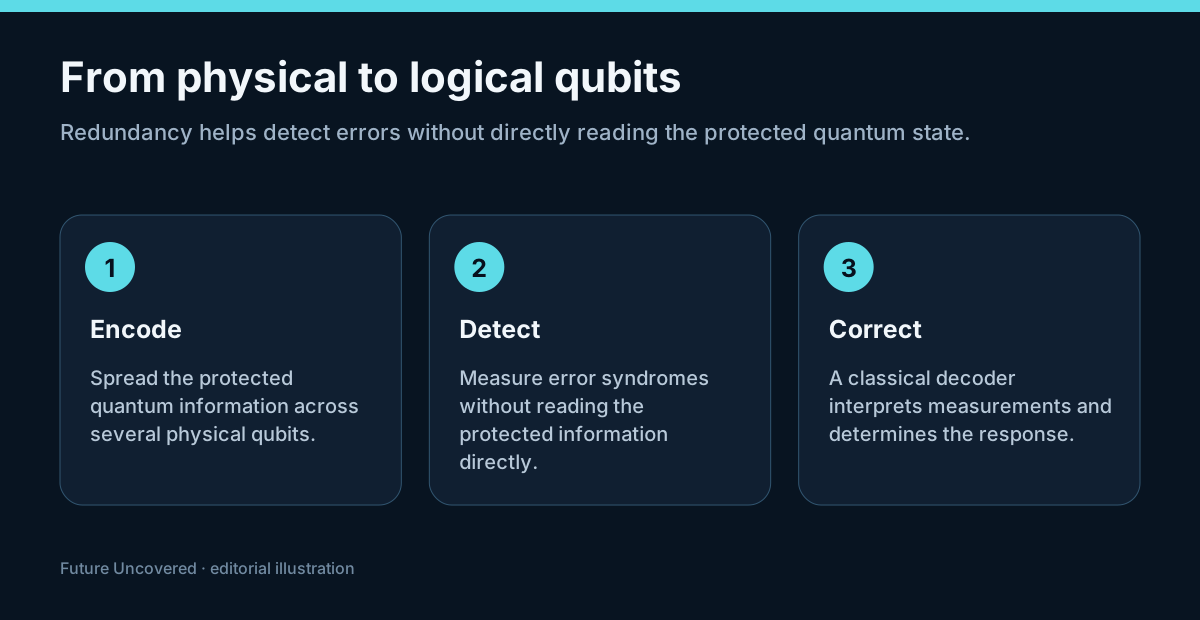
This is why attention is moving from physical qubits to logical qubits. A logical qubit is information protected by an error-correcting code and spread across many physical qubits. The aim is not to make each component perfect. It is to make the encoded information more reliable than any one component.
Quantum errors are different
In an ordinary computer, redundancy is familiar. Store several copies of a bit, compare them and use the majority value if one copy changes. Quantum information makes this harder. A qubit can hold a superposition of states, and measuring it directly normally changes the state. The no-cloning theorem also prevents engineers from making an arbitrary perfect copy as a simple backup.
Quantum error correction therefore looks for the pattern of an error without directly reading the protected information. Extra qubits are arranged so that carefully chosen measurements — called syndrome measurements — reveal whether something likely went wrong and where. A classical decoder interprets those syndromes and decides how the computation should respond.
One widely studied approach is the surface code, which arranges qubits in a grid and checks local relationships between them. Other codes use different layouts and trade-offs. There is no single universal recipe, and the number of physical qubits needed for one useful logical qubit depends on hardware quality, code design and the computation being attempted.
The threshold is the crucial test
Error correction has a demanding condition. Adding more physical qubits and a larger code must reduce the logical error rate. If the extra components introduce errors faster than the code can remove them, scaling makes the result worse.
Researchers call the useful boundary the error-correction threshold. Below that threshold, increasing the code’s size should suppress logical errors. In a 2024 Nature paper, Google Quantum AI reported that its Willow processor demonstrated below-threshold surface-code memories: as the code distance increased, the encoded information lasted more reliably. That was an important experimental result, but it was not a general-purpose fault-tolerant quantum computer.
The distinction matters. A protected quantum memory, a logical gate and a full algorithm are different achievements. A useful machine must initialise logical states, perform many operations, connect modules where necessary, decode errors fast enough and deliver a result before the remaining noise overwhelms it.
Why 2026 is a revealing year
Current roadmaps increasingly describe performance in terms beyond raw qubit count. IBM’s 2026 roadmap, for example, lists goals for deeper circuits, real-time decoding and a processor module combining logical processing with quantum memory. IBM also proposed three practical hardware measures in July 2026: programmable qubits, qubit operations and maximum circuits per second.
These are company targets and company-defined metrics, not independent proof of quantum advantage. Roadmaps can change. Their value is that they show what engineers now regard as the bottleneck: quality, connectivity, speed and error management must improve together.
The same change is visible across the field. Teams are developing better physical qubits, denser wiring, faster control electronics, modular links and more efficient codes. Progress in any one layer can reduce the burden on the others.
What a logical qubit does — and does not — tell us
A logical-qubit count is more meaningful than a raw device count, but it is not a complete score. Two logical qubits may have different error rates. A machine that preserves a state may not yet execute a long sequence of high-fidelity gates. An impressive result on one benchmark may not transfer to chemistry, optimisation or cryptography.
Useful questions include:
- How many operations can the logical qubit survive?
- Does reliability improve as the code grows?
- Which gates have been demonstrated, and at what error rate?
- Does the result include the time and hardware used for error decoding?
- Was there a practical task with a verified advantage over the best classical method?
These questions make flashy claims less simple, but they also make genuine progress easier to recognise.
The goal is not a perfectly quiet qubit. It is a system that can remain reliable while every physical part is slightly imperfect.
Will this break today’s encryption?
Large, fault-tolerant quantum computers could threaten widely used public-key systems by running algorithms such as Shor’s at sufficient scale. Today’s experimental machines cannot do that. Estimates vary because the answer depends on hardware quality, code efficiency and the size of the cryptographic key.
Security agencies are not waiting for a final machine. NIST has standardised post-quantum algorithms designed to run on ordinary computers and resist both classical and quantum attacks. Migration takes years because cryptography is embedded in software, devices and long-lived data. Preparing now is risk management, not evidence that a code-breaking quantum computer has arrived.
Where useful quantum computing may begin
Quantum computers are not faster versions of laptops. They are specialised machines that may help with particular simulations, materials problems and mathematical tasks. For many jobs, classical computers will remain cheaper, faster and easier.
The earliest useful systems may work alongside high-performance classical computers. Classical processors will prepare workloads, control hardware, decode errors and analyse outputs. Quantum processors will be used only for steps where their structure offers a real advantage.
That makes error correction more than a repair mechanism. It is the bridge between a laboratory demonstration and a dependable computing service. Without it, a long algorithm accumulates noise. With it, in principle, a computation can be extended by adding enough reliable hardware and decoding capacity.
The hidden classical workload
Error correction also explains why a quantum computer is not a sealed box working alone. Syndrome measurements can arrive continuously. Classical electronics must collect them, a decoder must infer the most likely error pattern, and the control system must keep pace with the quantum hardware. If that loop is too slow, the protected state may be lost before the machine responds.
This creates an engineering problem that crosses physics and conventional computing. Better algorithms can reduce decoding work. Faster chips can shorten the feedback loop. Cryogenic components may bring some control closer to the qubits, while other tasks remain outside the refrigerator. A credible fault-tolerant design therefore needs power, cooling, cabling and classical processing as well as a quantum processor.
It also changes the economics. A useful calculation must justify not only the number of physical qubits but the whole supporting system. That is one reason researchers compare complete workloads rather than treating a qubit count as a substitute for performance.
A better way to read the next announcement
When the next quantum chip appears, look past the largest number in the headline. Ask what kind of qubits are being counted, how errors were measured and whether performance improved as the system scaled. Check whether the result is a published experiment, a company roadmap or a projection.
Quantum error correction does not mean the field is finished. It means engineers are finally demonstrating parts of the machinery needed to make fragility manageable. The discovery is not that quantum systems make mistakes. It is that carefully designed redundancy may allow useful information to survive them.
Sources & Further Reading
- Google Quantum AI and collaborators — Quantum error correction below the surface code threshold (Nature, 2024)
- Google — Meet Willow, our state-of-the-art quantum chip
- IBM — Quantum Roadmap
- IBM — How to measure the performance of a quantum computer (16 July 2026)
- NIST — Post-Quantum Cryptography
- NIST NCCoE — Migration to Post-Quantum Cryptography