How to Check an AI Answer Before You Trust It
A confident paragraph is not evidence. This practical five-minute method helps you separate a useful starting point from a claim you can safely rely on.
An AI answer can be clear, detailed and completely wrong. It may invent a quotation, combine two genuine events, misread a date or cite a source that exists but does not support the claim. The writing style gives you very little warning.
This is not because the system is trying to deceive you. A generative model produces likely sequences of words from patterns in data and from the context you provide. Some tools can search the web or quote documents, which can improve grounding, but a link beside a sentence is still not proof that the sentence matches the source.
The sensible response is not to reject every AI answer. It is to decide what needs checking and to use a repeatable method. For a dinner idea, a small error may be harmless. For money, health, law, safety, work decisions or public claims, verification must be much stronger.
The short version
Extract the claim. Open the original source. Check the date and scope. Confirm the important point elsewhere. Increase the effort when the stakes rise.
First, decide how much checking the answer deserves
Verification is not all-or-nothing. A low-stakes brainstorming answer may only need a quick sense check. A factual explanation for a school assignment needs real sources. Advice that could affect a medication, legal deadline, contract, bank transfer or workplace decision should not be accepted from an AI tool alone.
A useful question is: What happens if this is wrong? If the answer is “I make a slightly disappointing meal”, the risk is low. If it is “I lose money, miss a deadline or harm someone”, stop and use authoritative information or a qualified professional.
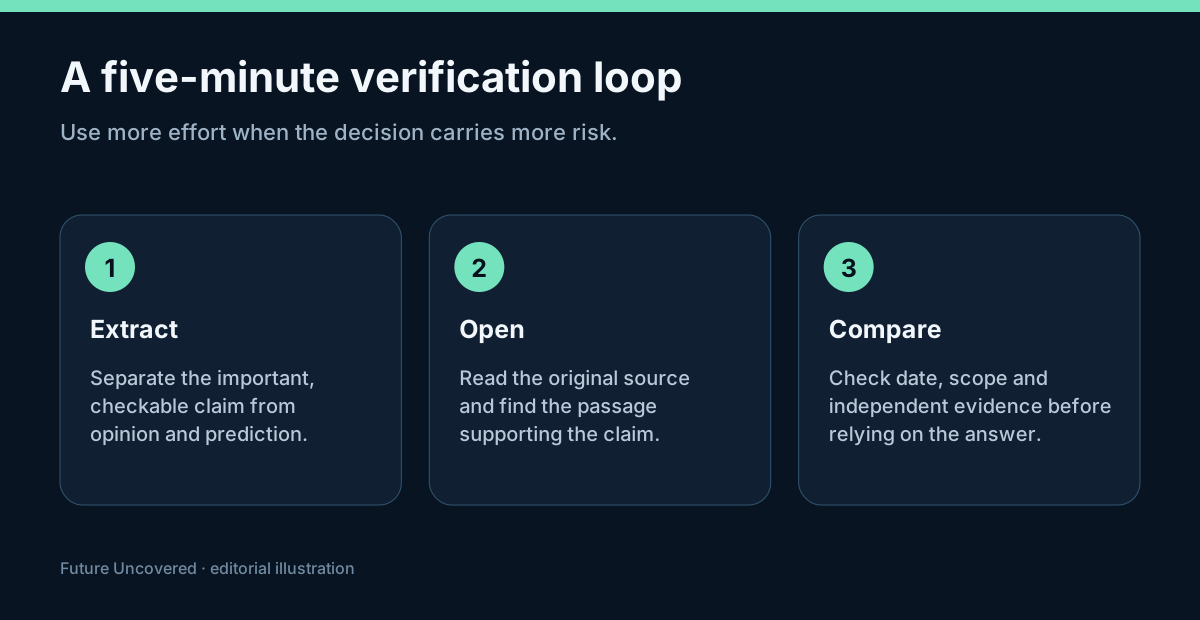
The five-minute verification loop
- Turn the answer into checkable claims.
Do not try to verify a whole polished paragraph at once. Pull out the points that can be true or false: a date, number, quotation, rule, cause or named study. Mark opinion and prediction separately. - Ask where each important claim comes from.
You can ask the AI for sources, but treat its list as leads, not evidence. Copy the title or key phrase into a normal search. For public rules, prefer the responsible government department or regulator. For science, look for the original paper and a reputable explanation. - Open the source and find the relevant passage.
Do not stop at a search snippet. Check that the page exists, the author or organisation is credible and the source actually says what the AI claimed. A genuine paper can be cited for a conclusion it never reached. - Check date, place and scope.
A rule for the United States may not apply in the United Kingdom. A 2019 figure may be obsolete. A study of 40 volunteers does not automatically describe everyone. Look for the population, conditions and limits. - Confirm the decisive point independently.
For an important claim, find a second reliable source that is not simply copying the first. Agreement between two news articles that repeat the same press release is weaker than agreement between an original report and an independent expert body.
A worked example: the invented statistic
Imagine an assistant says: “A 2026 UK study found that 72 per cent of adults now use AI every week.” The sentence sounds plausible. It contains a country, year and precise number — details that make it feel researched.
Start by searching the exact statistic in quotation marks. If nothing appears, search broader terms and ask the assistant for the study title, publisher and sample. Then visit the organisation’s site. You may discover that the survey measured people who had heard of generative AI, that the sample was limited to employed adults, or that the percentage referred to monthly rather than weekly use.
The correct response may not be “false”. It may be “the AI compressed several different findings into one unsupported sentence”. That is a common and subtle failure.
How to judge a source quickly
A polished website is not automatically reliable. Check who is responsible for it, how they know what they claim and whether the evidence can be inspected.
- Primary sources include legislation, official statistics, original research, technical standards, court judgments and a company’s own product documentation.
- Strong secondary sources explain or test primary evidence and clearly name it. They include established newsrooms, academic reviews and specialist institutions.
- Weak signals include anonymous text, missing dates, circular citations, dramatic certainty and pages built mainly to sell a product connected to the claim.
Primary does not mean unbiased. A company is the primary source for what it announced, but not necessarily the best judge of whether its product is superior. A research paper is primary evidence for its experiment, but the experiment may still have limitations.
Check quotations, links and calculations separately
AI tools can produce quotation marks around words that nobody said. Search a distinctive phrase and find the transcript, document or recording. If you cannot find the original, do not publish the quote as genuine.
Open every important citation. Check the title, author and publication date, then search within the page for the relevant term. A broken link may be an innocent change, but a fabricated journal title or mismatched author is a clear warning.
For numbers, repeat the calculation yourself. Ask what the denominator is, whether percentages are absolute or relative, and whether units match. If an answer converts currencies or prices, check the rate and the date. If it summarises a chart, inspect the axes.
Prompts that make checking easier
A better prompt cannot guarantee truth, but it can make the output easier to audit. Try:
Separate established facts, reasonable inferences and uncertain points. For every important factual claim, give the original source, publication date and the exact section that supports it. Say clearly when you cannot verify something.
You can also provide the documents yourself and ask the tool to answer only from them, with page or paragraph references. Then sample-check the references. This reduces open-ended invention but does not remove the need for review: the model can still misunderstand the supplied text.
Common traps
“It gave three sources, so it must be right”
Three citations can all trace back to one claim, or none may support the wording. Count the evidence, not the links.
“The second AI agreed with the first”
Two models may have learned from the same material or repeat the same common error. An independent answer engine is not the same as an independent source.
“The detail is too specific to be invented”
Specific names, page numbers and statistics can be fabricated. Specificity is a reason to check, not a reason to trust.
“I asked it to be accurate”
Instructions can improve care, but they do not give the model access to missing facts or guarantee that it recognises uncertainty.
When checking is not enough
Some decisions need a person with responsibility and expertise. Use a doctor or pharmacist for medical decisions, an authorised legal professional for legal advice and official financial or regulatory sources for money decisions. If an AI answer conflicts with the professional or the original document, do not average the two.
At work, follow your organisation’s rules for confidential information. Verification does not undo a privacy breach. Do not paste personal, commercial or protected data into a public AI tool unless your policy and the service terms allow it.
Make verification a habit, not a punishment
AI is useful for generating questions, organising notes, explaining unfamiliar language and suggesting where to look. It becomes risky when fluent wording is mistaken for evidence.
The simplest habit is to pause before you act or share. Pull out the claim that matters most. Open the original source. Check whether it says the same thing, in the same context, at the right date. If the consequences are serious, go further.
You do not need to distrust everything. You need to know what would count as proof.
Sources & Further Reading
- UK Government AI Knowledge Hub — How to use AI at work
- House of Commons Library — Working with AI and spotting AI-generated text (19 May 2026)
- UK Government — Artificial Intelligence Playbook
- Province of British Columbia — Review generative AI outputs (21 January 2026)
- UNESCO — AI can make mistakes: why media literacy matters more than ever
- UNESCO — Media and Information Literacy responses to generative AI