
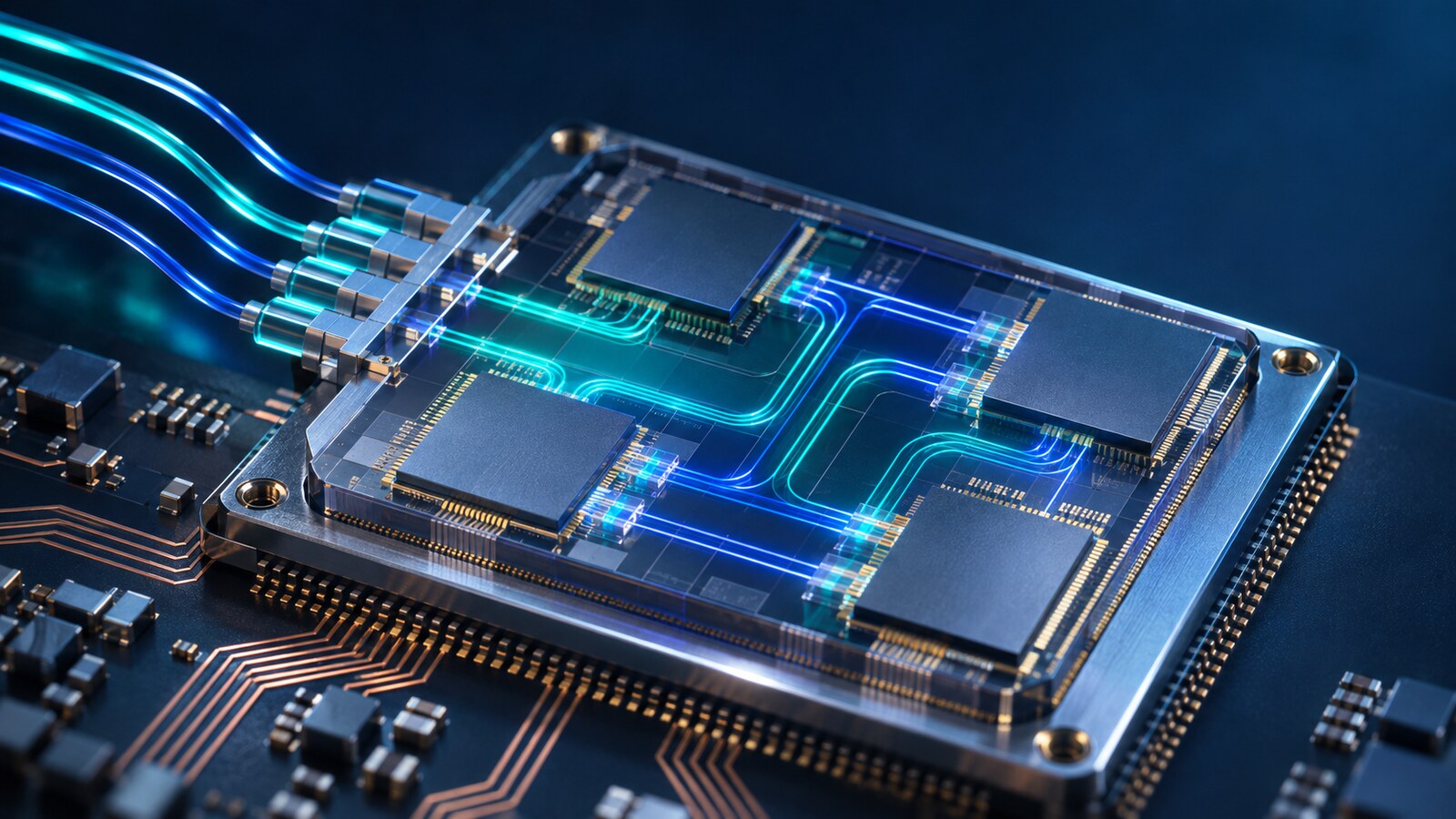
Open a laptop and nearly every useful operation depends on electrons moving through transistors and metal wires. That design has transformed the world. Yet modern artificial-intelligence systems expose one of its growing costs: moving enormous quantities of data between processors, memory and other processors can consume time, chip area and energy. The calculation may be quick; delivering the numbers can become the bottleneck.
Light offers a different route. A beam can carry information at high speed, several colours can travel through the same waveguide, and optical signals can cross useful distances without the electrical resistance of a copper trace. Silicon photonics brings tiny waveguides, modulators and detectors onto semiconductor devices made with manufacturing methods related to those used for electronic chips.
That sounds like a simple exchange: replace electricity with light. The reality is more interesting. Photonic systems are becoming useful first where light has a clear physical advantage — moving data and carrying out highly parallel mathematical operations. Electronics still stores information, makes decisions and performs much of the surrounding work. The emerging machine is hybrid.
Two different ideas often share one name
“Photonic computing” can mean at least two things.
The first is optical communication inside and between computing systems. Electrical data drives a modulator, which changes a light signal. The light travels through a fibre or an on-chip waveguide, then a photodetector converts it back into an electrical signal. The purpose is transport, not calculation. Optical fibre already carries data across the internet; the newer challenge is bringing the optical link closer to processors and switches.
The second is optical computation. Here, a network of waveguides and optical components transforms light so that the output represents the result of a mathematical operation. Many experimental accelerators target matrix multiplication, a repeated operation in neural networks, image processing and scientific computing.
The categories can overlap, but they are not interchangeable. An optical link beside an AI chip does not mean that the AI model itself is being calculated with light. A laboratory photonic processor does not mean the whole server has abandoned electronics.
Why data movement has become such a serious problem
A large AI workload is spread across many accelerator chips. Each device repeatedly exchanges model parameters, intermediate results and training data. Copper connections work well over short distances, but faster electrical links face losses, signal distortion and demanding power requirements. Engineers add equalisation, retimers and other circuitry to preserve the signal, and that supporting machinery uses energy too.
Recent research on co-packaged optics puts optical transmitters and receivers close to the switch or processor package. The aim is to shorten the most difficult electrical path and let light handle the longer, higher-bandwidth journey. A 2026 review in Nature Electronics describes this as a possible foundation for future high-performance systems, while also identifying unresolved work in heat management, manufacture and standards.
This is the most practical answer to the title question today: light is beginning to replace some electrical connections, especially where many chips must exchange data. It is not replacing the transistors that run the operating system or the memory cells holding the model.
How can a beam perform arithmetic?
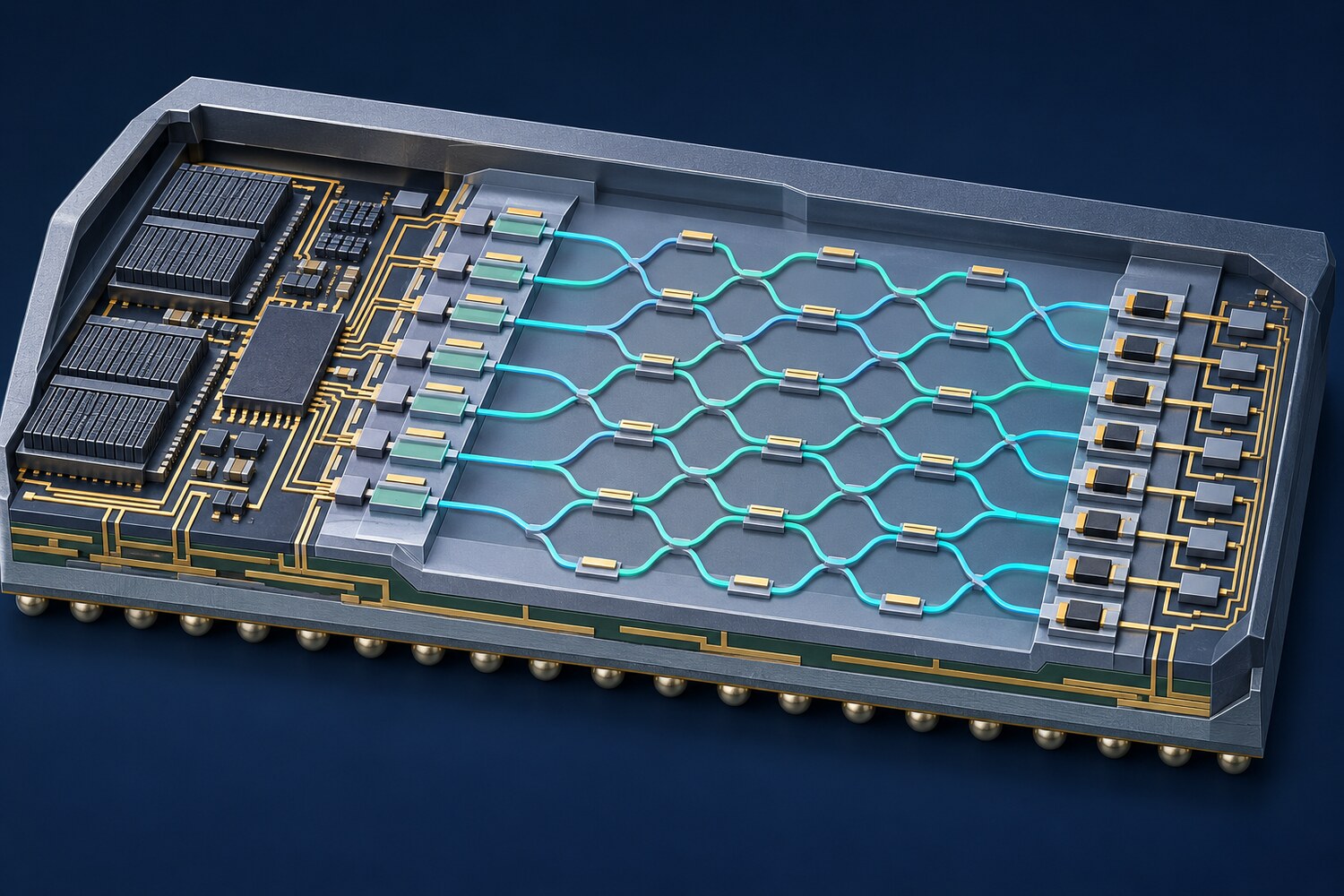
Light has several controllable properties: intensity, phase, wavelength and polarisation. A photonic circuit can encode numbers in one or more of them. Tiny devices split and combine beams. Interference makes some outputs brighter and others dimmer. Photodetectors measure the result and turn it into an electrical value.
A common design uses a mesh of Mach–Zehnder interferometers. Each interferometer divides light into two paths, adjusts their relative phase, then combines them again. By tuning many devices, the network can implement a mathematical transformation. Other architectures use rings, diffraction or several wavelengths at once. Different colours can act as parallel channels, a technique related to wavelength-division multiplexing in telecommunications.
The attraction is that the physics performs many multiply-and-add operations as light passes through the network. There is no clocked transistor switching for every individual multiplication. For a suitable large, repeated operation, this can offer high throughput and low delay.
But useful AI is more than one matrix multiplication. A complete system must load input values, set the optical weights, detect outputs, apply nonlinear functions, manage memory and correct errors. Those steps usually involve electronics. If conversion into and out of the optical domain consumes too much energy, the advantage inside the photonic core can disappear.
What has actually been demonstrated?
Research has moved beyond tiny toy examples. In April 2025, a paper in Nature reported a photonic AI processor running models including ResNet and BERT as well as a reinforcement-learning task. The authors framed precision as a central challenge: earlier photonic demonstrations had generally been limited to simplified benchmarks.
Other work focuses on communication. A 2025 Nature Photonics paper described dense three-dimensional integration of 80 photonic transmitters and receivers in 0.3 square millimetres for chip-to-chip links. IBM has reported co-packaged-optics modules using polymer waveguides and reliability tests under thermal stress.
There are also commercial products and evaluation platforms. Lightelligence presents PACE², released in 2025, as an optoelectronic accelerator card with a configurable 128 × 128 optical matrix. Lightmatter announced in March 2026 that an evaluation version of its Passage co-packaged-optics technology had demonstrated 1.6 terabits per second per fibre; its announcement says evaluation kits were available for lead-customer testing.
Those statements describe real engineering milestones, but their status matters. A peer-reviewed prototype demonstrates a result under stated experimental conditions. An evaluation kit lets selected customers test hardware. Sampling means that early units are being supplied. None of these words, by itself, means that millions of ordinary computers contain the technology or that it has proved cheaper and more reliable over years of operation.
Why not build an entirely optical computer?
First, light is awkward to store. Electronic memory can hold billions of values compactly and access them repeatedly. Practical optical delay lines are not a drop-in substitute for RAM.
Second, many photonic calculations are analogue. Manufacturing variation, temperature, detector noise and imperfect control can change the result. Digital electronics has an enormous advantage: it restores clean zeros and ones at each stage. Photonic systems can calibrate and compensate for errors, but that costs hardware, time and energy.
Third, light does not naturally provide every operation a program needs. Neural networks require nonlinear functions, comparisons and data-dependent control. These are often simpler in electronics. Lasers, modulators, detectors and data converters also have their own energy and area costs.
Finally, integration is difficult. A fast optical component is not enough; it must connect to fibres, electronic drivers, memory, packaging and cooling. The whole system has to be manufacturable, repairable and economical. A spectacular result from one device does not automatically survive those boundaries.
Where light is most likely to arrive first
The near-term path is not a glowing optical laptop. It is optical technology appearing in data centres where the pressure is greatest and the economics can justify specialised packaging.
The first broad role is likely to be interconnect: moving data between switches, accelerator packages, boards and racks. The second is specialised acceleration, where a hybrid photonic engine repeatedly performs a well-matched operation while electronic processors handle control and everything irregular. Edge systems may eventually use smaller photonic accelerators where extremely low delay or energy per operation matters, but size, laser power and cost remain demanding.
This gradual adoption resembles other changes in computing. Graphics processors did not replace CPUs; they became valuable partners for parallel work. A photonic accelerator may develop in the same way — not as a universal substitute, but as another engine chosen for a particular part of the job.
A checklist for reading the next breakthrough
When a headline announces an “optical computer”, ask five questions:
- Is light carrying data, performing a calculation, or both?
- Which task was measured, at what precision and against which electronic baseline?
- Does the energy figure include the laser, converters, memory and control electronics?
- Is the device a laboratory prototype, an evaluation kit, a sampled product or a volume deployment?
- Can it be manufactured and calibrated at useful scale?
These questions do not diminish the research. They reveal what has genuinely changed.
The answer is a partnership
Can light replace electricity inside a computer? In selected connections, yes — and that transition is already moving closer to the processor. In selected mathematical operations, photonic chips can also do useful work with impressive parallelism. Across the whole computer, no: not with current technology, and perhaps not as the most sensible goal.
The more credible future is optoelectronic. Light moves information and accelerates operations that suit its physics. Electrons store data, implement logic and manage the system. The breakthrough will not be the moment one defeats the other. It will be the point at which their partnership makes computation faster and less energy-hungry without becoming too fragile or expensive.
Sources & Further Reading
- Nature Electronics — Co-packaged optics for high-performance computing and artificial intelligence (19 August 2026)
- Nature Nanotechnology — How nanophotonics can drive optical computing toward practical applications (9 September 2026)
- Nature — Universal photonic artificial intelligence acceleration (9 April 2025)
- Nature Photonics — Three-dimensional photonic integration for ultra-low-energy, high-bandwidth interchip data links (21 March 2025)
- IBM Research — Co-packaged optics module with single-mode polymer waveguide (6 December 2025)
- Lightelligence — PACE² optoelectronic accelerated computing card
- Lightmatter — Passage evaluation milestone, 1.6 Tbps per fibre (11 March 2026)
Original editorial content. AI tools assisted with research, writing, editing, translation and illustrations. Future Uncovered remains responsible for the published material. The illustrations are AI-generated editorial visualisations, not documentary photographs.