How Roman Engineers Built Systems That Outlived an Empire
Aqueducts, roads and concrete were impressive. The deeper achievement was learning how to measure, organise and maintain infrastructure across a vast and varied world.
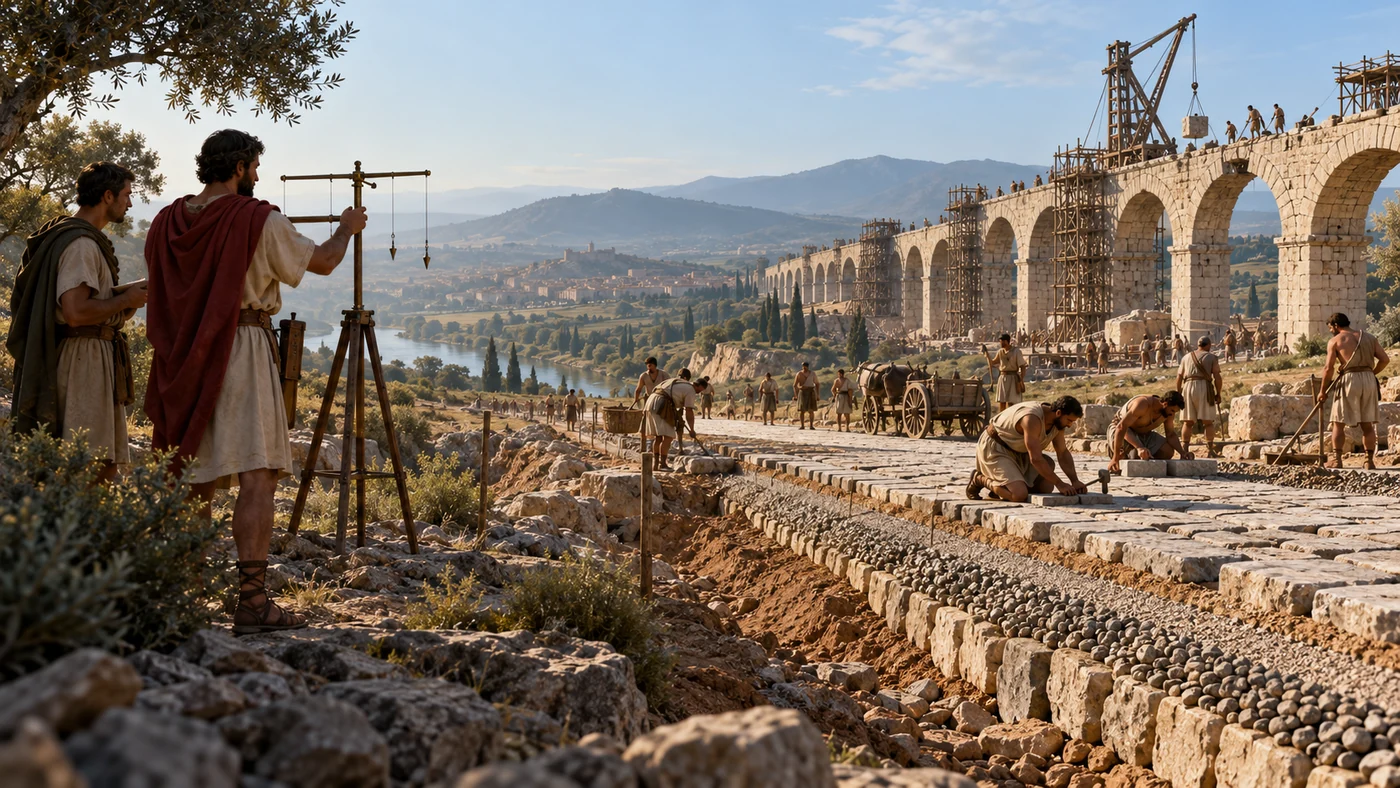
A Roman aqueduct crossing a valley looks like a triumph of arches. A surviving road looks like proof that Roman builders had discovered a perfect recipe. Both images are striking, but they can hide the most important part of the story. Roman engineering was not one secret material or one brilliant device. It was a way of turning many local decisions into a working system.
That system joined surveying, practical geometry, materials, labour, administration and repair. It allowed water to travel for kilometres at a controlled gradient, roads to cross very different ground and buildings to enclose spaces that earlier methods struggled to span. It also depended on imperial power and the forced or unequal labour structures of the Roman world. Engineering served public life, trade and sanitation, but also conquest, taxation and control.
This first episode of Before AI: Logic, Measurement and Machines looks past the postcard view. The useful question is not simply “How did the Romans build that?” It is “How did they make thousands of separate tasks fit together?”
They inherited ideas — then built at scale
Roman engineers did not begin from nothing. Builders around the Mediterranean had long used arches, drainage, surveying and lime-based materials. Greek and Etruscan traditions helped shape Roman practice. What changed under Roman rule was the scale, repetition and connection of projects across an empire.
A road was not valuable because it was straight. It was valuable because it connected forts, ports, towns and supply routes. An aqueduct was not just a channel. It joined a source, a carefully surveyed route, settling tanks, distribution points, pipes and a maintenance organisation. A bath complex depended on water supply, drainage, heating, fuel and staff. Each part had to work with the others.
That is why the word infrastructure fits so well. The visible monument was only the top layer of a network.
Survey first: turning a landscape into numbers
Before builders moved stone, surveyors had to decide where a road or water channel could go. Roman texts and archaeological evidence describe simple instruments that made repeatable measurements possible. A groma helped establish straight lines and right angles. Vitruvius described the chorobates, a long levelling instrument used when checking gradients for water channels.
These tools were not magical. Their power came from procedure. A team could mark a line, check a level, repeat the measurement and hand the result to others. The design became something that could be communicated rather than held only in one craftsperson’s eye.
Aqueducts show the difficulty clearly. Water normally moved by gravity, so the channel needed a continuing fall. Too little and the flow could stagnate; too much and fast water could damage the channel. The route might pass through tunnels, run along the ground, cross a valley on arches or, in some cases, use pressurised siphons. Contrary to the familiar image, much of a Roman aqueduct could be underground. The high arcade was a solution for particular terrain, not the whole system.
Roman roads were not one universal recipe
Popular diagrams often show every Roman road as four perfectly named layers topped with fitted paving stones. Real roads were more varied. English Heritage describes a typical raised core, or agger, made from layers of stone or gravel, with larger material below and smaller material nearer the surface. On soft ground, builders could use timber piles and brushwood. Local geology and the importance of the route changed the design.
Drainage mattered as much as the surface. A raised camber helped shed rain, while ditches carried water away. In towns or on major approaches, paving could be substantial. Elsewhere, a compacted gravel surface was practical. “Roman road” describes a family of engineered routes, not a single construction diagram stamped across Europe.
The famous straightness also needs context. Surveyors preferred direct lines where they were useful, especially for military movement and clear navigation, but roads bent around steep slopes, rivers and existing settlements. The network succeeded because it adapted while preserving its purpose.
Concrete changed the shapes builders could attempt
Roman builders made extensive use of opus caementicium, a concrete-like material combining mortar with pieces of stone or brick. In parts of Italy, volcanic ash known as pozzolana helped create hydraulic binders that could set in damp conditions. This supported harbour works, vaults and large interiors. The Pantheon’s great dome is the most famous survivor, but concrete was used far more widely.
There was no single “Roman concrete recipe”. Materials and methods varied by period and region. Modern research has examined lime clasts, volcanic materials and hot-mixing techniques to understand why some surviving examples can seal small cracks. That does not mean every Roman wall was self-healing or that an ancient mixture can simply replace modern structural concrete. Survival also creates a bias: the structures that failed are less visible to us.
The important change was freedom of form. Concrete placed behind brick or stone facing could create curves, vaults and thick load-bearing masses. Arches carried loads around openings; repeated arches formed arcades; vaults extended the principle through space. Materials, geometry and temporary wooden formwork worked together.
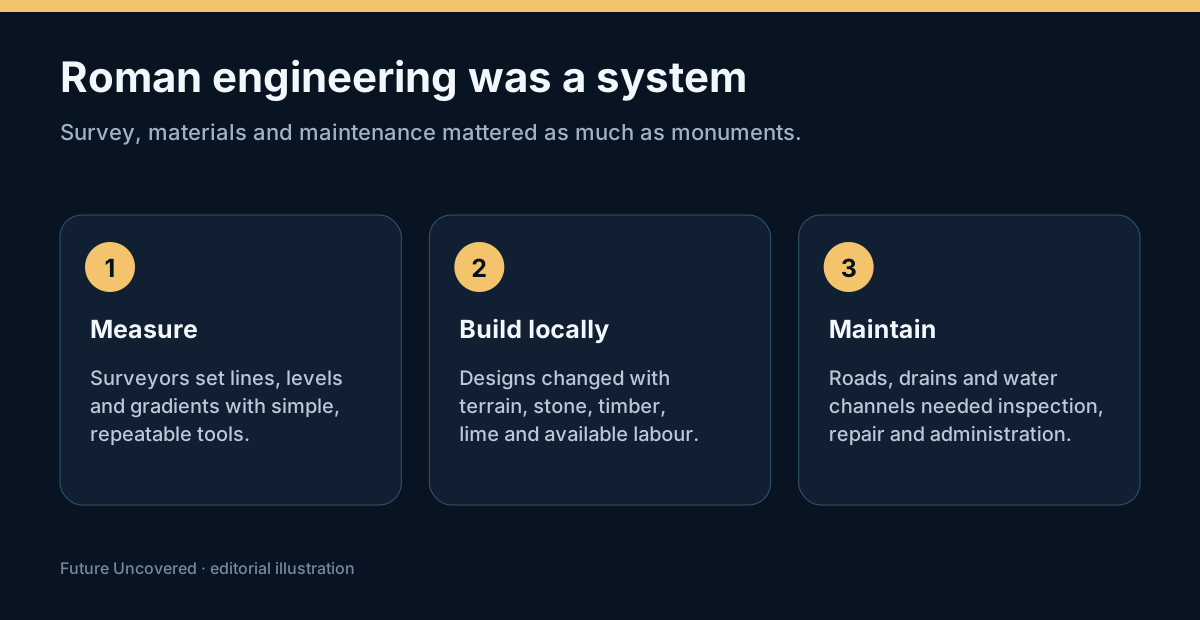
Roman engineering was less like discovering one perfect trick and more like building a reliable chain: measure, design, source, construct, inspect and repair.
Maintenance was part of the invention
A channel silts up. A road edge collapses. Mineral deposits narrow a pipe. Stonework moves. Any large network begins ageing on the day it opens.
Rome’s water supply was managed by officials and workers who inspected routes, settled disputes, cleared deposits and repaired damage. Frontinus, appointed curator of Rome’s aqueducts in the late first century CE, wrote about the system’s condition and administration. His account reminds us that engineering is also information: knowing where water should go, where it is being diverted and which repair has priority.
The same principle applies to roads and bridges. Construction creates an asset; maintenance keeps it useful. A spectacular structure without people, records and resources to care for it becomes a ruin.
What this has to do with modern technology
It would be misleading to call a Roman aqueduct an early computer or to draw a straight line from Roman roads to artificial intelligence. The technologies, purposes and knowledge are different. The connection is a habit of thought.
Modern digital services also depend on systems that most users never see: data centres, cables, standards, energy, software updates, monitoring and people who repair failures. A clever algorithm cannot compensate for unreliable inputs or neglected maintenance. Roman infrastructure makes that lesson visible in stone.
Measurement turns a vague intention into a specification. Standard procedures let many people cooperate. Modular techniques make work repeatable. Feedback from inspection leads to repair. None of those ideas belongs only to Rome, but Roman projects show what happens when they are combined across a network.
The real legacy
The most impressive Roman achievement was not that every road was straight or every structure permanent. It was the ability to coordinate practical knowledge across distance and time. Builders adjusted to local conditions while working within shared methods. Administrators treated water and transport as continuing services. Structures were designed as parts of larger networks.
Empires fall. Materials crack. Routes are reused for new purposes. Yet the underlying engineering questions remain familiar: What must be measured? Which variation is acceptable? How will the parts connect? Who will maintain the result?
Those questions open the second season of Before AI. Before machines could process logic, people first had to make the physical world measurable, repeatable and manageable.
Sources & Further Reading
- English Heritage — Roads in Roman Britain
- The Metropolitan Museum of Art — Roman Art: A Resource for Educators (PDF)
- Vitruvius, On Architecture, Book VIII — Perseus Digital Library
- Deming — The Aqueducts and Water Supply of Ancient Rome
- MIT News — Riddle of Roman concrete durability
- Smarthistory — Ancient Roman architecture, an introduction