BEFORE AI · EDITORIAL FEATURE
The Ancient Ideas Behind Artificial Intelligence
An honest look at the ancient tools and ideas that illuminate AI’s history—without pretending the ancients invented computers.
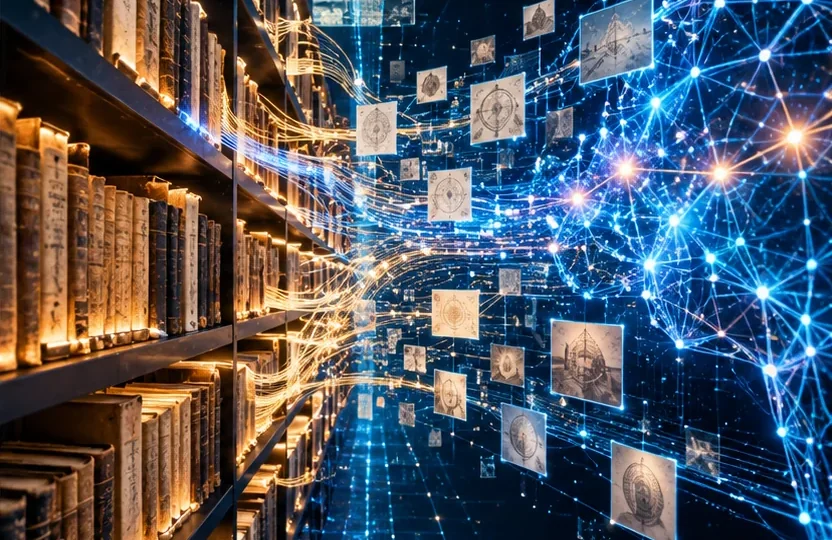
Start with a line of stones on a counting board. Move forward to a clay tablet pressed with symbols, a water clock emptying into a basin, a wooden printing press and a carefully constructed geometric proof. Each solves a different problem. None is artificial intelligence. Yet together they reveal something profound about the long history of human ingenuity.
People have repeatedly invented ways to move effort beyond the limits of an individual body or mind. A tool can concentrate force. A record can preserve memory. A mathematical representation can hold a quantity. A mechanism can repeat an action. What happened when these capabilities eventually converged with electronic computing was not predetermined—but the older stories help us understand why computing was such a powerful idea.
First we learned to change the world
Bronze metallurgy showed how people could alter materials through learned processes. That achievement did not supply the components of a modern computer. Instead, it illustrates a broader engineering habit: observe what happens, refine a technique and make it repeatable.
The important human actors were craftspeople, traders and communities. Their technologies emerged from material constraints and practical needs. The historian’s task is to see what they really achieved, not to flatter the past by pretending every clever device was an early version of something digital.
Then we began to store meaning
Early writing in Mesopotamia helped administrators record goods and obligations before scripts expanded to express increasingly complex language. Paper, developed in ancient China and refined across centuries, later changed the portability of written information. Printing technologies—including East Asian traditions and Gutenberg’s European system—made copying more efficient in different periods and regions.
These inventions did not produce artificial intelligence. They did something fundamental for knowledge: they enabled information to persist beyond one conversation, one lifetime or one location.
Today, language models work with digital representations rather than clay or paper. That contrast is enormous. But both histories confront a shared question: how can experience and ideas be represented so that they can be used again?
We gave quantities and reasoning a structure
Counting boards translated arithmetic into visible movements. Greek mathematical traditions refined deductive proof, with Euclid’s Elements offering a model of conclusions built from explicit assumptions. Timekeeping devices used consistent physical processes to organise the passing of hours.
The technologies were different, but each helped make something difficult to grasp more manageable: numerical value, logical consequence or elapsed time.
Modern computing would later formalise procedures into algorithms and encode information electronically. These developments required many subsequent breakthroughs, including symbolic logic, programmable machines, electronics and software. The older tools were not sufficient causes; they belong to a much wider intellectual landscape.
We taught devices to follow sequences
Hero of Alexandria described mechanical effects that relied on heat, air pressure, water, weights and pulleys. Ancient automata could enact a predetermined sequence without a person directly making every movement.
A self-moving theatrical device is not a learning machine. It follows the structure built into it. Nevertheless, the difference between a single manually performed action and a repeatable automated sequence became a central concern in later engineering.
The modern relationship between automation and AI remains delicate. Many factory controls contain no learning algorithm; many AI models produce text or images without physically moving anything. A machine can be automated without being intelligent, and an AI system can operate without looking like a robot.
What changed in the twentieth century?
The field now called artificial intelligence took shape much later. Researchers at the 1956 Dartmouth Summer Research Project on Artificial Intelligence set out to investigate aspects of learning and intelligence using computers. The machines available to them were the products of mathematical theory, electrical engineering, logic and new forms of information processing developed over many generations.
Even that meeting did not settle the meaning of intelligence. Decades of research have produced approaches with different capacities and limitations, from rule-based systems to modern machine learning. The label AI covers several traditions rather than one inevitable technological endpoint.
The real legacy of the ancient world
There is a tempting way to tell this story: the Greeks invented robots, the Mesopotamians invented databases, and everything led naturally to today’s AI. It makes an exciting slogan, but it flattens history and overlooks many cultures and intervening centuries.
A better conclusion is both more accurate and more ambitious. People in different places learned to break problems into smaller parts. They created durable records, abstract symbols, repeatable methods and systems of control. They made knowledge easier to share—and easier for future generations to challenge.
Before artificial intelligence could become a field of research, humanity spent millennia discovering what it meant to organise information and make tools act according to rules.
This is the end of Season One, but not the end of the journey. Next, Before AI follows the emergence of ever more sophisticated logic, measurement and machines. The future, it turns out, has a very long history.