BEFORE AI · EDITORIAL FEATURE
The Engineer Who Made Machines Move
Hero of Alexandria turned heat, pressure, water and weights into carefully orchestrated mechanical effects.
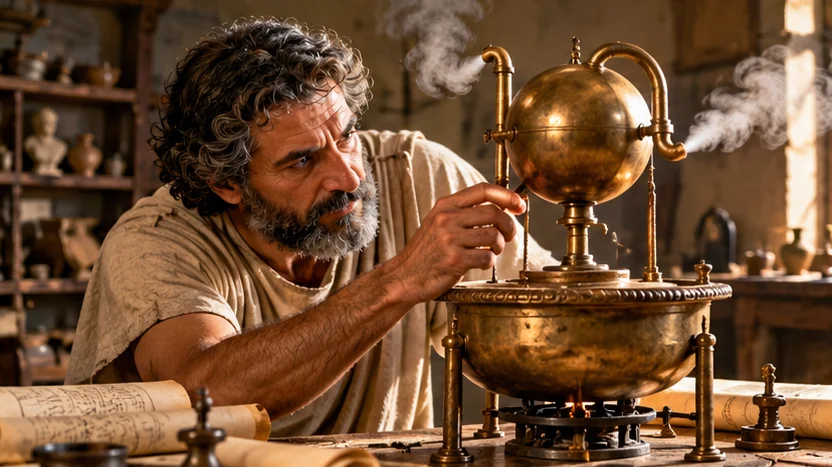
Imagine walking into a sanctuary. A fire is lit on an altar. After a moment, nearby doors begin to open without anyone visibly pushing them. To the audience, the effect might seem supernatural. To an engineer, it is a problem of heated air, displaced water, gravity, ropes and pulleys.
One of the most striking descriptions in ancient technical literature comes from Hero—also called Heron—of Alexandria. His treatise Pneumatica sets out mechanisms that demonstrate how physical forces can be made to do surprising work. The devices are fascinating not because they are secret modern technologies, but because they show just how far ancient engineering imagination could reach.
A laboratory of air and water
Hero lived and worked in Roman-era Alexandria, conventionally dated to the first century CE. He wrote about mathematics, mechanics and devices powered by pressure and fluids. His works preserve a tradition that also drew on earlier engineers, including Ctesibius, whose contributions deserve recognition.
In one famous mechanism, heating air beneath an altar increases pressure in a connected vessel. Water is forced through a siphon into a suspended container. As the container grows heavier, it pulls a system of cords and turns the door hinges. When the fire dies and the balance changes, the doors can close again.
The charm of the design is not simply that the doors move. It is that the machine turns one kind of change into another: heat becomes pressure, pressure displaces liquid, liquid changes weight and weight produces mechanical motion.
Steam, spectacle and a persistent myth
Hero’s name is also associated with the aeolipile, a spherical vessel that could rotate when steam escaped through bent tubes. It is often promoted online as an ancient steam engine that almost launched the Industrial Revolution.
That is an irresistible story—and an oversimplification. Hero’s device demonstrated motion produced by escaping steam, but there is no sound evidence that it was used like a modern practical industrial engine. Describing it as a direct lost prototype of the railway locomotive confuses a striking physical demonstration with a mature power technology.
The gap between knowing that steam can create motion and building an efficient, durable engine is enormous. Materials, manufacturing precision, fuel use, mechanical transmission, economics and demand all matter. History did not stand one small decision away from a Roman factory system.
Engineering as a chain of causes
Hero’s real achievement, and that of the technical tradition he represents, is clearer when we resist exaggeration. The devices break complicated effects into sequences that can be described and reconstructed. A moving door is not magic if its mechanism can be explained.
A translation of Pneumatica, published in the nineteenth century and preserved by Project Gutenberg, allows modern readers to inspect many of these designs. Some are practical demonstrations; others seem intended to astonish, entertain or teach. Modern reconstructions help researchers test whether particular arrangements could work as described.
That mixture of spectacle and experiment still defines parts of engineering culture. A successful demonstration gets attention, but careful analysis reveals what it can and cannot do.
What Hero did not invent
Hero did not build a robot with intelligence. His machines responded to their physical arrangement and the inputs supplied to them. They did not interpret new situations, understand their surroundings or make human-like judgements.
Yet they embody a foundational engineering strategy: choose an input, construct a sequence of transformations and obtain an intended output. This is an early form of mechanical control, not artificial intelligence. The distinction makes the history more accurate—and no less impressive.
The next episode moves beyond isolated demonstrations to devices designed to perform a sequence of actions on their own. That is where the ancient machine begins to resemble a performance with a script.