
How Movable Type Multiplied a Page
Printing a page is useful. Reusing its individual letters changes what a printer can make next — and the story begins long before Gutenberg.
In this article
- Before movable type, there was printing
- A Korean book older than Gutenberg's Bible
- What Gutenberg changed in Europe
- Why reuse matters
- A Korean book changes the familiar timeline
- Why making reusable type was so difficult
- The two histories are connected — but not identical
- Reusing pieces changes the economics of knowledge
- Sources and further reading
Imagine writing a page and wanting a hundred identical copies. If you copy it by hand, each page takes more labour. Carve the entire page into a woodblock and you can print many copies — but a new page needs a new carving. What if you could build a page from individual reusable characters instead?
That is the idea of movable type. It is simple to describe and difficult to make work well. The story stretches across different countries, languages and centuries, and it cannot be reduced to one European inventor.
Before movable type, there was printing
Woodblock printing was used in East Asia long before European letterpress printing. An entire text or image could be cut in reverse into a block, inked and pressed onto a surface. For a design that needed many copies, the method was powerful. For a book with many changing pages, each new block demanded substantial preparation.
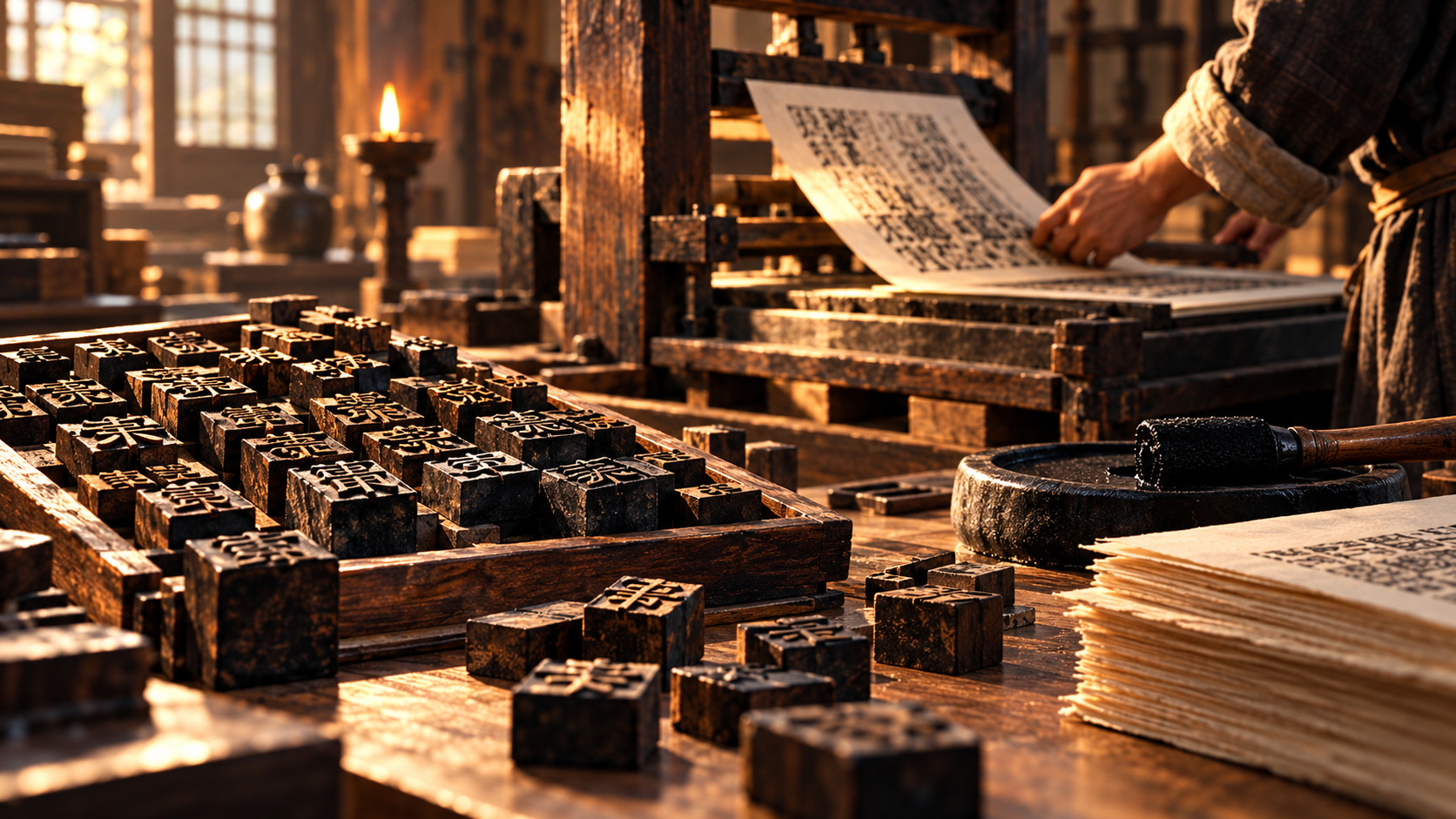
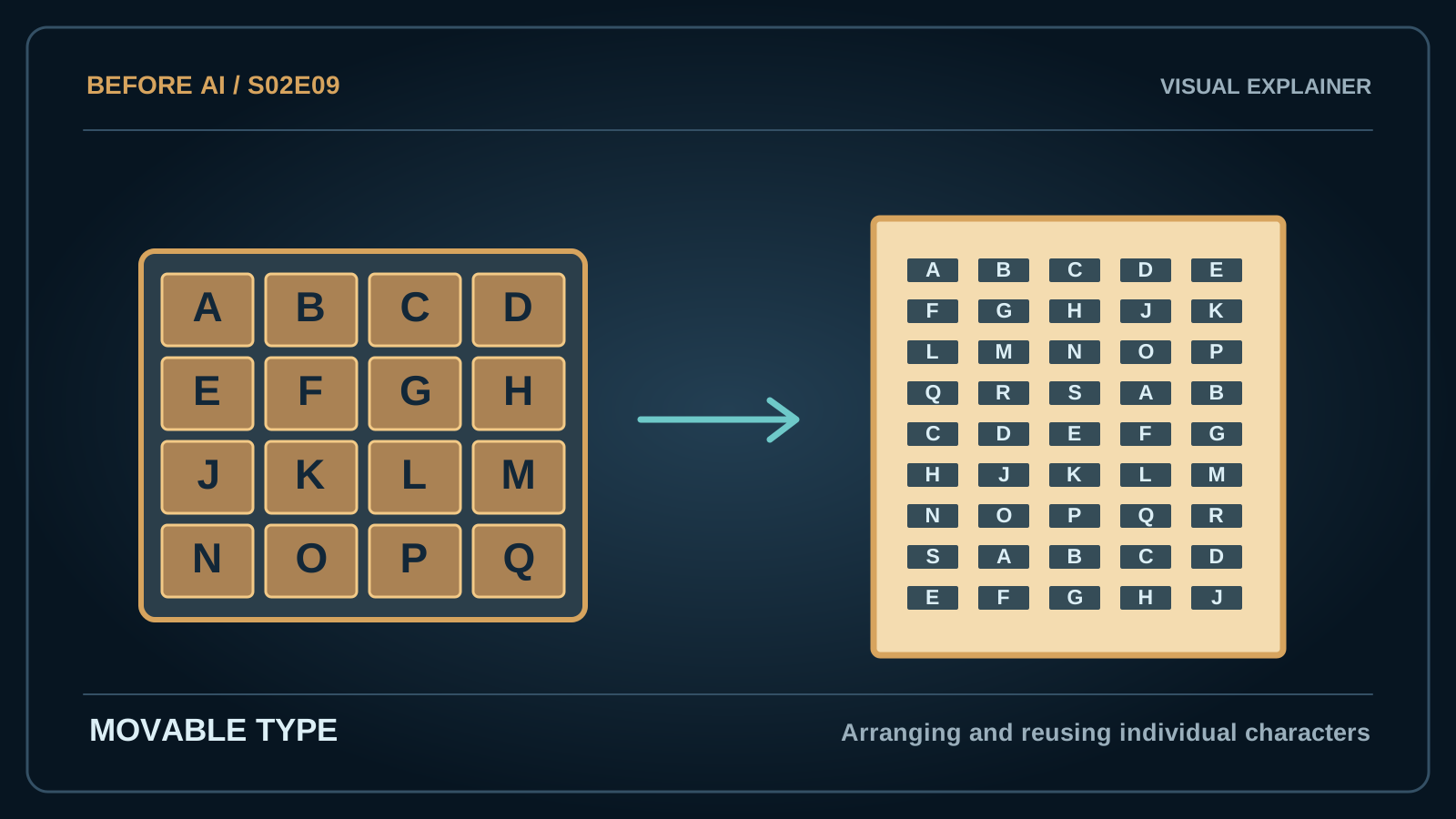
Movable type offered another possibility: make separate characters, arrange them into lines, print the page, then distribute the pieces so they can be used again. It is a little like building words from a box of small tiles, except the tiles must produce clean, repeatable impressions.
The idea appears in Chinese history with the eleventh-century innovator Bi Sheng, associated with movable ceramic type. Later developments used different materials and production methods. The choice of writing system, the number of characters needed, economics and workshop practices all shaped whether a method was useful.
A Korean book older than Gutenberg's Bible
In Korea, metal movable type was used long before the middle of the fifteenth century. One exceptionally important surviving book is Jikji, printed in 1377 at the Heungdeok-sa temple in Cheongju. The surviving second volume is held by the Bibliothèque nationale de France.
UNESCO recognises it as the oldest surviving evidence of a book printed with movable metal type. That is carefully worded: it does not mean it was necessarily the first book ever printed this way, or that nobody experimented earlier. Historical “firsts” often depend on what has survived.
Jikji is a Buddhist text. Its significance is both cultural and technical. It is evidence that metal type was a working printing method in Korea decades before the famous Gutenberg Bible.
What Gutenberg changed in Europe
In Mainz in the mid-fifteenth century, Johannes Gutenberg and the people around his workshop developed a successful European system combining reusable metal type, casting, ink, press and paper with organised production. The large-scale impact of printing in Europe came from the combination, not simply from one clever metal letter.
Historians should be cautious about assuming a simple direct line of transmission from Korean metal type to Gutenberg. The technologies belong to a connected world history, but the precise relationships and possible routes of influence are not established by the existence of similar-looking type alone.
Why reuse matters
The advantage of movable type was not that it made the first copy effortless. Setting type was hard work. Correcting errors, arranging lines, preparing ink and cleaning letters all took time. Its power came from repeated use: after one page had been printed, the same stock of characters could help compose another.
Today we reuse digital fonts, templates and code rather than physical metal type. The comparison is not exact, but the underlying design principle is familiar. Instead of rebuilding everything from the beginning, make smaller parts that can be rearranged.
The story of movable type is therefore bigger than a printing press. It is the story of modular thinking — and a reminder that important innovations often have more than one geographical centre.
A Korean book changes the familiar timeline
The surviving Jikji was printed at Heungdeok-sa temple in Cheongju, in present-day South Korea, in 1377. The Bibliothèque nationale de France preserves its surviving second volume. UNESCO recognises it as the oldest surviving evidence of a book printed using movable metal type.
That is before the Gutenberg Bible in Europe, which was produced around 1455. The comparison is not a contest that can be settled by naming one universal inventor. The technologies developed within different social and linguistic contexts. What the surviving evidence does establish is that movable metal type had been used successfully in Korea before Gutenberg's work in Mainz.
Why making reusable type was so difficult
Individual letters or characters must be cast, stored, selected, arranged in the right order and held firmly in place. The letters also need consistent height or the printed page will come out uneven. After printing, workers have to clean and redistribute the type for reuse.
These demands create a whole workshop system around a seemingly simple idea. A press, ink, paper and type matter together. A successful method depends on available materials, skilled people, patterns of reading and an audience able to buy or borrow the finished pages.
The two histories are connected — but not identical
Movable ceramic type is associated with Bi Sheng in eleventh-century China. Korean workshops later developed important metal-type practices. Gutenberg's mid-fifteenth-century European process involved its own combination of movable metal type, a press, inks and workshop organisation. Scholars continue to study the complex relationships and the limits of evidence for direct transmission.
Instead of a single arrow running from one workshop to another, it is more useful to picture several traditions of experimentation and refinement. It is equally mistaken to erase East Asian achievements or to treat Europe as contributing nothing new.
Reusing pieces changes the economics of knowledge
A handwritten manuscript can be exquisite and valuable. A carved woodblock can produce repeated copies of a specific page. Movable type gives a different kind of flexibility: the same pieces can be combined into many new pages. That is an early example of a modular system.
The principle turns up across technology. Replaceable parts, interchangeable tools and reusable instructions can reduce the effort needed to make the next thing. The rise of printed books also depended on literacy, patronage, distribution and the changing demand for texts. No printing machine alone can explain a whole cultural transformation.
Today we drag words across a screen and change fonts with a click. Behind that apparent ease is a familiar idea: a page is built from elements that can be arranged, stored and used again.
Sources & Further Reading
The main illustration is AI-generated, not historical photographic evidence. The technical diagram is an original editorial illustration.