
How Universities Organised Knowledge
Long before search engines, communities of teachers and students built systems for asking questions, arguing about answers and preserving learning.
In this article
- A school becomes a community
- Teaching was more than reading aloud
- Rules made learning portable
- Why we still use the same basic idea
- The classroom was often a conversation
- Why being a corporation mattered
- A subject, a teacher and a qualification
- Learning was never restricted to one civilisation
- Sources and further reading
Imagine wanting to learn medicine or law eight hundred years ago. There is no search box, no online course and certainly no video tutorial. You might travel to a city, find a respected teacher, pay for lessons and join other students arguing over the meaning of a text.
Medieval universities grew from arrangements like these. Their great innovation was not the invention of knowledge. It was finding a way to organise learning across generations so that ideas could be taught, tested, debated and passed on.
A school becomes a community
The University of Bologna traces its origins to a school that developed during the late eleventh century. The familiar date 1088 is a conventional founding date, not the day someone opened a modern university campus with a ribbon-cutting ceremony. Its early reputation grew especially around the study of law.
At Oxford, the university's own history records evidence of teaching by 1096, while making clear that there is no single certain founding date. It grew gradually, too. These institutions were shaped by teachers, students, patrons, local authorities and their changing relationships.
The fact that medieval European universities took a distinctive form does not mean organised advanced learning began in medieval Europe. Earlier and parallel scholarly centres existed in many parts of the world, including the Islamic world, South Asia and East Asia. Histories that start and end with a few European names miss much of the exchange of ideas.
Teaching was more than reading aloud
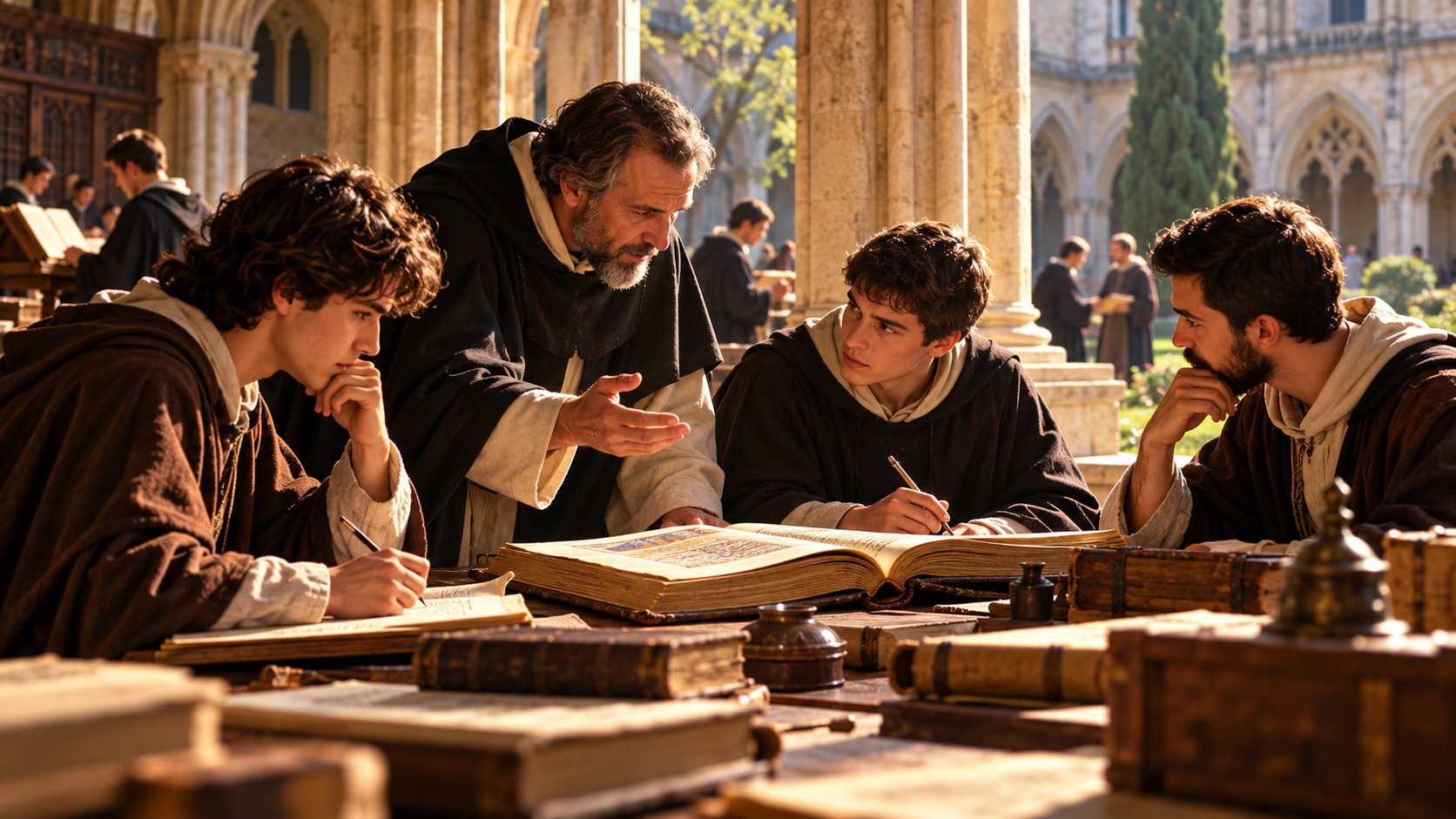
A medieval classroom could begin with a text that everyone considered important. The teacher explained passages, outlined problems and connected the material to other works. Students also learnt through questions and formal debates, often called disputations.
A disputation was not a social-media argument. At its best, it demanded that a position be stated clearly, objections considered and a reasoned response offered. The forms varied by place and time, but the underlying educational idea is easy to recognise: understanding improves when a claim can be questioned.
Much of the curriculum looks distant today. Grammar, logic, rhetoric, arithmetic, geometry, music and astronomy belonged to the traditional liberal arts. The study of law, medicine and theology developed in specialist faculties. Manuscripts were valuable and copying them was labour-intensive, which made access to a shared collection of books important.
Rules made learning portable
As universities developed, they created ways to recognise membership, arrange teaching and award degrees. A qualification could show that someone had followed a recognised course of study, even though standards and privileges differed greatly from one institution to another.
Academic communities also had limits and inequalities. Many people were excluded by wealth, sex, legal status or social position. Universities could defend established authorities as well as encourage critical thought. The institution was not a machine that automatically produced truth.
Still, preserving methods and making discussion possible changed what a scholarly community could do. Knowledge no longer depended entirely on one expert teaching one apprentice in private.
Why we still use the same basic idea
Today's universities are much more diverse in their subjects, students and technologies. Yet lectures, seminars, research papers, peer criticism and qualifications still express parts of the old organisational challenge: how can people learn from others while developing the ability to judge an answer for themselves?
This matters in the age of AI. A system can generate a fluent explanation in seconds. But fluency does not establish truth. Learning still requires questions, evidence, correction and people willing to disagree constructively.
The most lasting university invention might therefore be less like a building and more like a promise: an idea deserves to be examined, not merely repeated.
The classroom was often a conversation
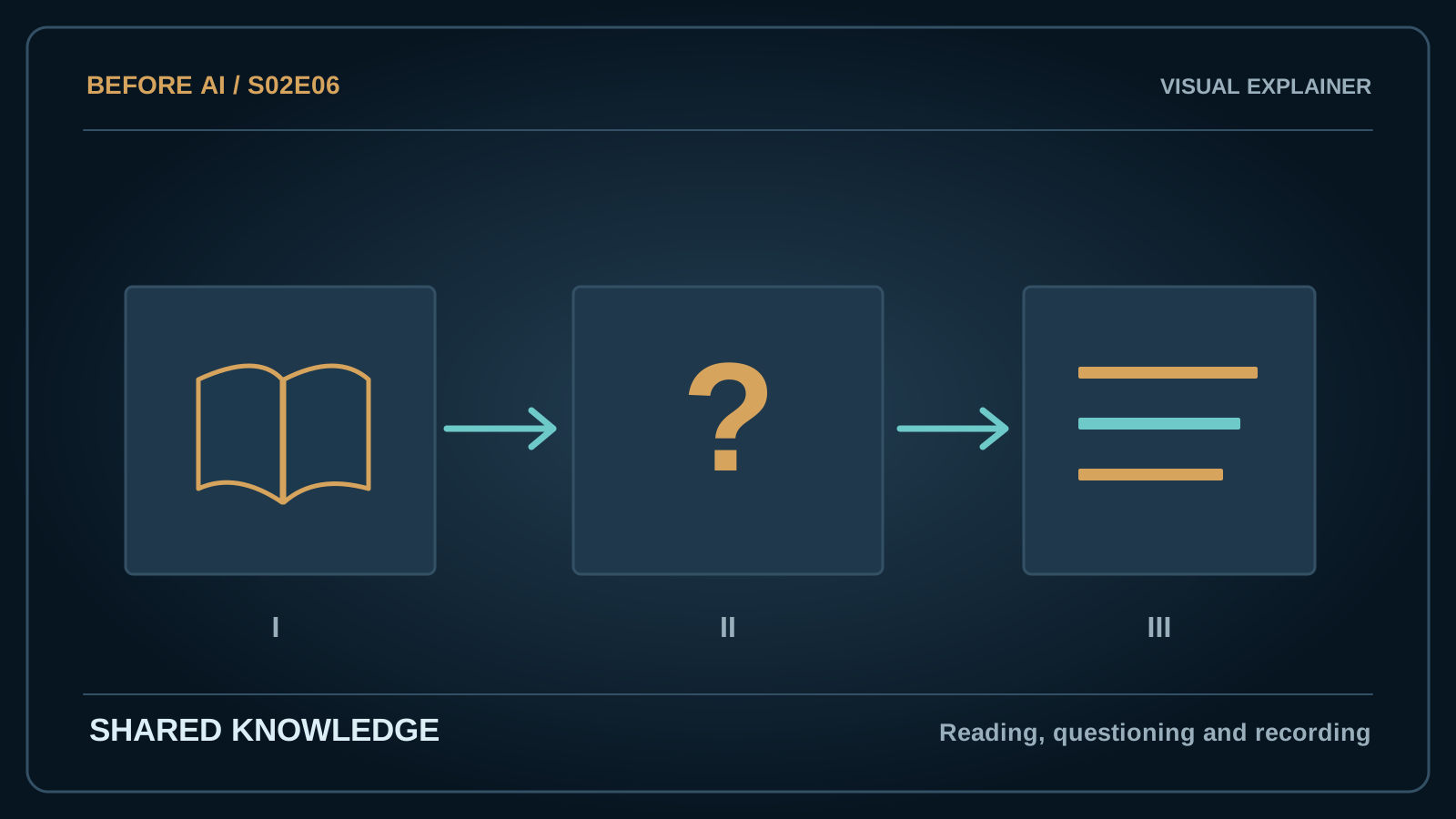
A medieval lecture could involve a teacher reading and explaining an authoritative text while students took notes. But a university was not only a place where information flowed in one direction. Formal questions, objections and disputations became important in many university settings. The purpose was to learn how to distinguish an argument that merely sounded confident from one that could survive examination.
Of course, teaching was not always open-minded by modern standards. Theology and institutions imposed boundaries. Access also depended heavily on sex, status, money and language. A typical university student was not an average member of the medieval population. Looking at the exclusions is part of understanding the historical achievement honestly.
Why being a corporation mattered
In medieval law, a universitas was a recognised corporate body. The word did not initially mean a collection of every subject known to humanity. Teachers and students needed ways to negotiate fees, lodging, privileges, discipline and their relationship with a sometimes hostile town.
The University of Bologna describes how student associations helped organise early teaching and payment. That is a less romantic story than a founding genius opening a grand college, but it explains why the institution could last. People built rules around the activity of learning.
A subject, a teacher and a qualification
Studying law, medicine or theology required years of practice. University students often began with subjects we would now associate with the arts, including logic and language. Training created a community that could recognise particular forms of expertise and, eventually, award qualifications.
It would be wrong to say that every academic degree and examination today descends unchanged from one university. These institutions developed differently in different places. But they illustrate how a society can create shared ways to preserve knowledge, teach skills and decide when someone has demonstrated them.
Learning was never restricted to one civilisation
Formal scholarship also flourished in institutions and networks beyond Latin Europe. Baghdad, Córdoba, Cairo, India and China had their own teachers, texts and traditions. Philosophical works translated between Arabic, Greek and Latin were important in the intellectual life of medieval Europe. An accurate history should include those connections, not draw a false line between isolated worlds.
The Internet changes the speed of access; it does not solve the challenge of judging information. A university organised people to ask difficult questions together. That remains a valuable idea when an AI system can provide an answer before its reader has learnt how to test it.
Sources & Further Reading
The main illustration is AI-generated, not historical photographic evidence. The technical diagram is an original editorial illustration.