
How Mechanical Clocks Kept Time
A falling weight can make a wheel spin. An escapement makes it stop, start and count — turning movement into measured hours.
In this article
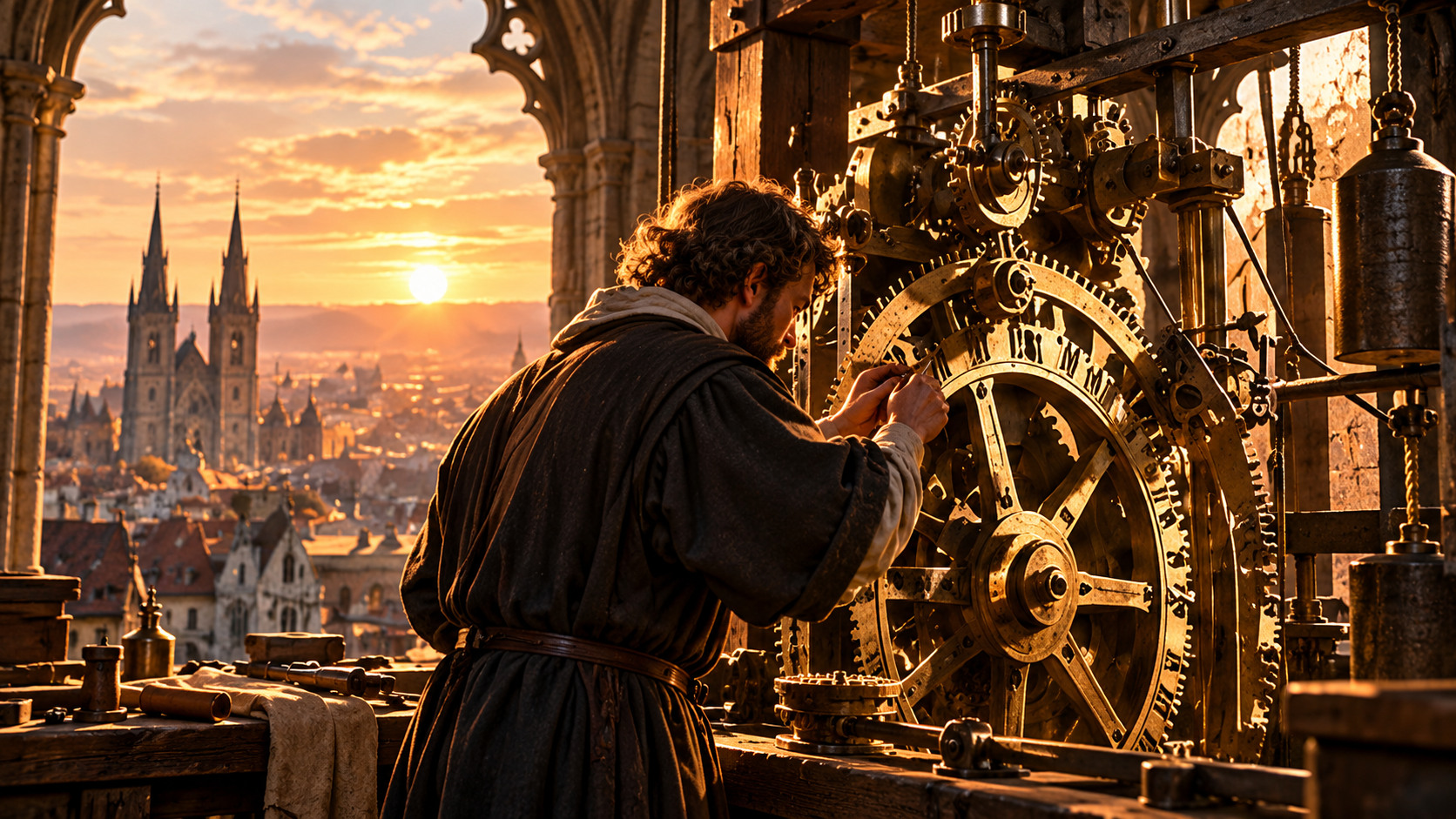
Stand beside a medieval town square and listen for a bell. You might not see a clock face at all. Yet the bell tells traders, workers and worshippers that another part of the day has passed. Somewhere inside a tower, heavy machinery is doing something remarkable: it is slowing a continuous force into a repeated beat.
Earlier people had measured time with sundials and water. Mechanical clocks approached the problem differently. Instead of relying on a shadow or the flow of a liquid, they used a weight, a train of gears and a clever device called an escapement.
The problem with a falling weight
Lift a stone on a rope, then let it go. Gravity pulls it down. Wrap the rope around a drum connected to gears and the weight can turn the mechanism. But there is an obvious difficulty: left alone, it would unwind too quickly. You would get one rapid burst of motion, not useful hours.
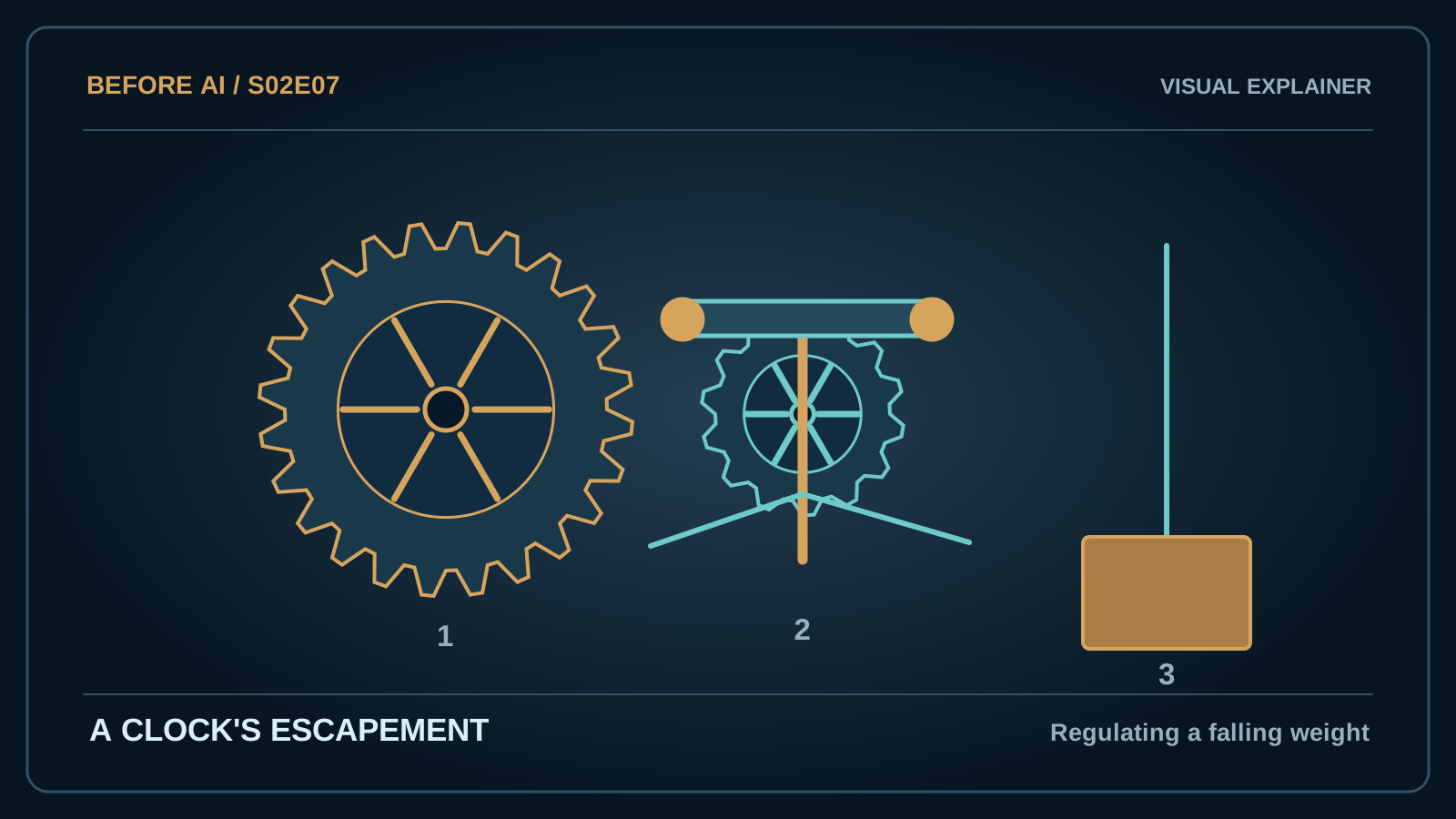
The escapement provides the solution. It allows a wheel to advance in small steps while an attached regulator moves back and forth. In many early European clocks, a verge escapement worked with a horizontal bar carrying adjustable weights, called a foliot.
The parts did not produce perfect timekeeping. Friction, wear, changing power and adjustment all mattered. They were nevertheless a breakthrough because they made a machine capable of maintaining a repeating rhythm without someone repeatedly measuring water or watching the Sun.
What the gears actually do
The falling weight supplies the energy. The escapement controls how quickly the system is released. Gears connect the different movements and can drive an indicator or the mechanism that strikes a bell.
Think of three jobs: supply power, regulate movement and display the result. That division of labour is still familiar in machines today. A modern electronic clock uses completely different technology, but it still needs a timekeeping reference and a way to show the answer.
Early tower clocks were often built to serve an entire community. Their public function mattered as much as their precision. They helped coordinate prayer, working hours and civic life, although local time practices were not all identical.
A real machine from Wells
The Science Museum Group holds the mechanism of the Wells Cathedral clock, dated to 1392. Its original workings used weights and a foliot regulator. Like many early clocks, it was later altered; the mechanism was converted to pendulum regulation after the seventeenth century.
That detail is useful. A surviving medieval machine is not always a perfectly untouched window into the past. Clocks were repaired, adjusted and improved because people needed them to keep working. Their history can be read in layers of older and newer engineering.
The faces, bells and moving displays attached to famous clocks also deserve attention, but they were not the same thing as the mechanism measuring time inside.
When minutes began to matter more
A fourteenth-century bell needed to announce useful intervals, not coordinate a global computer network. Over later centuries, developments in pendulum clocks, springs and other regulators made more accurate timekeeping possible. Then accurate portable clocks became vital for navigation, and eventually electronic standards transformed the meaning of precision.
Do not picture the history of clocks as one straight march from “bad” to “good”. Different societies used different systems for different needs. What counts as accurate depends on what you are trying to do.
The central invention here was the ability to regulate a machine's motion so that its output followed a measured rhythm. Once humans could make machines count repeated events, the same basic thinking could be adapted to other kinds of automation.
A clock without a clock face
Some early public clocks announced the hour by striking bells. People cared about knowing when to gather, trade, pray or begin a task. A numbered dial was not always the centre of the experience. The mechanism could be hidden high in a tower while the sound reached an entire neighbourhood.
This also means historians have to be careful with words. Medieval sources may mention a clock without telling us whether it used water, weights or another mechanism. No single surviving machine marks a universally accepted moment at which mechanical timekeeping began.
The escapement is the clever part
Think of a staircase built into a moving wheel. A heavy weight pulls downward and tries to make the wheel turn quickly. The escapement's pallets alternately catch and release teeth, letting the wheel move one small step at a time. A horizontal regulator, the foliot, rocks back and forth while adjustable masses affect its rhythm.
This is not the smooth swing of a pendulum. The more familiar pendulum clock arrived much later, in the seventeenth century, and gave clockmakers a more stable way to regulate time. Early verge-and-foliot systems could be ingenious without meeting modern expectations of accuracy.
Maintenance made timekeeping real
An unattended mechanism could stop because its weight reached the floor, its teeth wore, or its lubricant failed. Keepers wound clocks, made repairs and adjusted them. For a town, keeping the time was therefore a social activity as much as a mechanical one: someone had to maintain the promise that the bell would ring when expected.
This echoes earlier infrastructure stories in our series. The invention is not simply a set of metal parts. It becomes useful when people can construct, explain and maintain a working system over time.
From shared hours to precise coordination
The development of clocks did not make everyone immediately obey the same minute. Local calendars, seasonal routines and natural daylight still mattered. As mechanical timekeeping improved, however, communities gained a more regular way to organise activity without relying directly on the Sun's position or the movement of water.
In the age of satellites and digital networks, precise timing is essential to communications, finance and navigation. These are not direct consequences of one medieval workshop, but they draw on the broader ambition to make time measurable, repeatable and shareable.
A ticking clock is a small lesson in an enormous principle: make something happen again and again at a predictable interval, then use that rhythm as information.
Sources & Further Reading
The main illustration is AI-generated, not historical photographic evidence. The technical diagram is an original editorial illustration.