
When Gears Became Calculators
A shipwreck, a box of bronze gears and a surprisingly modern question: can a machine turn movement into an answer?
In this article
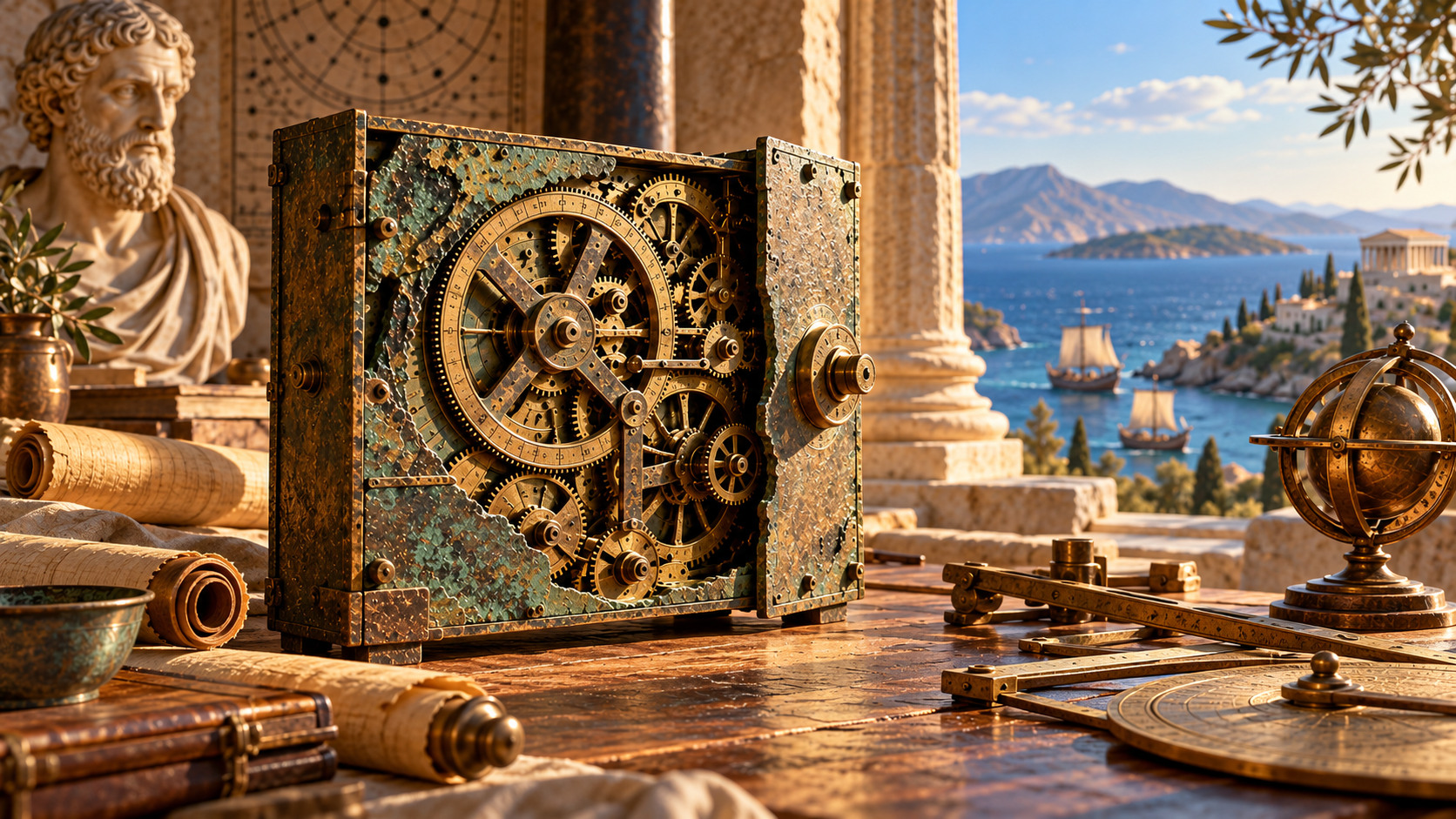
Imagine pulling a small bronze object from a shipwreck. It looks like a broken clock. Then you find tiny gear teeth, circular scales and inscriptions about the sky. The object is not a clock, and it is certainly not a laptop. Yet it contains an extraordinary idea: a machine can follow a mathematical relationship and give you a result.
The Antikythera mechanism, recovered from an ancient wreck near a Greek island, was made around the second century BCE. Its fragments are kept in Athens. Researchers study it with modern scanning techniques because most of the original machine has been lost. What survives is enough to show that it was far more than a decorative instrument.
When the sky became a gear train
The ancient sky was full of patterns. The Sun appeared to move around the seasons. The Moon changed phase. Eclipses returned according to long cycles. Greek astronomers drew on mathematical knowledge developed across the eastern Mediterranean, including Babylonian observations. The remarkable step was to represent some of those relationships in bronze.
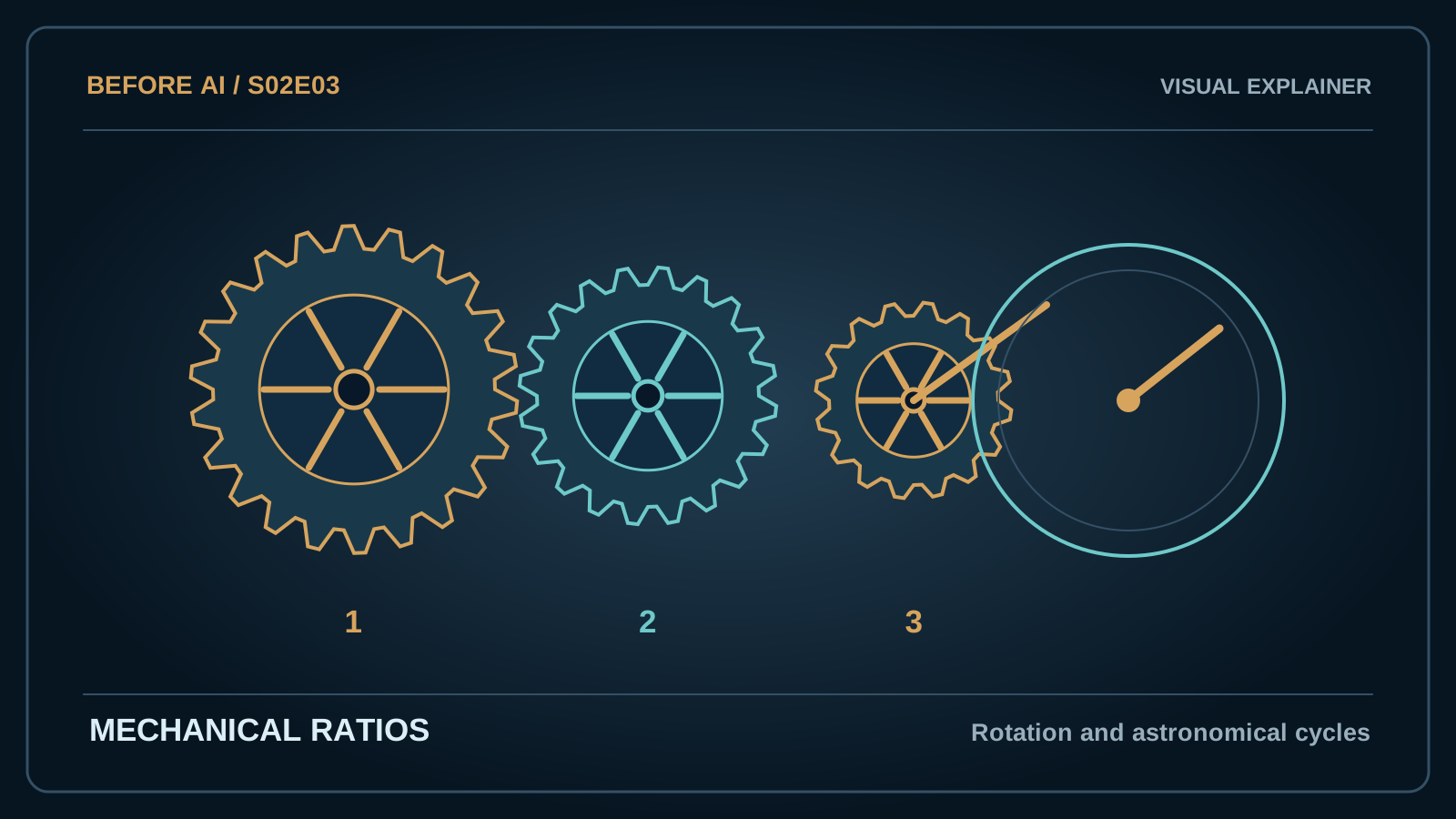
Turn the mechanism's input and linked gearwheels move pointers across scales. Different gear ratios represent different periods. A person no longer has to perform every calculation afresh: the geometry of the mechanism carries part of the work. That is what makes it an analogue calculator.
There are limits to what we know. Only fragments survive, and scholars continue to debate exactly how some displays were arranged. Modern reconstructions show plausible ways the pieces could have worked, rather than a complete original machine discovered intact. It would also be wrong to imagine an unbroken industrial tradition stretching from this Greek device to modern computers.
A tiny example: what gears can calculate
Picture two wheels connected together. The first turns ten times while the second turns once. That is a ten-to-one relationship. Change the size and number of teeth, and you can represent a different ratio. By combining wheels, a designer can model cycles without writing down the answer at every step.
It is similar to using the hands of a clock to represent seconds, minutes and hours, except the Antikythera mechanism modelled astronomical relationships. The machine embodied a rule. Someone could supply a position or date and read a prediction from its scales.
That is different from a counting board, where a person actively moves counters to do arithmetic. It is also different from the digital computers of today, which store and process information electronically. These distinctions make the history more interesting, not less.
The problem of carrying a number
Jump forward many centuries to seventeenth-century Europe. People were working with taxes, trade, measurements and enormous columns of figures. A machine that could add or subtract reliably would save exhausting work.
In 1642, the young Blaise Pascal began developing a calculating machine often called the Pascaline. Its numbered wheels could carry from one place to the next. If a wheel moved from nine through zero, the mechanism advanced the next place, so a person did not need to keep track of that carry manually.
This was not a pocket calculator for everyone. The machines were difficult and expensive to make, and their practical success was limited. But the important principle was now visible: an operation such as carrying one ten could be performed by a carefully designed mechanism.
A machine can hold a rule
We often describe computers as machines that do calculations. A deeper description is that they follow rules. The Antikythera mechanism embodied astronomical periods in gear ratios. Pascal's machine embodied parts of decimal arithmetic in wheels and carrying mechanisms.
Neither device was artificial intelligence. Neither thought, learnt or made decisions in the modern sense. They show something more basic: people learnt to move a piece of mental work into the structure of a tool.
The question that connects them to our world is not “Was this the first computer?” It is “What happens when a physical object can perform a repeatable operation for us?” Much of the history of technology begins there.
Why a shipwreck changed the story
The Antikythera device was recovered in 1901 among cargo from a wreck off the Greek island that gave the machine its modern name. Divers did not bring up a gleaming, ready-to-use instrument. They recovered corroded lumps that were initially difficult to interpret. Only much later did close examination, imaging and analysis reveal just how sophisticated the arrangement of gears and scales must have been.
That matters because the fragments offer two stories at once. The first is about ancient engineering. The second is about how historians work: they compare surviving pieces with inscriptions, mathematical models and other knowledge from the period. They can test whether a proposed gear train could physically fit the housing or reproduce a particular cycle. One impressive computer reconstruction is not proof that every part of the original looked exactly like it.
Two kinds of mechanical answer
The mechanism near Antikythera is often described as the earliest known analogue computer. It is a useful description when carefully explained. The device represented continuous astronomical cycles through mechanical motion. Moving one part could reveal a corresponding position or date on another scale. Its 'program', in a loose everyday sense, was fixed by the teeth and ratios of its gears.
Pascal's later calculator addressed a different kind of problem. It used decimal wheels to help with additions and subtractions, and its carrying mechanism could pass an extra unit to the next column. This is not the same as predicting an eclipse. What connects them is the transfer of a repeatable mathematical operation into an object.
In both cases a person still had to understand the task, operate the device and interpret the result. It was not a machine that could choose its own goals. Even in modern computing, speed and complexity should not be confused with thought or understanding.
What we can learn from the physical evidence
The scientific paper published in Scientific Reports in 2021 reports that around a third of the original Antikythera machine survives. Detailed X-ray scans have revealed inscriptions describing astronomical displays and cycles. The researchers put forward a mechanical reconstruction that tries to make these pieces work together. It is an evidence-based model, not a photograph of an intact ancient original.
That distinction is part of the delight. A bronze gear is tiny, but it opens a much larger question about who could manufacture such accurate parts, how those skills were taught, and how much ancient engineering has vanished. Archaeology sometimes reveals remarkable one-off survivals rather than an uninterrupted chain of inventions.
A machine does not need a screen to change how people think about calculation. Its working parts can carry an argument about numbers.
Sources & Further Reading
- Scientific Reports · Antikythera model
- Science Museum Group · Pascal calculator
- Nature Astronomy · Antikythera review
The main illustration is AI-generated, not historical photographic evidence. The technical diagram is an original editorial illustration.