
The Clock That Ran on Water
A bowl could keep time after sunset. Making that bowl dependable was a much harder problem.
In this article
- A clock you could hear
- Ancient evidence, without an invented inventor
- Two directions, one measurement problem
- Why the last water behaves differently
- Three ways to improve the reading
- When your speaking time was water
- The instrument includes the person using it
- What belongs in Before AI
- Sources & further reading
A clock you could hear
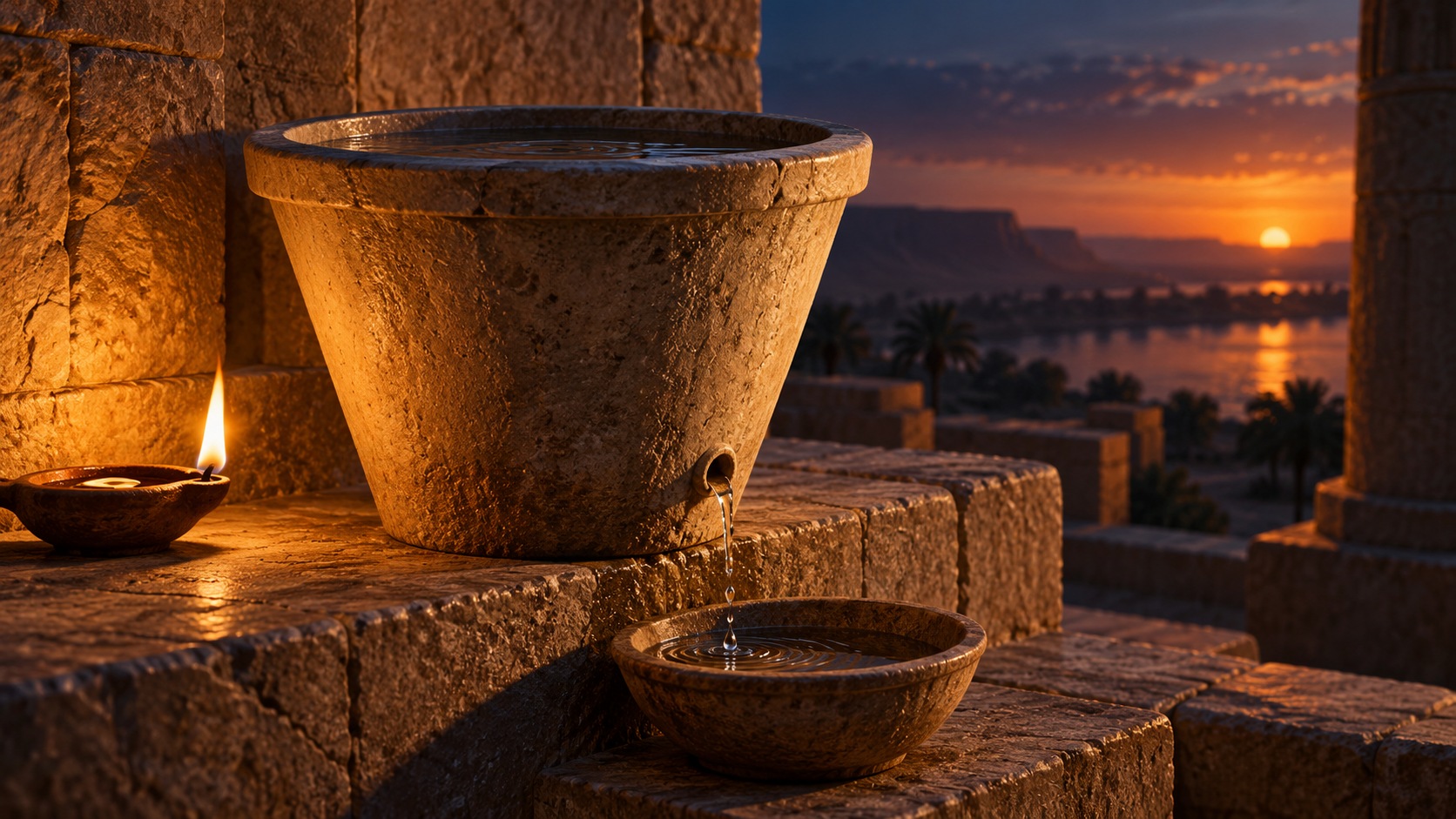
Picture a quiet room after dark. There is no moving shadow to read, no clock face on the wall and no battery-powered display. There is a vessel of water, a small opening near its base and a second bowl catching the drips. As the upper vessel empties, its changing level makes an otherwise invisible interval visible.
This is the central idea of an outflow water clock. Its apparent simplicity is deceptive. A hole makes water escape; it does not automatically make each minute equal. To turn a vessel into a useful instrument, someone has to connect its changing water level with a dependable measure of elapsed time. That connection is the real invention worth examining.
Our earlier Before AI article introduced sundials and water clocks together. Here we look inside the water clock: what moves, what the marks mean, why its rate changes and how a timed bowl could help organise a courtroom.
Ancient evidence, without an invented inventor
Water clocks were used in ancient Egypt long before mechanical clocks. The surviving Karnak example is associated with Amenhotep III in the fourteenth century BC; the specialist Ancient Egyptian Astronomy catalogue identifies it as an outflow clock. That gives us a physical object to study, rather than only a later story about an ingenious invention. [1]
A surviving object does not identify the first person ever to try the idea. Nor does it establish that every Egyptian clock looked or worked exactly alike. The useful question is what the evidence supports: people made vessels whose changing water levels served as time indicators. The atmospheric image above is an illustration, not a photograph of the Karnak object.
There is also a difference between measuring an interval and knowing the time of day. A bowl started now might tell you how long a speech has lasted. To tell you that a particular hour of the night has arrived, it needs a known starting point and an appropriate scale.
Two directions, one measurement problem
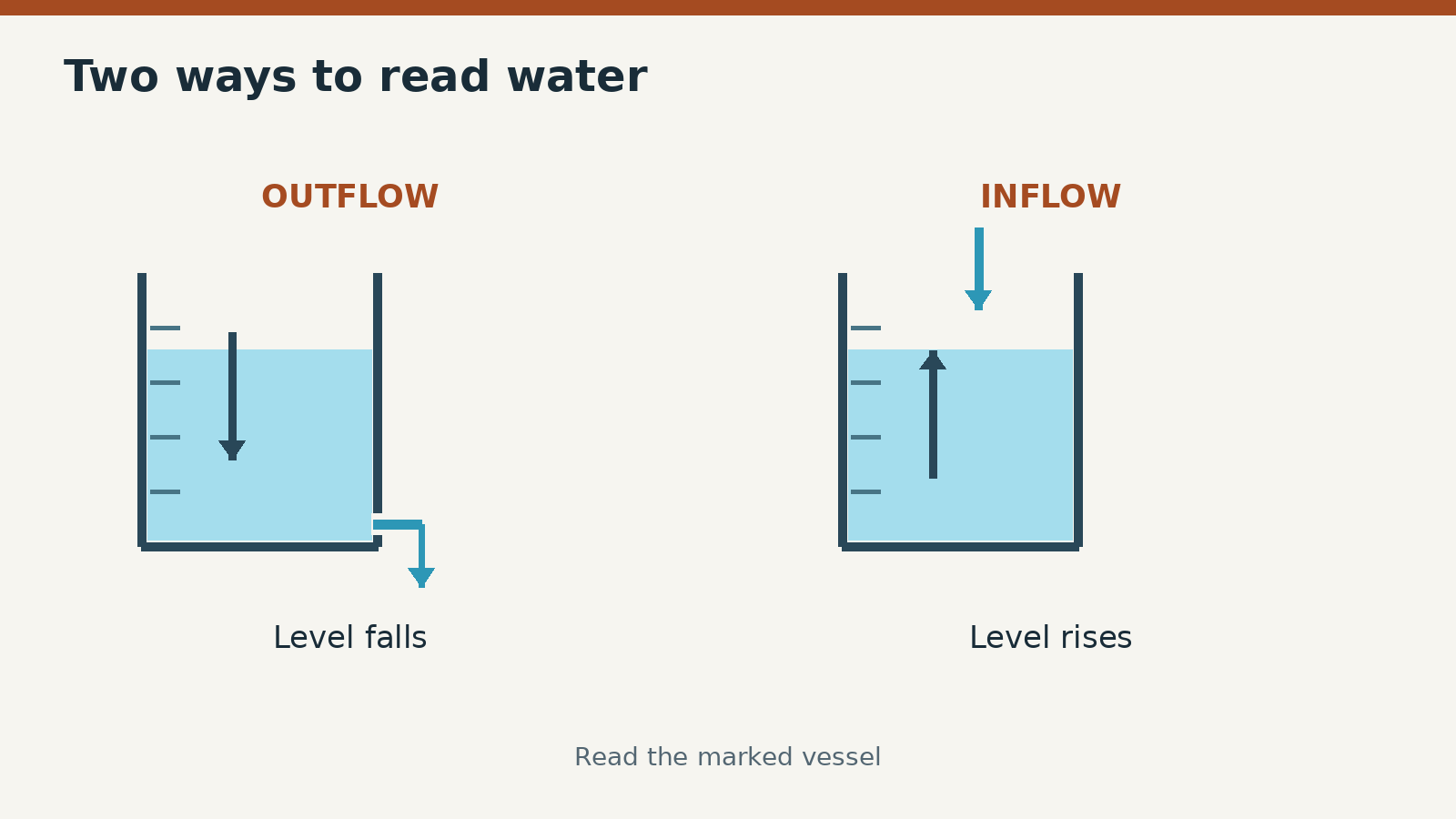
In an outflow design, you fill the vessel to a defined starting level and let water leave through a small opening. You read the falling surface against marks inside the vessel. The lower catching bowl is not automatically the clock: the scale may belong to the upper vessel.
In an inflow design, the marked vessel receives water. Its rising surface becomes the indicator. This arrangement can be easier to picture as a measuring jug slowly filling, but moving the scale does not solve the problem of irregular flow. If the supply speeds up or slows down, the receiving vessel records that change as well. Both arrangements are described in historical accounts of water timekeeping. [2]
In either case, the instrument needs a repeatable start. Filling an outflow clock only halfway and reading a scale intended for a full start changes what the reading means. The procedure is part of the measurement, just as pressing start at the right moment is part of using a stopwatch.
Why the last water behaves differently
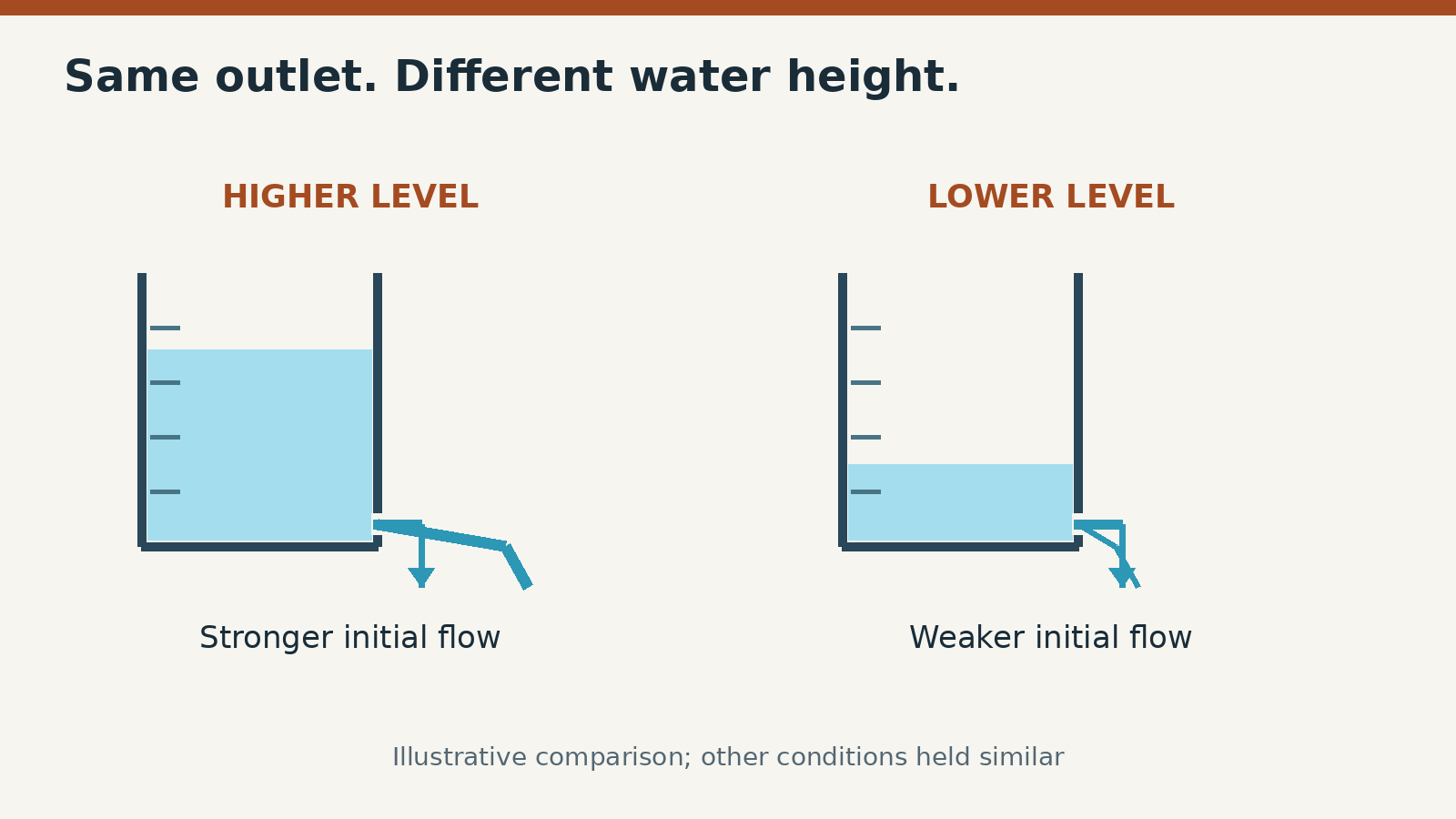
For otherwise similar conditions, a greater height of water above the outlet tends to produce a faster outflow. As the surface falls, that driving head becomes smaller. The underlying relationship appears in the physics of fluid flow; an idealised explanation is Torricelli's theorem. Actual small outlets also introduce resistance and other effects. [3]
That means a straight-sided vessel with equally spaced marks is not automatically a clock with equally spaced minutes. A centimetre of falling water near the start may take a different time from a centimetre near the end. An attractive scale can still be a misleading scale.
A useful thought experiment is to watch two identical vessels at different fill levels. Keep the outlet size and the receiving conditions the same. The more deeply filled vessel generally has the stronger initial flow. The comparison isolates the height of the water; it does not claim that every ancient clock used two bowls side by side, or that a modern formula was known to its maker.
Three ways to improve the reading
There are several engineering responses to a changing rate. First, calibrate the marks: observe where the surface is after known intervals rather than assuming that equal distances represent equal times. Second, change the vessel's shape, so that a change in volume produces a different change in height. Third, regulate the supply to make the driving conditions steadier. Historical clockmaking explored shaped vessels and flow regulation. [2]
These approaches should not be muddled together. A shaped bowl does not necessarily have a perfectly constant stream. It may instead make the movement of the surface more useful. Likewise, a receiving vessel cannot guarantee regular timing unless the water entering it is sufficiently predictable.
Calibration is best understood as a comparison. Imagine marking a transparent container every time a reference timer reaches the next minute. You are finding out what that particular setup does. You are not proving that its marks remain correct after changing the hole, tilting the container or using a different starting level. This is a modern explanatory example, not a reconstruction of an ancient calibration ceremony.
When your speaking time was water
In Athenian lawcourts, water clocks were used to time speeches. The archaeological study The Lawcourts at Athens brings together the equipment and evidence for those procedures. Here the clock helped allocate a limited speaking interval rather than simply announce the hour. [4]
Think about what that changes. A speaker cannot make the day longer by adding another argument. An agreed quantity of water makes the limit tangible: there is a visible process outside the speaker's control. The useful output is not necessarily a precise modern timestamp. It is an interval that can be administered according to an agreed rule.
The device itself does not make a legal system fair. Someone still decides the allowance, starts the flow and follows the procedure. A measuring instrument can support a rule; it cannot decide whether the rule is just. That distinction is our interpretation of the clock's role, not a claim that an ancient water clock guaranteed equal treatment.
The instrument includes the person using it
Refilling, a clear outlet and consistent setup matter. If a small opening becomes partly obstructed, the flow changes. If the starting level changes, the same marks no longer necessarily describe the same elapsed interval. A device can look unchanged while its behaviour has shifted.
This is why a useful question about any old instrument is not only 'How was it built?' but also 'How was it used and maintained?' A surviving vessel shows materials and geometry. Written evidence, experiments and careful reconstruction help explain operation, but gaps should remain gaps rather than being filled with a confident story.
Water clocks also remind us to separate resolution from accuracy. Adding more marks makes a scale look more detailed. It does not by itself make the underlying process more dependable. A finely labelled bowl can still be a poor timer if the flow varies unpredictably.
What belongs in Before AI
The water clock was not a computer, and it did not run a program in the modern sense. We do not need that claim to see why it belongs in this series. It turns a physical change into information that people can use, while exposing the work needed to make that information reliable.
The important chain is simple: choose a process, observe it, establish a reference and understand what can disturb it. The same questions are useful when judging a modern sensor or a digital dashboard. What is actually being measured? How does the display relate to it? Under which conditions does the relationship stop holding?
The achievement was more than letting water drip. It was learning how to make those drips mean something.
Sources & further reading
Sources checked 29 October 2026
Original editorial content. AI tools assisted with research, drafting, editing, translation and illustrations. Sources were checked; editorial responsibility remains with Future Uncovered.