
Give AI a Better Brief: Goal, Context, Limits and Format
Four small pieces of information can turn a vague request into a task you can actually judge.

In this article
- Start with the job, not a magic phrase
- 1. Goal: say what should exist at the end
- 2. Context: supply the facts that change the answer
- 3. Limits: state what must not change
- 4. Format: make the answer easy to use
- A complete brief you can copy
- Improve one thing at a time
- Keep private information out of the exercise
- A brief is a starting point you can test
- Sources & further reading
Start with the job, not a magic phrase
'Write something about our event' leaves an AI assistant with a great many decisions to make. Who is invited? What is happening? Where is it? Should the result be a poster, a message or a long article? A polished answer can still miss the job completely.
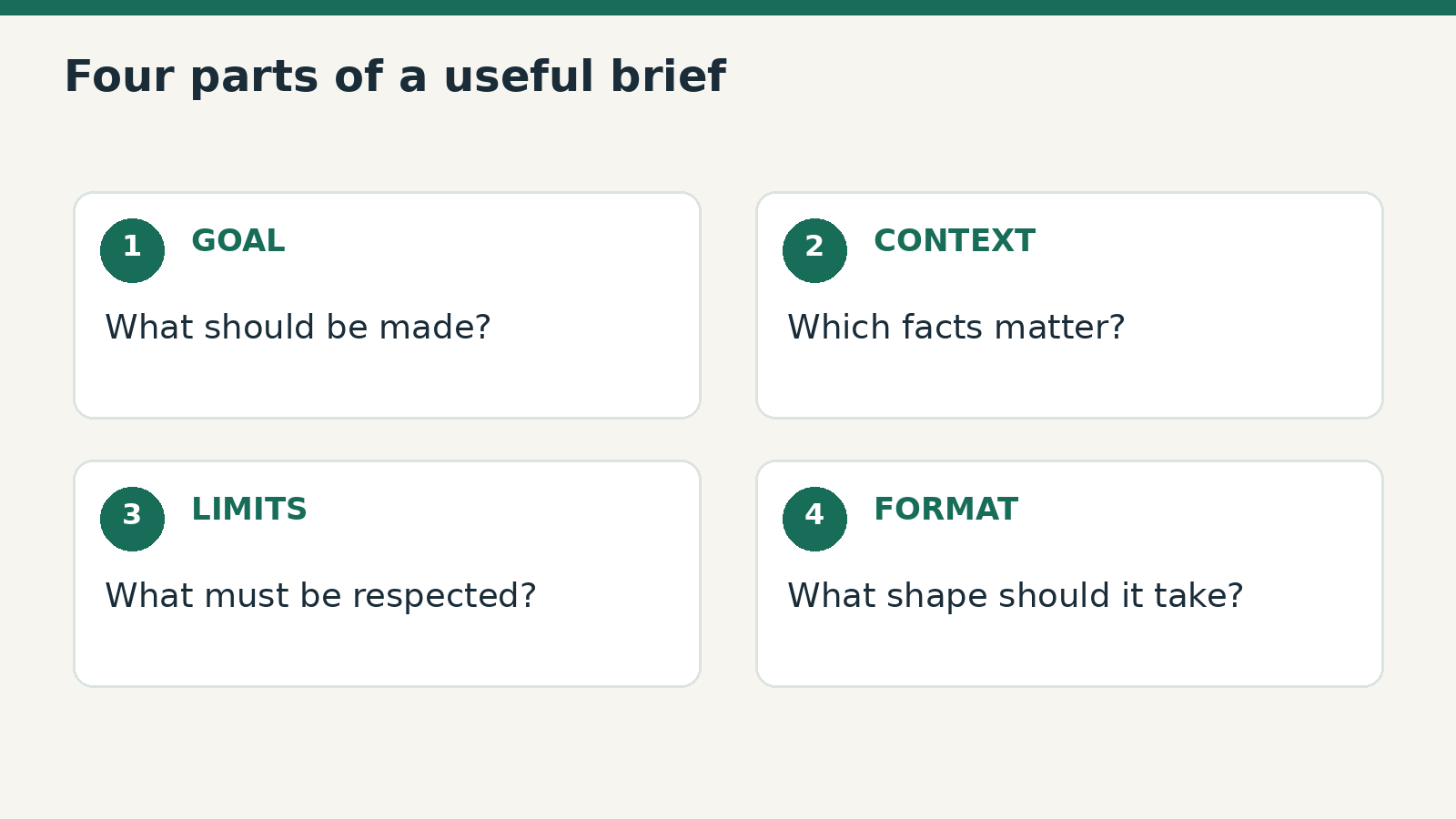
You do not need an elaborate formula to fix this. Give the assistant the outcome you want, the information it needs, the boundaries it must respect and the form the answer should take. In this guide we call those four parts goal, context, limits and format.
This is an editorial working method, not a guaranteed way to remove mistakes. It follows the practical principle of giving clear instructions, relevant context and examples where useful, also reflected in model-provider guidance. [1] The value is that you can see what you asked for and compare the result against it.
1. Goal: say what should exist at the end
A goal describes the deliverable. 'Help with our book swap' is a subject. 'Draft a short invitation to our book swap' is a task. The second tells the assistant what to produce without requiring it to invent the entire activity.
Use an ordinary verb: draft, summarise, compare, explain, organise. If there are several jobs, decide which comes first. Asking for an event plan, a budget, a poster and a social campaign in one sentence can make it harder to see whether any of them meets your needs.
Also separate preparing an action from carrying it out. 'Draft an invitation for me to review' is clearer than 'Tell everyone about the event'. Where a tool can send messages, your wording should make the intended boundary explicit. A useful draft does not need to be sent automatically.
2. Context: supply the facts that change the answer
Context should answer the questions a helpful person would ask before starting. For an invitation, that usually means the audience, activity, place, timing and practical details. The assistant cannot reliably infer those from your enthusiasm for the event.
Our fictional example is a neighbourhood book swap on Saturday 14 November 2026, from 14:00 to 16:00 in the community hall. Entry is free, adults and children are welcome, and each person may bring up to five books. These are made-up facts for the exercise, not an announcement of a real event.
Leave out unrelated information. A long personal history will not necessarily improve a two-sentence invitation. The test is simple: would changing this detail change the answer I want? If not, it probably does not belong in the brief. When a fact is missing, identify it rather than inviting a confident guess.
3. Limits: state what must not change
Limits protect the useful parts of the task. You might require British English, a maximum length, a friendly tone or the use of supplied facts only. They should be concrete enough that you can check them afterwards.
'Keep it professional' is open to interpretation. 'Use plain English, no sales language and no more than 80 words' is much easier to assess. Similarly, 'Do not invent booking details, refreshments or a contact person' is more specific than 'Be accurate'.
Do not turn the prompt into a list of every possible failure. Name the constraints that matter for this job. If two requirements conflict, choose which has priority. A demand to include every detail and stay under ten words may not be workable; the assistant should be allowed to say so instead of silently dropping facts.
4. Format: make the answer easy to use
Format is the shape of the deliverable: a short paragraph, a table with named columns, a numbered sequence or three alternative titles. It is separate from tone. A friendly answer can still arrive in the wrong format.
For our invitation, ask for one heading followed by one paragraph, with no introduction from the assistant. For a comparison, name the columns you need. For a task list, decide whether owners and dates should appear, and say how unknown values should be shown.
A tiny example can help when a preferred style is hard to describe. Use a harmless sample you are allowed to share. Be clear whether its wording should be copied or only its structure followed. Otherwise the assistant may repeat a date, name or claim that belongs to the sample rather than the new task.
A complete brief you can copy
GOAL: Draft an invitation to a neighbourhood book swap for me to review. Do not send it.
CONTEXT: This is a fictional exercise. The event is Saturday 14 November 2026, 14:00–16:00, in the community hall. Entry is free. Adults and children are welcome. Each person may bring up to five books.
LIMITS: Use friendly, plain British English. Use only the supplied facts. Do not invent booking requirements, refreshments, an address or a contact person. Keep the complete invitation under 80 words.
FORMAT: One short heading and one paragraph. Return only the invitation. If an essential detail is missing, ask one specific question before drafting.
Possible result, written here as an editorial example rather than a recorded model test: 'Neighbourhood book swap. Join us at the community hall on Saturday 14 November, from 14:00 to 16:00. Bring up to five books to swap. Entry is free, and adults and children are welcome.'
Now the answer has something concrete to be checked against. The date, time, location, book allowance and free entry can all be compared with the brief. You can also count the words. The example demonstrates a structure; it does not promise that every model will return the same wording.
Improve one thing at a time
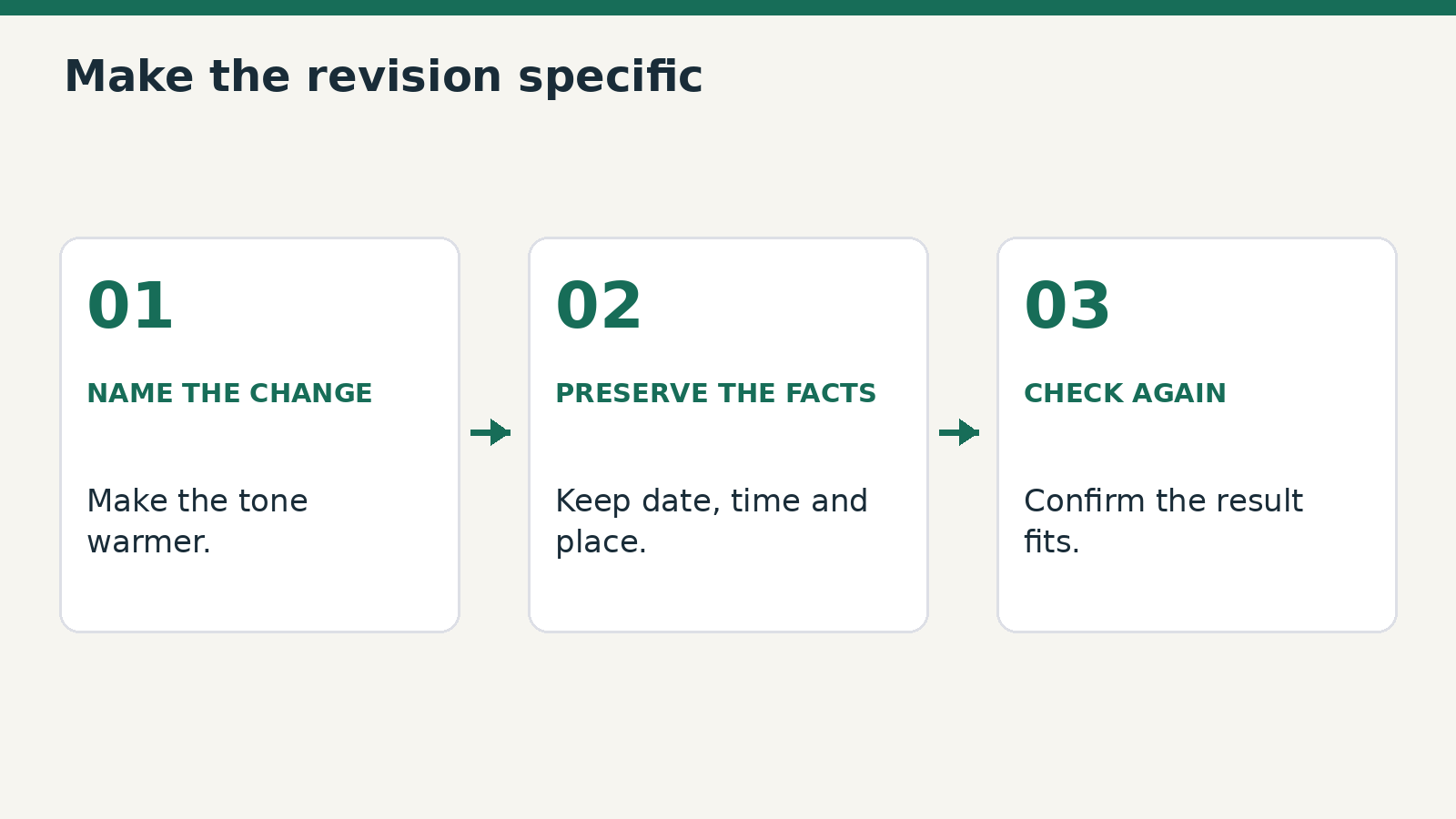
If the answer is too formal, do not restart with another vague request. Say what should change and what must stay: 'Make the wording warmer. Keep every factual detail and the same heading-plus-paragraph format. Stay under 80 words.'
If it invents refreshments, point to the exact addition: 'Remove the sentence about tea and coffee; I did not provide that information.' A targeted revision makes it easier to check whether the error has been removed without introducing new changes elsewhere.
When the conversation has accumulated several conflicting revisions, write a fresh brief containing the current facts and requirements. You should not have to remember which of ten earlier messages still applies. A clear current instruction is easier for you to review as well as easier for the assistant to use.
Keep private information out of the exercise
Useful context is not the same as maximum disclosure. For practice, use fictional names and harmless public information. For work, use only tools and information-sharing methods your organisation permits. Personal records, internal reports and customer details should not be pasted into an unapproved service just to make a prompt more specific.
The UK government's AI Playbook discusses security, appropriate human control and the limitations of AI. [2] The practical lesson here is to decide what information the task really needs before sharing it. Replacing a name with 'Person A' may still leave someone identifiable through the remaining details.
Also remember that an instruction such as 'keep this confidential' does not change a service's data handling settings or your organisation's rules. Check the relevant product settings and workplace requirements when they matter. Clear wording cannot grant permission to share a file.
A brief is a starting point you can test
Try the method on a low-risk task you already understand. Write the vague version first, then add the four parts. Compare the results against your actual requirements, not against which answer sounds more confident. If you use different models or settings, note that they may affect the comparison too.
Check three things before using the result: did it do the requested job, preserve the supplied facts and follow the important limits? For factual claims beyond your material, use the separate verification method in our earlier Learn article. Better instructions and fact-checking solve different parts of the problem.
You do not need to become a 'prompt engineer' to ask clearly. A useful brief gives the assistant less room to guess and gives you a better way to decide whether the answer is good enough.
Sources & further reading
Sources checked 29 October 2026
Original editorial content. AI tools assisted with research, drafting, editing, translation and illustrations. Sources were checked; editorial responsibility remains with Future Uncovered.