
AI Worlds You Can Explore: What World Models Actually Do
An explorable scene can respond to your actions. That does not make it a reliable copy of the physical world.
In this article
- What happens if I turn left?
- A prediction, an action and another prediction
- The idea predates the latest beautiful demo
- What changed this week: Genie 4
- A simulation can look right and be wrong
- Where the idea could be useful
- Five questions for the next demonstration
- Explore with curiosity, keep the categories clear
- Sources & further reading
What happens if I turn left?
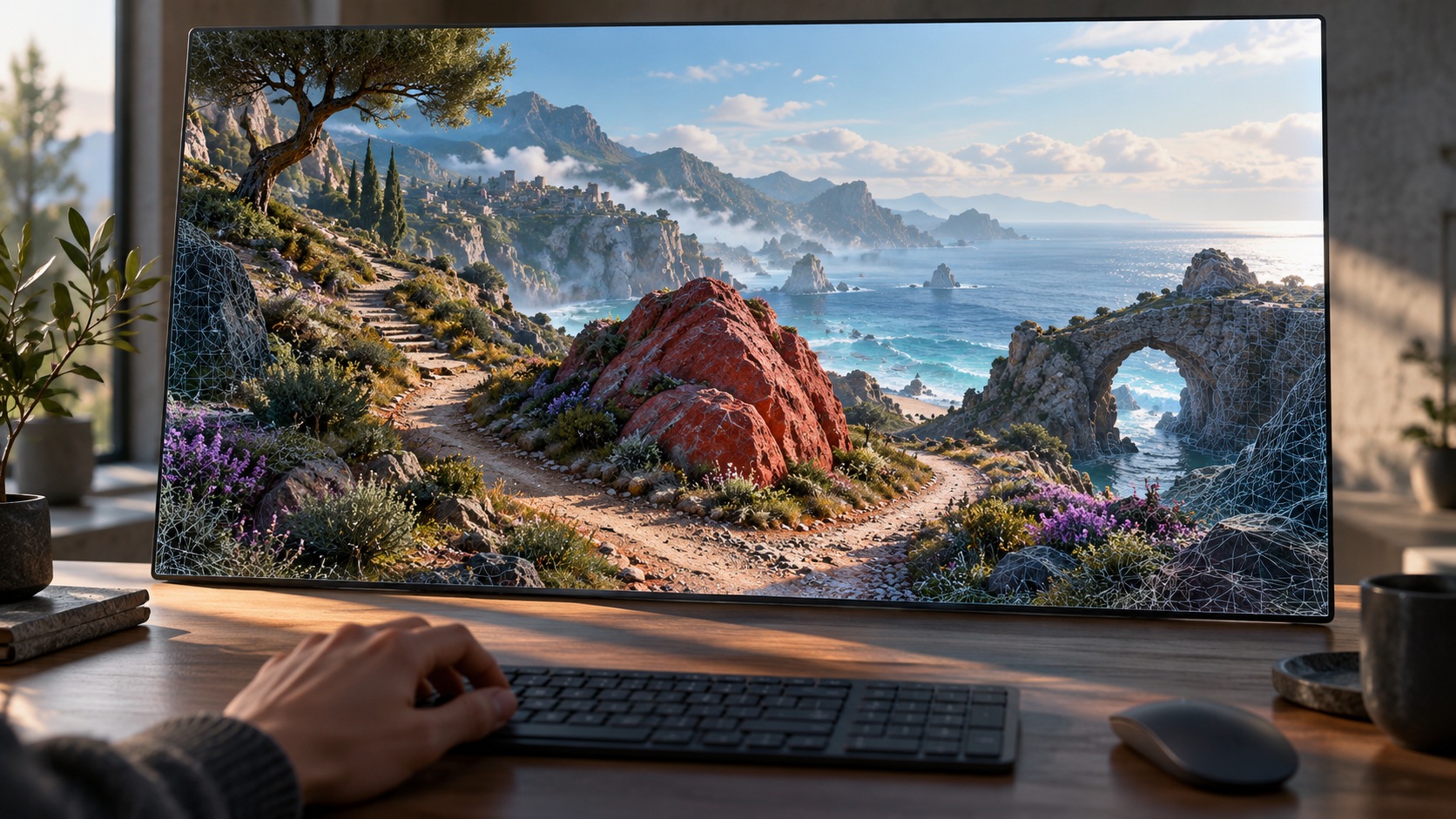
Imagine a path beside the sea. You turn towards a stone arch, walk around a red boulder and look back. In a prerecorded film, the next view was already selected. In an interactive generated environment, your action helps determine what appears next. That is the appeal of the new wave of explorable AI worlds.
The phrase 'world model' can make this sound grander than it is. It does not necessarily mean a complete model of Earth, a conscious machine or a system that understands every law of physics. At a useful introductory level, it is a learned representation of an environment and how it may change, often in response to actions.
The word also covers different kinds of research. Some models generate scenes a person can explore. Others operate inside an agent, predicting compact internal representations rather than producing a polished landscape for a human viewer. These are related ideas, but they should not be treated as interchangeable products.
A prediction, an action and another prediction
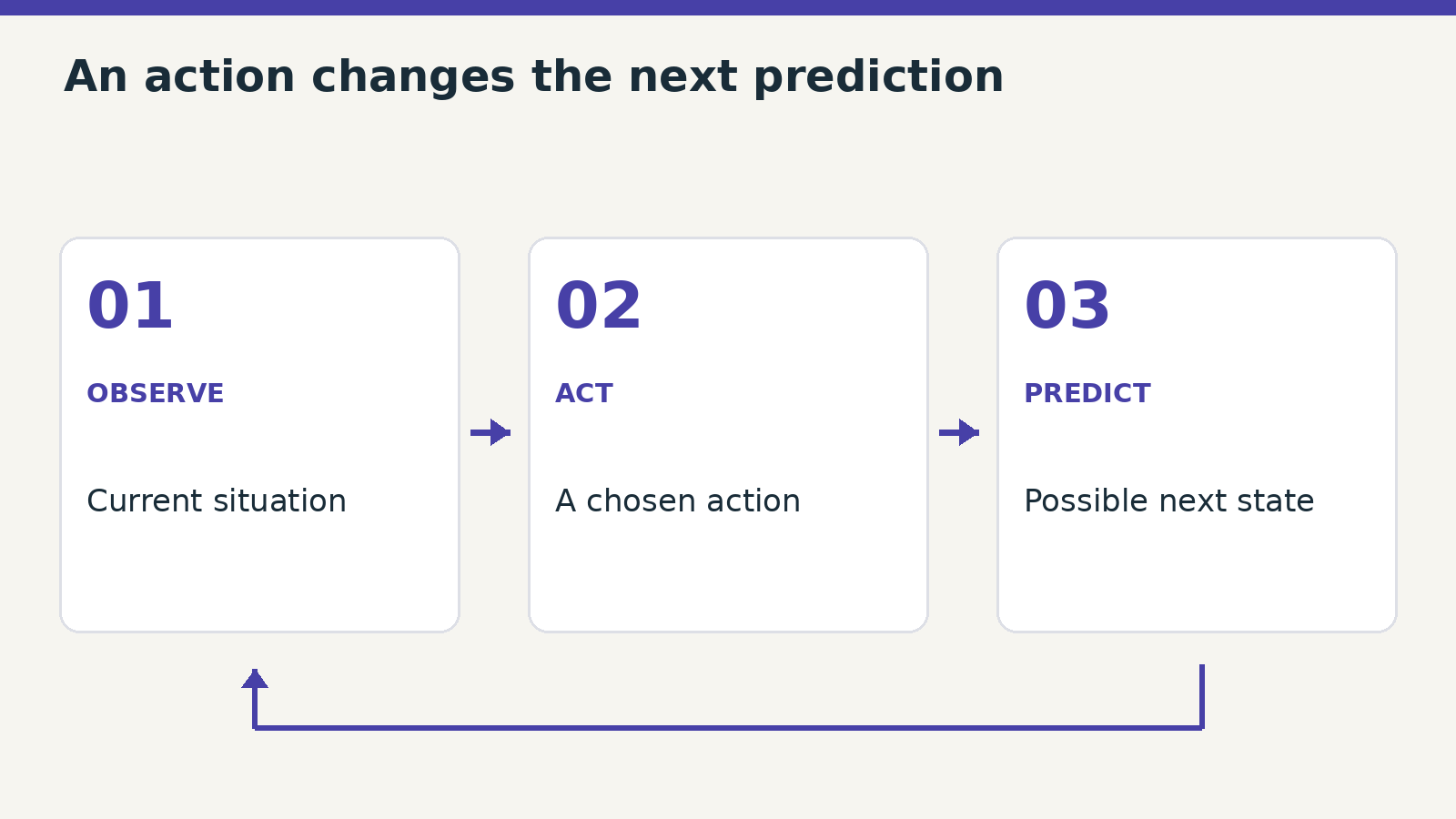
A helpful conceptual loop has three parts: an observation of the current situation, a possible action and a prediction of what follows. A system can then use new observations or further generated states to continue. The exact architecture differs between models; this is an explanation of the idea, not a wiring diagram for every product.
Consider a simple fictional room with a box and a doorway. 'Move forward' changes the view. 'Turn around' asks whether the door remains where it was. 'Push the box' tests whether an object responds in a plausible way. One convincing frame answers none of these questions by itself.
The challenge grows when the system must preserve several relationships at once. The box should not silently become a chair. A doorway should not migrate while it is out of view. The consequences of an earlier action should matter later. Those are useful tests to ask about, even before looking at a product's headline resolution or visual style.
The idea predates the latest beautiful demo
In their 2018 World Models work, David Ha and Jürgen Schmidhuber investigated learned internal representations and training a controller within a model-generated environment. The research concerned specific tasks, not a universal virtual world. [1]
A later example, Dreamer, learns an environment model and improves behaviour using imagined future trajectories. A 2025 Nature paper reports results across more than 150 tasks. That is evidence from a defined experimental programme, not proof that any real robot can safely learn any job in a generated scene. [2]
These examples help explain why a world model need not look cinematic. If a compact representation helps an agent anticipate consequences, it can be useful without becoming a video that a person would enjoy watching. Visual richness and usefulness for decision-making are different properties. An impressive interface is not a substitute for the evaluation that the intended task requires.
What changed this week: Genie 4
On 27 October 2026, Google DeepMind announced Genie 4, describing live scene steering and natively generated audio. As checked on 29 October, the announcement describes a research preview for trusted testers, with wider access planned. It should not be presented as a generally available tool. [3]
That status matters to a reader deciding what they can actually use. An announcement, a waitlist, a limited trial and a broadly available service are four different things. A video embedded in a product page is evidence of what the company is showing; it does not establish that every user can reproduce it under ordinary conditions.
Google's model page also lists continuing limitations involving consistency, interactions, accurate locations, text and session length. Those disclosures belong beside the exciting examples, not in a footnote that the reader never reaches. [4]
The fair description is therefore a promising interactive research system with documented limitations. Claims about what it could eventually support should remain future possibilities unless there is separate evidence of a working deployment.
A simulation can look right and be wrong
Suppose a generated cup falls from a table. The motion looks natural, a sound plays at the right moment and the scene continues. For a creative storyboard, that might be useful. For determining whether a particular cup will break, the demonstration tells us very little unless material properties, forces and outcomes are validated.
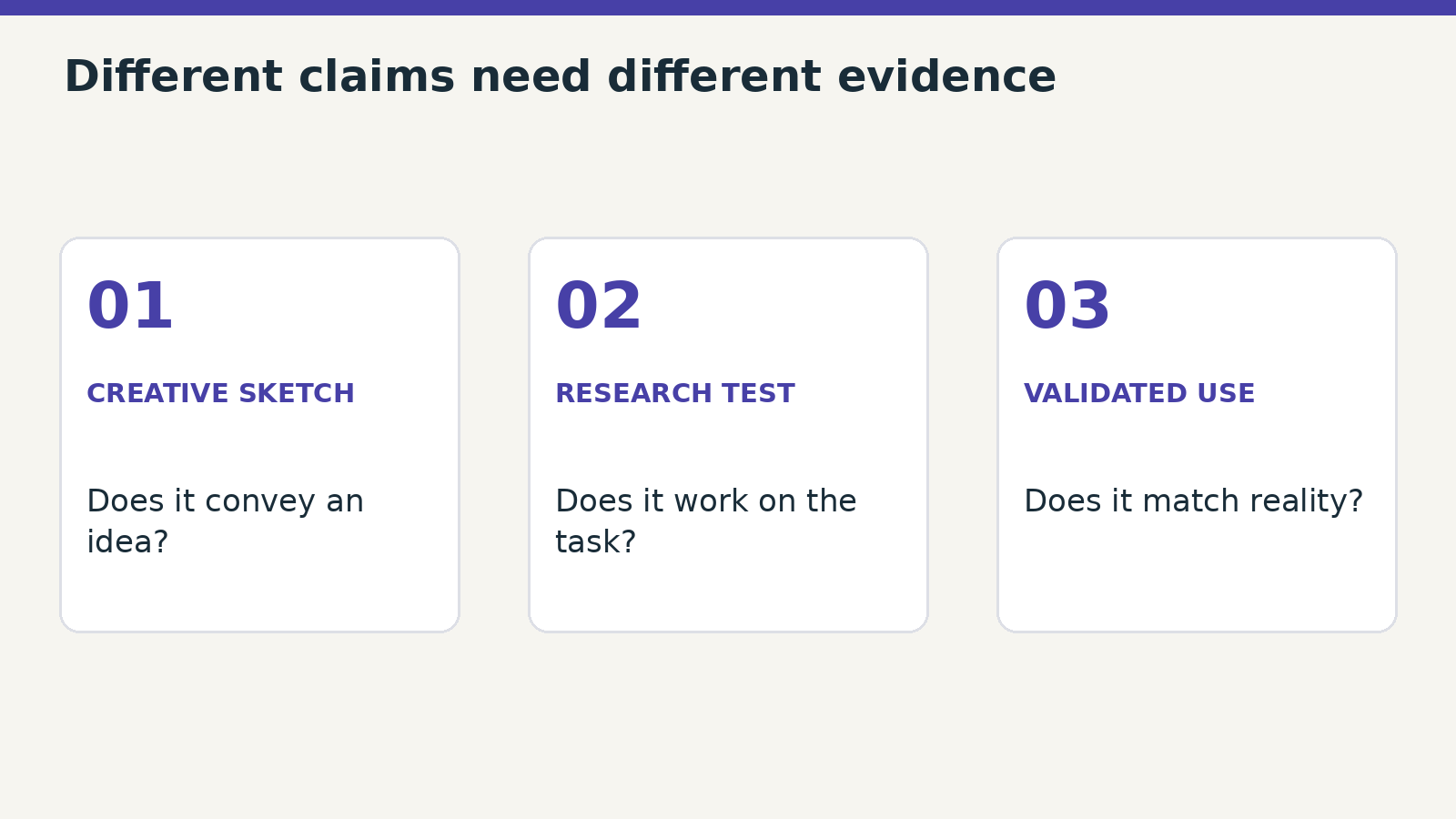
The difference lies in the question being asked. 'Does this communicate the idea of a dropped cup?' is a creative question. 'Will this component survive a drop from this height?' is an engineering question. The same attractive clip cannot be assumed to answer both.
A learned environment can reproduce patterns that look familiar while getting a hidden relationship wrong. Nor does adding more pixels necessarily fix this. A higher-resolution mistake is still a mistake. For real-world decisions, the model needs evidence that its relevant predictions match measured outcomes within an acceptable range.
That is also why a generated visit to an ancient street must be labelled as a reconstruction. Exploring a plausible space does not reveal what happened there, prove the layout or turn invented dialogue into historical testimony.
Where the idea could be useful
Creative exploration is an understandable use case: try a camera position, compare a mood or discuss the feel of an environment before committing to a more controlled production. The output can be treated as a proposal. A concept does not have to be a complete game or a validated physical experiment to help a team communicate.
Research on agents offers a different possibility: use models to consider potential actions and learn from predicted consequences. The cited research supports that direction in tested environments. Extending it to a real home, factory or road introduces a separate validation problem. Sensors, contact, unusual objects and human behaviour can differ from the training setting.
The practical question is not simply whether simulated practice is possible. It is whether learning in that simulation produces useful, reliable behaviour in the environment that actually matters. A result should be described with its task, conditions and limits, rather than reduced to 'AI understands the world'.
Five questions for the next demonstration
First, who is choosing the actions: a person, an autonomous agent or an edited script? Second, how long does the unbroken interaction last? Third, what persists when the camera looks away and returns? Fourth, which controls are genuinely available, and which changes are introduced by a prompt outside the agent's normal action space? Finally, what independent or repeatable evaluation supports the intended use?
These are our suggested questions for interpreting a demonstration, not a standard certification checklist. Their purpose is to uncover what the clip leaves unanswered. A short, carefully selected sequence can be an honest illustration while still providing little evidence about long sessions or difficult cases.
A particularly useful distinction is between 'the model generated this outcome' and 'the model predicted the real outcome correctly'. The first is a capability claim. The second requires a comparison with something outside the model.
Explore with curiosity, keep the categories clear
World models are interesting because they connect representation with change: what is here, what action is taken and what might follow. Explorable visuals make that idea easier to experience, but they are only one expression of it.
For now, judge a system against the job it is meant to do. A creative sketch, a research benchmark and a validated simulator deserve different expectations. Ask which one you are being shown before accepting a claim about all three.
Status note: product availability in this article was checked on 29 October 2026. This article is an explanation based on published sources, not a hands-on review of Genie 4. The illustrations are conceptual and are not product screenshots.
Sources & further reading
Sources checked 29 October 2026
Original editorial content. AI tools assisted with research, drafting, editing, translation and illustrations. Sources were checked; editorial responsibility remains with Future Uncovered.