
How Zero Became a Number
There is a difference between leaving a space empty and treating nothing as a number. That difference changed mathematics.
In this article
- First, the problem of an empty place
- But is nothing really a number?
- A manuscript with a difficult date
- A number that travelled
- The empty place that made room for more
- The Bakhshali manuscript: a clue, not a stopwatch
- What happens when you divide by nothing?
- Why place-value notation changed daily work
- A number that can mean absence — without meaning nothing
- Sources and further reading
You have five apples. You give away all five. How many are left? None. That sounds like the easiest question in mathematics. Yet the idea that “none” can be written as a number, placed into calculations and governed by rules took a long and complicated journey.
Zero did not arrive as one sudden invention by one person. Several cultures developed ways to mark an empty position in numerical writing. Turning zero into a number that could be used in arithmetic was another step — and one that mattered enormously.
First, the problem of an empty place
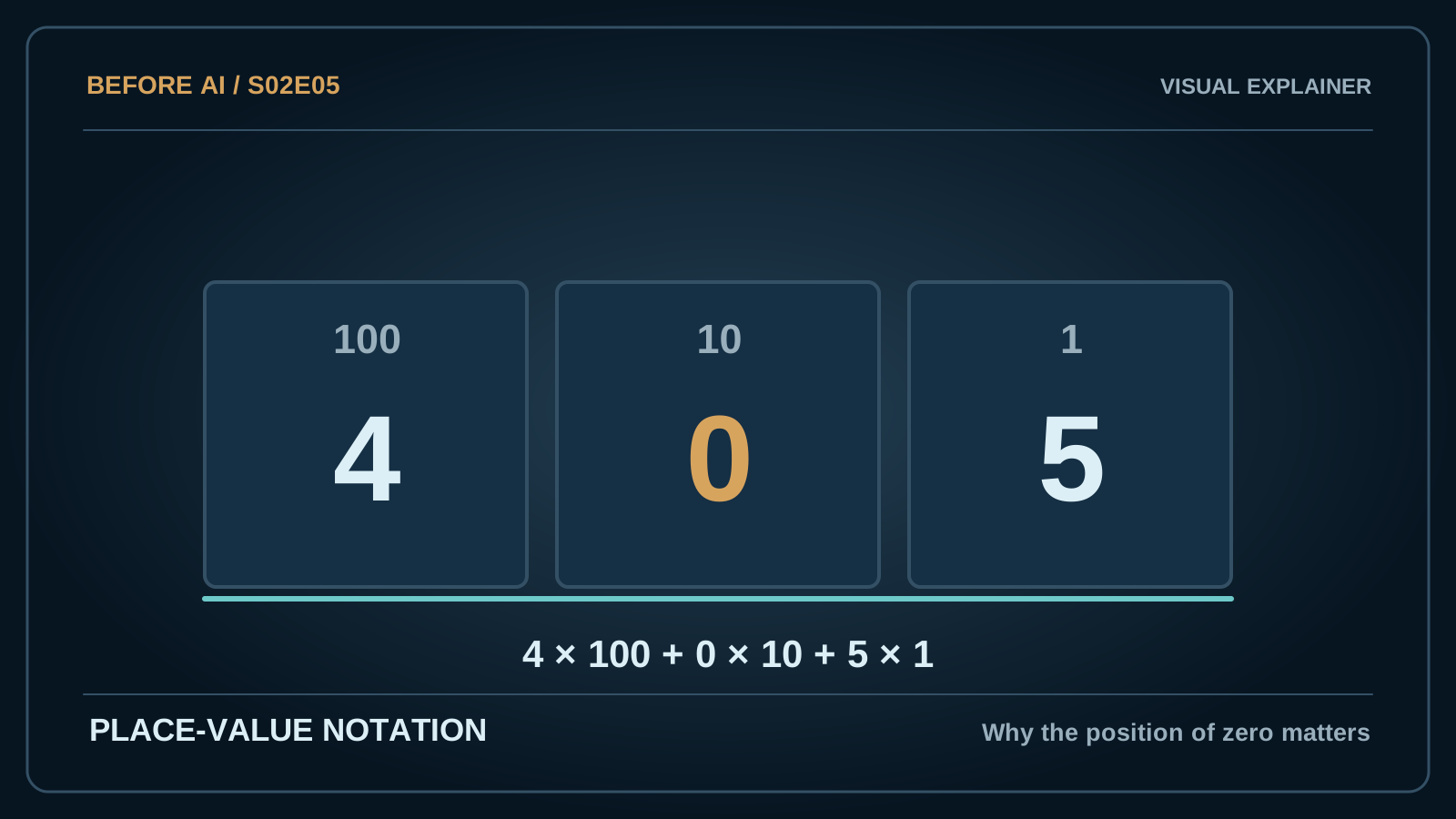
Look at 205 and 25. Those are not the same number. The zero in 205 tells us that the tens position is empty while the hundreds and units positions are occupied. In a place-value system, each digit changes meaning according to its position.
Without a reliable way to mark empty places, written numbers can become ambiguous. Ancient Babylonian mathematicians used positional methods, and over time they developed conventions for indicating missing values. Other societies devised different systems and symbols.
This is the first role of zero: a placeholder. It helps written numbers say exactly what we mean.
But is nothing really a number?
The second role is more surprising. Zero can behave like a number in an equation. Seven minus seven is zero. Zero added to seven still leaves seven. Multiplying seven by zero gives zero.
Indian mathematical traditions were central to the development of zero within the decimal place-value system and to its treatment as a number. In the seventh century, the mathematician Brahmagupta discussed arithmetic rules involving zero and negative quantities. Not all early rules were correct by modern standards. In particular, dividing by zero is not a valid ordinary arithmetic operation.
This is a useful reminder that a mathematical idea can develop in stages. A symbol may be used for centuries before people fully agree on how it should work.
A manuscript with a difficult date
The Bakhshali manuscript, kept at Oxford's Bodleian Libraries, contains many dots used as placeholders. In 2017, the Bodleian announced radiocarbon results suggesting that parts of the material might be much older than previously thought. That announcement attracted headlines about the “oldest zero”.
The dating is more complicated than a headline suggests. Radiocarbon dating measures the age of the material — in this case birch bark — rather than directly dating every line of writing. The manuscript is fragmentary, and its precise chronology has been debated. An Oxford research report published in 2024 documents radiocarbon measurements for several leaves.
It is safer to say that the manuscript is important evidence for the history of zero notation, not that one scientific test has conclusively identified the moment zero was invented.
A number that travelled
Mathematical knowledge moved across South Asia, the Islamic world and Europe through study, exchange and translation. The decimal system and its zero became part of an increasingly powerful way to record and calculate numbers. Many people contributed to the journey, and adoption was not instant.
Today zero feels invisible because it is everywhere. It helps represent very large and very small values; it appears in coordinates, measurements, accounting and computing. Digital machines also use binary notation, which combines 0 and 1 — though the modern binary system should not be mistaken for the direct creation of any one ancient mathematician.
The empty place that made room for more
The story of zero is really about two achievements. One made numerical writing clearer. The other expanded what a number could be. Both required people to accept that an absence could be represented, reasoned about and checked.
Sometimes the most powerful tool is not a complicated machine. Sometimes it is a small symbol that lets the rest of the system work.
The Bakhshali manuscript: a clue, not a stopwatch
The Bakhshali manuscript, held at Oxford's Bodleian Libraries, has helped make the history of zero particularly visible. It contains small dots used in calculations where an empty position needed marking. But it is not straightforward evidence of the exact moment zero was invented.
The manuscript is made from birch-bark folios, and scholarship has debated how its material dates relate to the age of the writing and the mathematical tradition. A 2024 Oxford research report publishes further radiocarbon determinations. The sensible interpretation is therefore cautious: the manuscript is important evidence of a mathematical practice, not a magic timestamp for the creation of the whole concept.
What happens when you divide by nothing?
Learning the rules of a new kind of number is not automatic. Addition is easy to picture: add zero apples to five apples, and the amount stays five. Multiplication by zero also has a clear everyday interpretation. Division is different. If you attempt to divide five by zero, you are asking for a number which, multiplied by zero, gives five. No ordinary number can do that.
Brahmagupta's seventh-century work discussed zero as a mathematical quantity, but the division rules were not fully consistent with later mathematics. This was not a failure of an otherwise finished system; it shows the work of discovering which rules make sense when an idea is extended.
Why place-value notation changed daily work
Imagine adding 4,705 and 305 with a method that does not distinguish empty tens or hundreds places clearly. Reliable place value lets each column have a defined meaning. Once numbers can be written consistently, arithmetic can be recorded, taught and checked by someone else.
These practical advantages spread across astronomy, trade and administration. Modern decimal numerals reached Europe through several routes of translation and exchange; calling them 'Arabic numerals' reflects part of that journey, not the complete geographic origin story.
A number that can mean absence — without meaning nothing
Zero is surprisingly busy in modern life. On a thermometer, it can mark a chosen reference point rather than a total absence of temperature. On a number line, it separates positive and negative values. Inside a computer, a binary zero is one of two distinct symbols in an electronic representation.
The historical breakthrough was not that people first noticed empty baskets. It was that they developed a consistent way to record absence as part of an ordered, calculable system. That tiny change made it possible to write far bigger and more reliable mathematical stories.
Sources & Further Reading
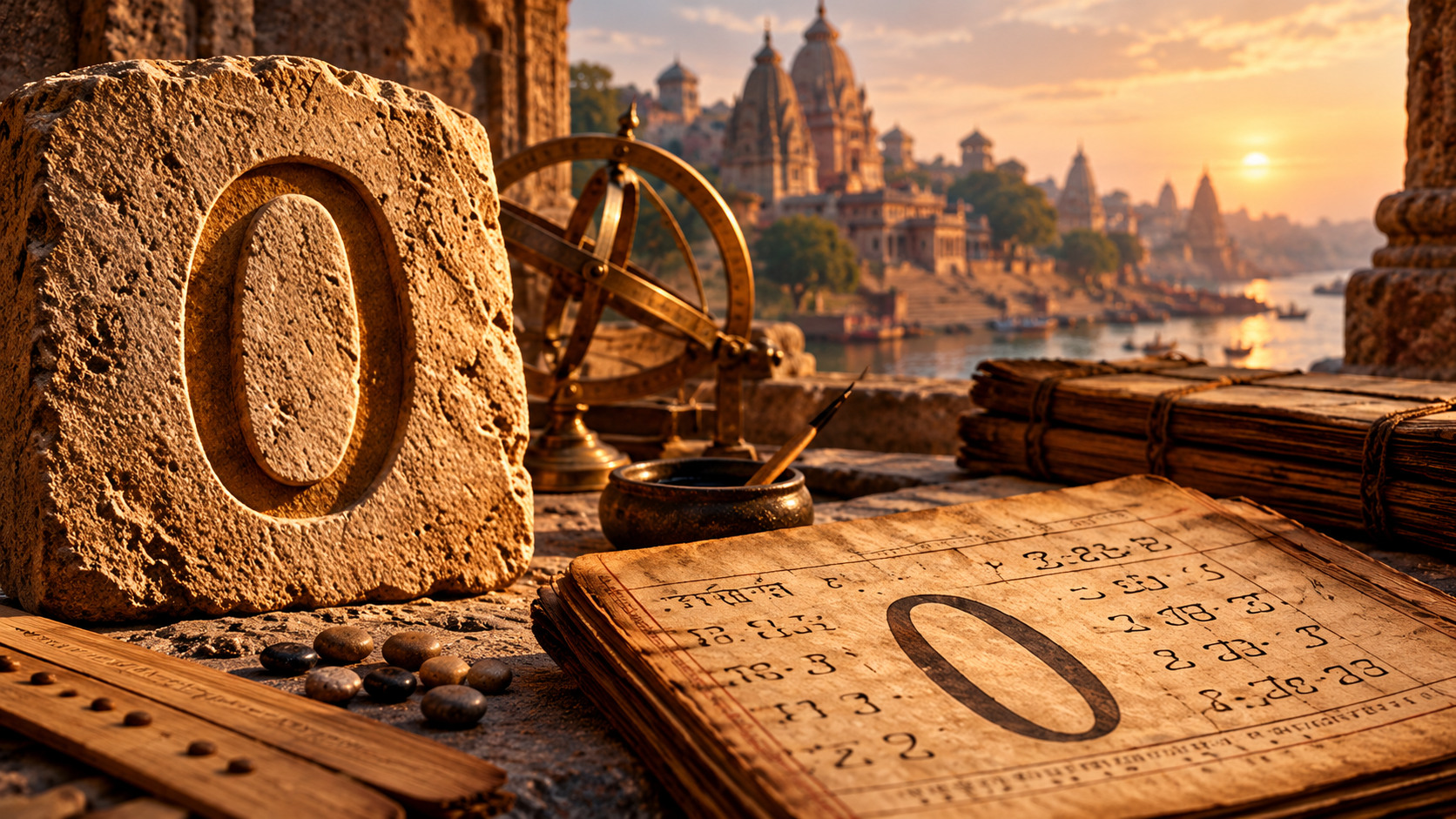
The main illustration is AI-generated, not historical photographic evidence. The technical diagram is an original editorial illustration.