
The Book That Gave Algebra Its Name
An unfamiliar word travelled from ninth-century Baghdad into modern classrooms — along with a powerful way to solve problems.
In this article
Suppose two people inherit a sum of money, but the shares depend on several rules. Or a builder knows the area of a plot but not the length of one side. You cannot solve every such problem simply by counting what is in front of you. Sometimes you need a method for finding something you do not yet know.
That need existed long before modern algebra lessons. Around the ninth century, the scholar Muhammad ibn Musa al-Khwarizmi worked in Baghdad, an important centre of scholarship under the Abbasid caliphs. One of his books helped give a name to a way of thinking we now use every day.
The title that outlived its author
Al-Khwarizmi's book is often known by a shortened version of its Arabic title, al-jabr wa'l-muqabala. The word al-jabr passed into European languages and eventually became algebra. The other word refers to balancing or comparing terms.
These were not mysterious incantations. They described operations for rearranging an equation into a form that could be solved. The book included worked methods for linear and quadratic problems — problems involving a number, or its square.
Al-Khwarizmi did not invent every earlier idea that became algebra. Babylonian, Greek and Indian mathematicians had solved related problems long before him. His achievement was to explain a systematic, teachable set of procedures in a work that travelled and influenced later scholars.
An equation is a balancing act
Take a simple example: a number plus five equals twelve. Today we might write x + 5 = 12. To find the missing number, remove five from both sides. The answer is seven.
That sounds obvious when written with modern symbols. But al-Khwarizmi did not write his algebra using our x signs and equals signs. He described problems and methods in words. His approach asked the reader to transform a complicated situation into familiar types that could be solved in an orderly way.
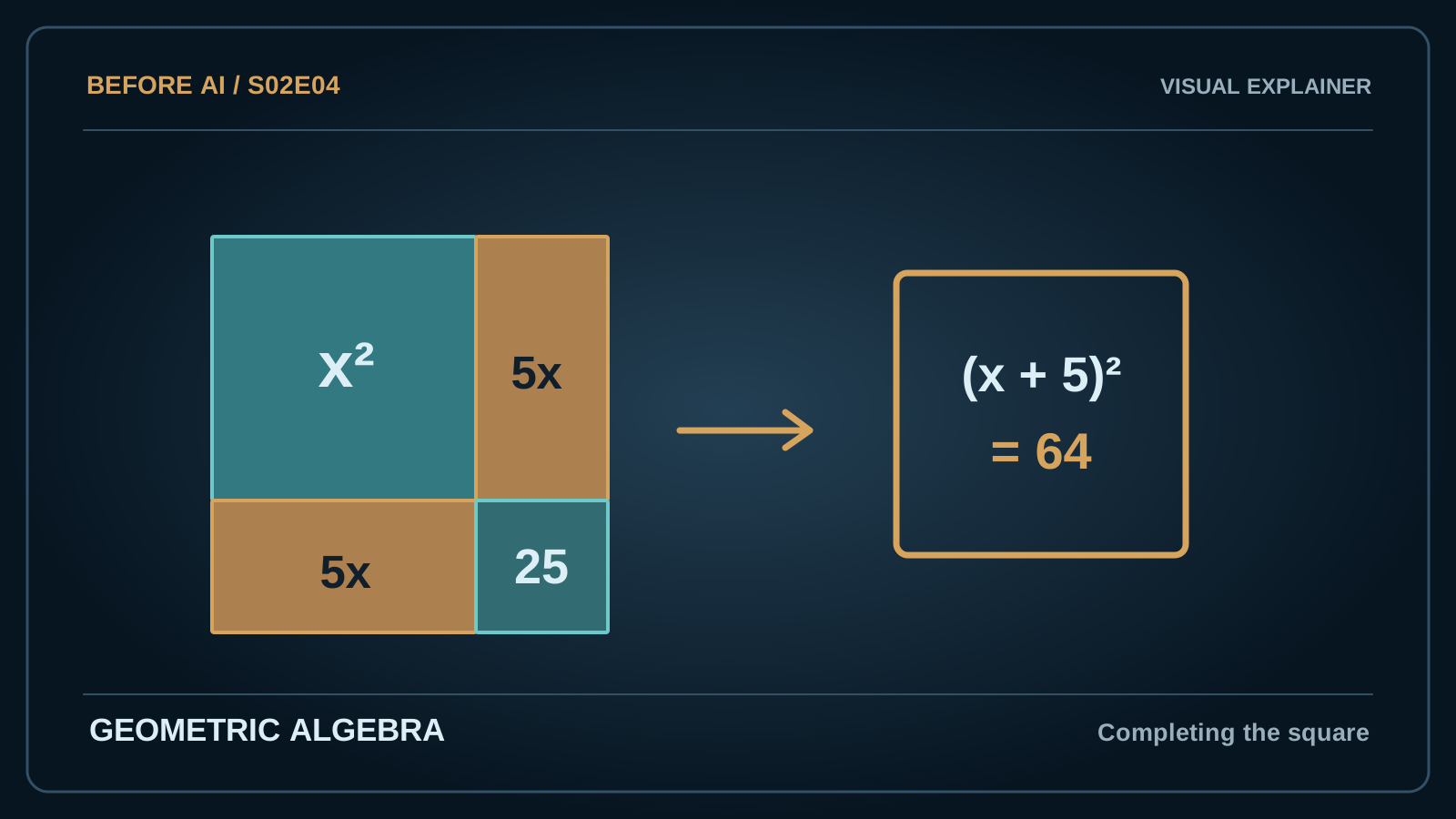
For a more ambitious example, consider a square together with ten times its side, making a total area of thirty-nine. In modern notation we write x² + 10x = 39. The solution is x = 3, because 9 + 30 = 39. Al-Khwarizmi explained how geometric arrangements could help reveal a result like this. His method is related to what students now call completing the square.
The important point is not memorising that procedure. It is seeing how a messy real-world question can be turned into a problem with repeatable steps and a checkable answer.
Baghdad was part of a larger conversation
The intellectual world around al-Khwarizmi was connected to many cultures. Scholars studied and translated work from Greek, Persian and Indian traditions while producing new research of their own. Mathematical ideas moved through manuscripts, teachers, trade and later translations.
The names themselves carry traces of those journeys. The word algorithm also has a connection with the Latinised form of al-Khwarizmi's name. That does not mean he invented today's computer algorithms; it shows how later European writers associated systematic arithmetic procedures with his work.
Why this matters beyond maths
Think about a spreadsheet formula, a recipe or a route-finding instruction. Each turns a specific task into a set of steps. Algebra does something similar for quantities: it lets us describe relationships without knowing every value at the beginning.
That is why an old book from Baghdad matters to modern science and technology. It helped make calculation easier to communicate, teach, adapt and verify. Modern AI uses mathematics of a very different scale, but the habit of replacing guesswork with explicit relationships is part of the older story.
The next time you see a letter standing for an unknown number, remember the real breakthrough: not the letter, but the method that makes the unknown approachable.
A geometric way to see a difficult sum
Take the example x² + 10x = 39. Imagine the unknown x as the side of a square. Its area is x². Now imagine adding two long strips whose combined area is 10x. They do not yet form a neat square, because a corner is missing. Add the missing corner, worth 25 square units, and the new complete square has area 64. Its side is 8, so the original side was 8 minus 5: x is 3.
That explanation uses modern notation, not a literal transcription of the ninth-century manuscript. But it gives an intuitive sense of the completing the square reasoning associated with al-Khwarizmi's work. The method does not require us to guess the answer, only to transform the shape of the problem while keeping it balanced.
Why a textbook mattered
A single brilliant solution is useful to the person who discovers it. A repeatable method is useful to a class of students and to people who were never present in the original room. In this respect a mathematical book can be as important as a physical invention. It preserves not just a result, but a path to that result.
The book discussed commercial calculations, inheritance and surveying: problems with real consequences. It made the case that unknown values could be approached systematically. Today that feels natural because algebra is part of so many school curricula, but learning a reusable technique was once a powerful bridge between individual craft and a shared discipline.
Not the invention of every algorithm
The modern word algorithm derives historically from Latin forms associated with al-Khwarizmi's name. An algorithm is now a series of specified steps for completing a task. But it would be misleading to claim that this scholar invented every methodical procedure or modern computing. Long before ninth-century Baghdad, people had procedures for counting, measuring, building and astronomy.
The better historical story is one of transmission and refinement. Ideas circulated through translations and scholarly exchanges; later generations added symbols, notation and more powerful techniques. Algebra today is far broader than solving small equations, yet the core experience remains familiar: describe what is unknown, set down relationships, transform them fairly and test the answer.
Where the evidence ends
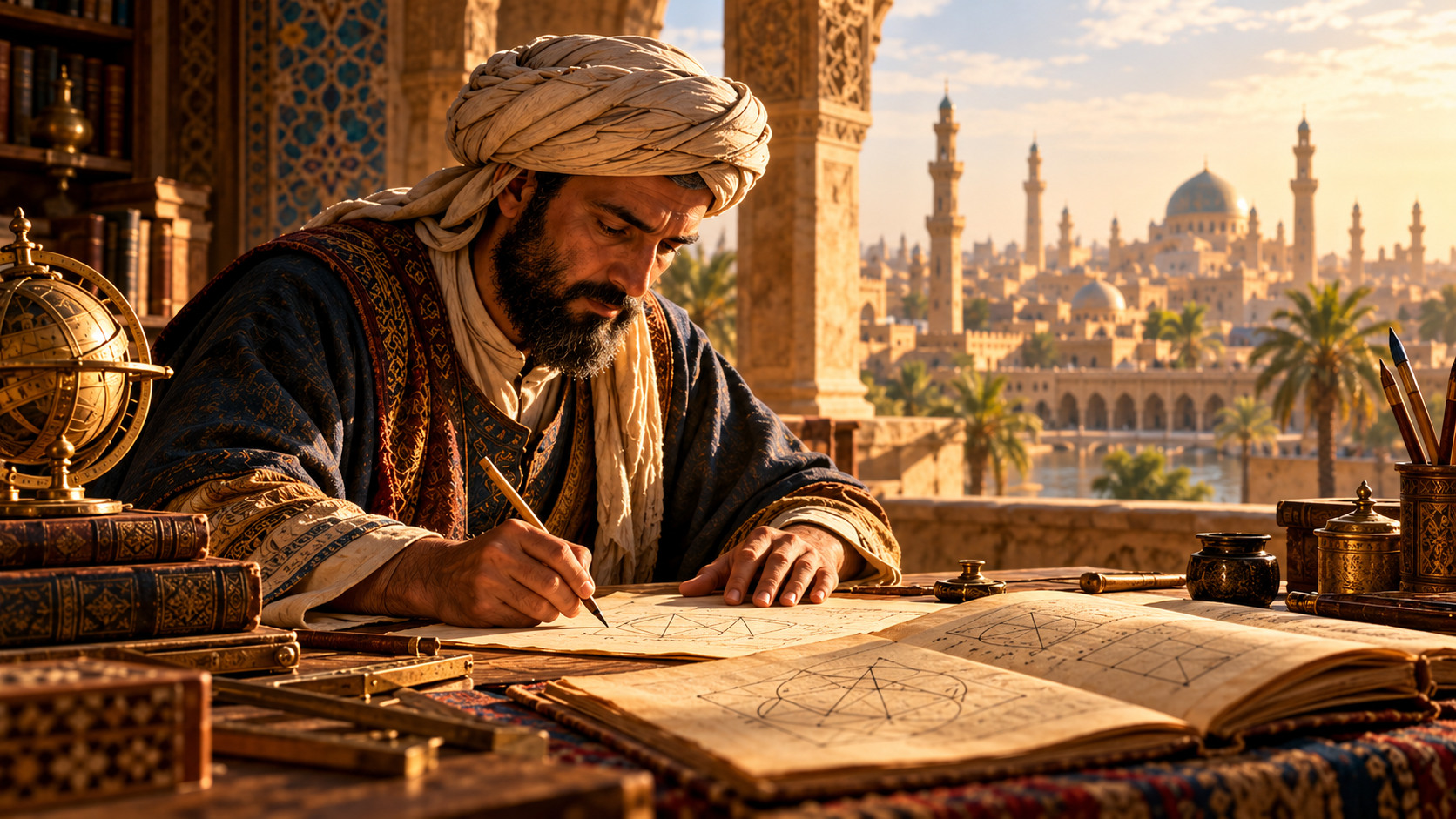
The biography maintained by the University of St Andrews notes how little is certain about al-Khwarizmi's personal life. Later stories often fill those gaps with dramatic scenes. Illustrations of a scholar at work can help readers imagine the setting, but they must remain illustrations rather than reconstructed portraits. We do not know his exact appearance or the precise look of every working room he used.
His strongest legacy is not an idealised face. It is the survival of ideas that other people could learn and improve.
Sources & Further Reading
The main illustration is AI-generated, not historical photographic evidence. The technical diagram is an original editorial illustration.