BEFORE AI · EDITORIAL FEATURE
The Woman Who Imagined Software Before Computers Existed
In 1843, Ada Lovelace described how a machine that had never been built could follow algorithms and manipulate symbols, not just numbers.

The machine did not exist. Its designer had spent years drawing mechanisms that nineteenth-century engineers struggled to build. Yet in 1843, a young mathematician looked at those plans and imagined something astonishing: a machine that could do more than calculate.
Her name was Ada Lovelace. Nearly two centuries later, she is celebrated as a pioneer of programming. But the most remarkable part of her story is not a claim about being "first." It is how clearly she saw the possibilities of a technology that had never been completed.
A meeting with a machine that was not quite a computer
London, 1833. Seventeen-year-old Ada Byron met Charles Babbage, a mathematician and inventor trying to automate the production of mathematical tables. Babbage demonstrated part of his Difference Engine, a machine designed for a specialised form of calculation. Ada was fascinated.
Her education made that encounter possible. Born in 1815 to Annabella Milbanke and the poet Lord Byron, Ada had studied mathematics in an era when women were rarely offered sustained scientific training. Her intellectual circle later included Mary Somerville and the mathematician Augustus De Morgan.
But it was Babbage's next idea that would become her defining subject. His proposed Analytical Engine went far beyond the Difference Engine. In principle it could follow sequences of instructions on punched cards, store values and perform different kinds of calculations. The design anticipated several organising concepts of a general-purpose computer, even though the Engine was never completed in Babbage's lifetime.
The paper that became something bigger
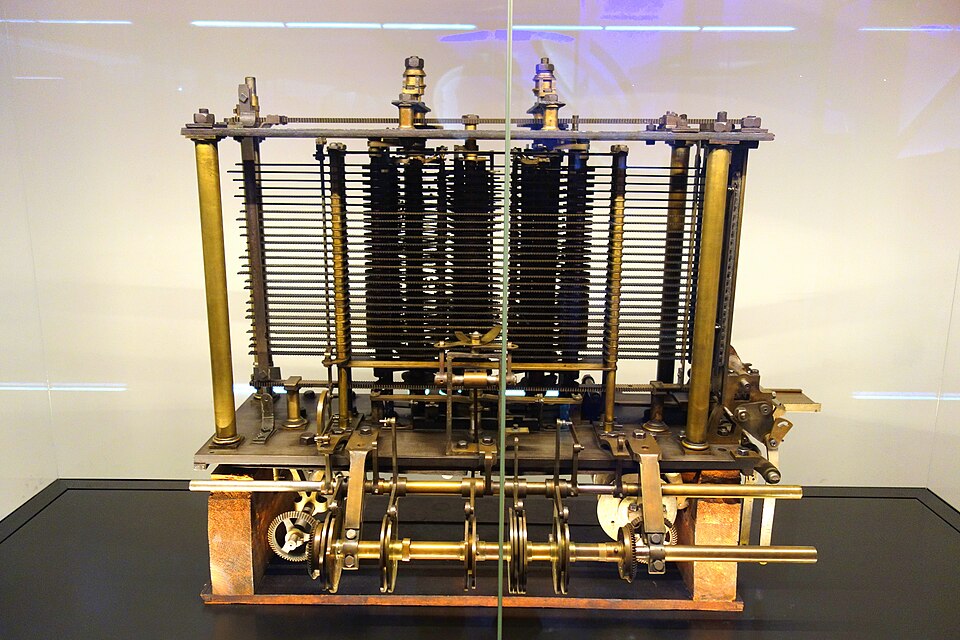
In 1842, Italian engineer Luigi Federico Menabrea published a French-language description of Babbage's Analytical Engine, based on lectures Babbage had delivered in Turin in 1840.
Ada translated the article into English. Instead of stopping there, she added seven substantial notes, labelled A through G. Published in 1843, her commentary grew considerably longer than the original text and explored not just how the machine might operate, but what it might mean to program one.
The final note, Note G, included a detailed table of operations showing how the proposed Engine could calculate a sequence of Bernoulli numbers. It is one of the earliest published examples of an algorithm expressed for execution by a general-purpose calculating machine.
Importantly, the table was not the result of code being run on a completed Engine. The machine was still a design. The achievement was conceptual: translating a mathematical procedure into steps that a hypothetical mechanism could follow.
From arithmetic to information
Lovelace's boldest idea was that a calculating machine might process more than quantities.
If numbers could stand for other things, she reasoned, and if the machine could act on those representations according to rules, then its operations might extend beyond conventional arithmetic. She suggested the possibility of working with musical relationships, and her notes also discussed symbols and abstract operations.
This matters because it points towards a distinction at the heart of modern computing. A processor is not limited to understanding what its bits represent. Under the right instructions, the same digital hardware can work with a spreadsheet, a photograph, a song or a piece of text.
It would be misleading to claim that Lovelace invented modern software, digital music or artificial intelligence. Those developments came much later, through many different people and technologies. Her contribution was an unusually early and explicit articulation of the larger possibility: a programmable machine could manipulate representations, not just totals.
The algorithm in Note G
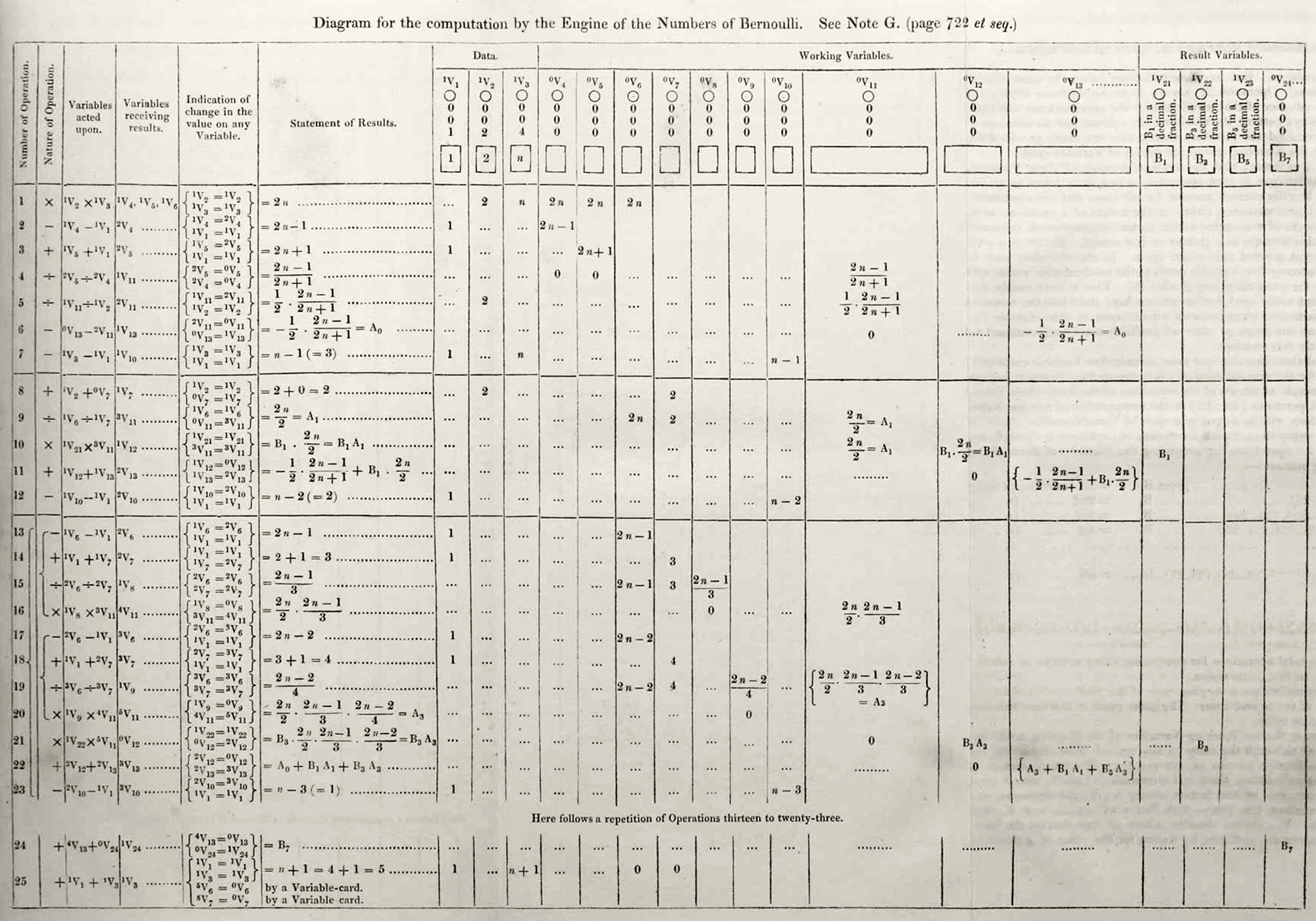
Why Bernoulli numbers? They are a sequence used in mathematics, including formulas associated with sums of powers. Computing them is intricate enough to illustrate how a machine might carry out a planned chain of operations.
Lovelace's table set out operations, working variables and results. It was not a computer program in a modern programming language; it was closer to an execution plan for Babbage's proposed machine. But it captured something familiar to today's programmers: to produce a result, a system must follow an ordered procedure, keep track of intermediate values and repeat operations when required.
Babbage and Lovelace worked closely together. Historians have found earlier unpublished programming-like work in Babbage's notebooks, and scholars debate precisely how much of Note G's method originated with each collaborator. Calling Lovelace "the first programmer" without explanation obscures that history.
A more defensible statement is that her 1843 notes contained a landmark published account of an algorithm for the Analytical Engine, alongside an exceptionally influential argument for general-purpose computation.
A surprisingly modern question about machines
Lovelace was visionary, but she was not a prophet of unlimited machine intelligence. In the same notes, she warned against attributing independent creative powers to the Engine simply because it could follow complex instructions.
Her famous discussion of what the machine could or could not originate later entered debates about artificial intelligence. It should not be treated as a final answer to those debates: the software, statistical learning methods and hardware used today differ profoundly from Babbage's mechanical design.
Still, her question has survived. When a machine produces music, images or prose, how much comes from its instructions and training, and what should count as originality? Modern systems have changed the terms of that discussion, but they have not made it uninteresting.
The machine that never ran — and the idea that endured
Babbage did not finish the Analytical Engine. Ada Lovelace died in 1852, aged thirty-six, long before electronic computers arrived. Her insights did not pass in an unbroken technological line from Victorian London to today's silicon chips; many computing principles were later developed independently.
That makes her achievement no less compelling. She recognised a powerful possibility within a set of mechanical drawings, pursued it through rigorous mathematics and explained it to readers who had never seen such a machine operate.
There is a lesson here for anyone trying to understand emerging technology. Its most important future use may not be the task its inventors first set out to solve.
The Analytical Engine was intended to perform calculations. Ada Lovelace imagined a machine that could work with ideas represented as numbers.
That distinction helped make her one of computing history's most enduring thinkers.
Sources & further reading
- Computer History Museum — Ada Lovelace
- Science Museum Group — Ada Lovelace
- Science Museum — Ada Lovelace: visionary of the computer age
- Computer History Museum — A Brief History of Babbage's Engines
- Ada Lovelace / Luigi Menabrea — Sketch of the Analytical Engine, 1843 (Project Gutenberg)
- York University — Notes by the Translator, Ada Lovelace, 1843