BEFORE AI · EDITORIAL FEATURE
The First Machines That Acted Alone
Ancient devices could follow predetermined sequences. They were not intelligent, but they made motion into a kind of performance.
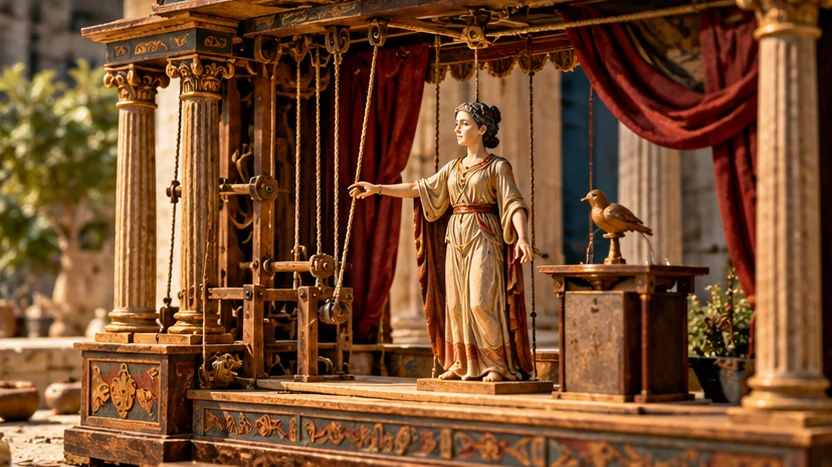
An audience waits before a miniature stage. Figures stand motionless. Then a hidden mechanism begins its work. A character moves, a scene changes and a sequence of actions unfolds in front of astonished viewers.
The performance is not powered by a computer. Its instructions are embodied in ropes, weights, pulleys and the geometry of the mechanism itself. That is the remarkable subject of ancient automata: machines designed not just to be moved, but to move through a prepared action by themselves.
When the mechanism became a storyteller
Ancient engineers explored self-acting devices long before electric motors. Hero of Alexandria’s treatise On Making Automata describes mechanical theatrical arrangements. One type could move through space; another performed in a fixed setting. Their goal was partly theatrical: to stage events in an order that spectators could follow.
The University of Glasgow’s research project on Hero’s theatrical automata has examined the text alongside engineering reconstructions. The researchers investigate whether the mechanisms were practical devices, thought experiments, performance technologies or some combination of the three. That careful approach is essential because a surviving written description is not the same as surviving proof of every performance.
Hero was not the only figure in this tradition. Earlier Greek engineering, including the work associated with Philo of Byzantium, explored pneumatic and mechanical effects. The broader history was collaborative across generations, even when surviving texts make individual names stand out.
A script written in rope and wood
Modern readers often associate programming with instructions typed into a screen. Ancient automata show a very different kind of instruction storage. The sequence was built into the machine’s physical arrangement.
A wound cord could release at a particular time. A weight could descend at a controlled pace. Mechanical connections could cause one motion to trigger another. A stage device could therefore produce a series of effects without a performer manually directing each one in real time.
The result might look intelligent to an audience unfamiliar with the mechanism. But it was fixed in advance. It could not decide to tell another story or improvise a response to an unexpected question. The apparatus followed a constrained path, and any change generally required someone to alter the mechanism.
That is a useful distinction today. Automation means that a process can operate with reduced direct human intervention. Intelligence, as applied to modern AI research, raises additional questions about adaptation, learning, representation and decision-making. The two ideas overlap in contemporary products, but they are not synonyms.
Why the ancients built wonder
It is tempting to judge a theatrical automaton by whether it could carry bricks or plough a field. That misses its cultural purpose. Machines can be designed to demonstrate knowledge, create wonder, imitate life or stage religious and civic experiences. Engineering has always served human imagination as well as economic utility.
A dramatic mechanical performance also offers an educational lesson. The audience sees the effect before it understands the cause. The engineer can then reveal how everyday physical principles—falling weights, flowing fluids, rotating axles—produce an apparently impossible outcome.
If the machine is unreliable, however, the show fails. Ancient automata demanded care in fabrication, timing and assembly. The same requirement appears in modern automation, where a carefully planned sequence succeeds only if its physical components work together.
A step toward systems thinking
We should not call Hero’s stage a programmable computer. Its operations were embodied in particular hardware, and its capacities were narrow. Still, the surviving designs offer a compelling illustration of an organised sequence of actions executed by a device rather than by a human operator.
That idea would reappear in many forms: clocks, textile machinery, industrial controls and finally the computers of a much later era. The connections are historical parallels and developments, not proof of one continuous unbroken chain.
Our next story returns to something less theatrical but just as transformative: a light sheet of material that made ideas easier to carry.