BEFORE AI · EDITORIAL FEATURE
When Mathematics Became Proof
The true innovation was not a clever diagram but a method: conclusions could be built from assumptions and examined by anyone.
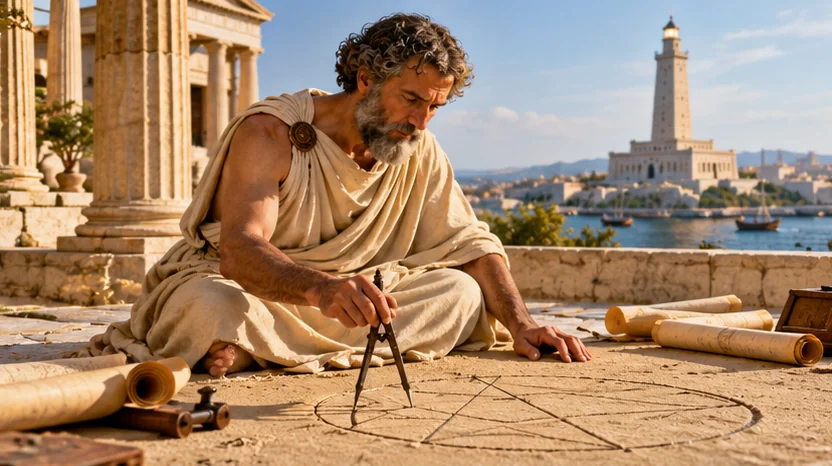
Draw a triangle in the sand. You may see at once that its angles seem to fit together in a familiar way. Yet a convincing sketch is not the same as a proof. A drawing could be inaccurate. The next triangle could look different. What would it take to establish a result for every triangle of the relevant kind?
That question brings us to one of the great transformations in the history of thought. Mathematics became not just a way of calculating quantities, but a disciplined way of building conclusions from definitions and assumptions.
A book that organised an intellectual world
Around 300 BCE, the mathematician Euclid worked in Alexandria, according to the conventional account of his life. Details of his biography remain uncertain, but the influence of the work associated with his name, Elements, is unmistakable.
The book begins with definitions, postulates and common notions, then develops propositions in a structured sequence. Its power lies in the architecture: later results depend on claims established earlier. Rather than asking readers to trust an individual authority, the argument makes the logical route visible.
The University of St Andrews’ MacTutor history of mathematics notes that Euclid did not necessarily discover most of the results in Elements. His achievement lay in organising and presenting mathematical knowledge with extraordinary coherence. That distinction matters. Invention can mean finding new facts, but it can also mean creating a new structure in which established facts become more useful.
Proof is a public act
A worked example can show that a particular numerical answer is correct. A proof aims to explain why a conclusion necessarily follows under specified conditions. It makes hidden assumptions visible and gives others a chance to detect mistakes.
That does not mean Greek mathematics sprang from nothing. Egyptian, Babylonian and other mathematical traditions were already sophisticated, with practical algorithms and numerical techniques. The distinctive prominence of deductive geometry in surviving Greek texts should not be mistaken for proof that earlier cultures lacked reasoning or insight.
Nor was Euclid’s framework beyond criticism. Centuries of mathematicians struggled with questions surrounding the parallel postulate. The later development of non-Euclidean geometries showed that different consistent systems could begin from different assumptions. Far from diminishing Euclid, that development demonstrates how productive it is to make assumptions explicit.
Geometry as a technology of trust
Proof changes the relationship between a claim and its audience. A person may be brilliant or famous, but in mathematics, the conclusion ultimately depends on whether the reasoning works. A proof can be checked elsewhere, taught to someone else and used as a foundation for another result.
The same intellectual discipline influenced many areas of modern science and engineering. When designers need confidence that a component or a method behaves as claimed, evidence and reasoning matter. Modern software verification draws on formal logic and mathematical techniques, although real-world systems also require empirical testing.
There is an important warning here. A statement proved within a mathematical model is not automatically a faithful description of the physical world. Models require assumptions, and those assumptions must be tested against reality. Formal certainty and practical reliability are related but different things.
From logical steps to artificial intelligence
Some AI systems rely heavily on mathematics, logic and algorithms. However, modern machine learning often draws conclusions from patterns in data rather than constructing formal proofs of every output. That difference is crucial when deciding whether a machine-generated answer should be trusted.
Euclid’s lasting contribution to our story is not that he invented AI. It is the principle that complex understanding can be assembled from explicit, inspectable steps. In that sense, the history of proof leads naturally toward later questions about algorithms, programs and machines.
Could physical devices be designed to follow a carefully specified sequence? In Alexandria, engineers were already exploring an answer.