BEFORE AI · EDITORIAL FEATURE
The Machines That Multiplied Knowledge
Gutenberg did not invent printing. His European system of reusable metal type helped change the economics of copying knowledge.
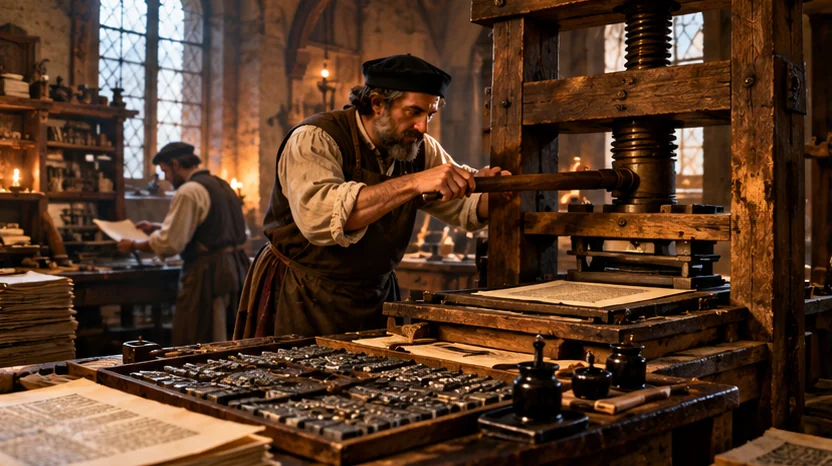
Imagine a workshop in Mainz in the 1450s. The air carries the smell of ink and damp paper. A printer arranges tiny pieces of metal into lines, inks their raised faces and brings a sheet down beneath a press. When the paper is lifted, an entire page is there. The astonishing part is what happens next: much of the same equipment can be used again.
In a manuscript culture, producing another copy of a book meant an immense amount of skilled labour. Printing did not remove every human task, but it offered a different relationship between preparation and reproduction. Once a page was composed, multiple impressions could be made.
A revolution built from a system
The familiar heroic version gives Gutenberg a single magical machine. The historical story is richer. His European printing method depended on compatible metal type, ways of casting and assembling characters, suitable ink, a pressing mechanism and a disciplined workflow.
Each component presented practical challenges. Type had to be uniform enough to produce consistent lines. Ink needed to transfer effectively to metal and paper. Pages had to be arranged so they could be read, corrected and printed. The press was important, but the entire process mattered.
The best-known result was the Gutenberg Bible, printed at Mainz around 1454–1455. The Library of Congress describes it as the first great large-format Bible printed in Europe with movable metal type. Estimates suggest a print run of roughly 180 copies, remarkable for such an ambitious work in its setting.
The part history often leaves out
Printing was not born in Europe. Woodblock printing had long been practised in East Asia. Forms of movable type also appeared in Asia before Gutenberg; surviving Korean evidence of printing with movable metal type predates his Bible. A global account must recognise these earlier histories rather than place the origin of printing at Mainz.
Gutenberg’s contribution was a major European breakthrough in bringing together techniques and organising production. The consequences for European publishing were profound, but the technology also entered a world already rich in manuscript traditions, libraries, readers and institutions.
Indeed, early printed books could still require considerable hand-finishing. Initials, headings, decoration and binding were sometimes added by different craftspeople after the sheets came off the press. The Library of Congress points out that individual surviving Gutenberg Bibles differ partly because they were completed by hand.
More copies, new questions
Reproducing texts in greater numbers transformed the possibilities of communication. Scholars could compare copies; merchants and institutions could circulate documents; new audiences could encounter ideas beyond the communities where they began. Over time, print helped underpin religious debate, scientific exchange and new forms of public discussion.
But more copies did not mean equal access overnight. Books still cost money. Many people could not read. Authorities could attempt to censor publications, and printers could reproduce errors or propaganda as effectively as discoveries. A technology that amplifies knowledge can amplify misinformation too.
That double-edged power makes the printing press feel unexpectedly modern. The question is not only how quickly information can be reproduced. It is who controls its production, who can reach it and how readers decide what deserves trust.
An ancestor of scale, not of the algorithm
Gutenberg’s machines did not compute or reason. Their great achievement was repeatability. A carefully prepared arrangement of type could generate a large number of matching outputs. The same basic principle—invest effort in a reliable process, then repeat the result—became crucial in industrial production and information systems.
The press also helped create the conditions in which knowledge could be checked and built upon more systematically. When ideas travel further, disagreement and correction can travel too.
The machine at Mainz was therefore not an early computer. It was something equally transformative in its own sphere: a new way to multiply access to recorded thought. The next chapter asks how thinkers learned to distinguish convincing claims from claims that could actually be proved.