BEFORE AI · EDITORIAL FEATURE
The First Calculators: When Stones Did the Math
Pebbles on a board could stand in for quantities and operations—a simple device with a powerful mathematical idea behind it.
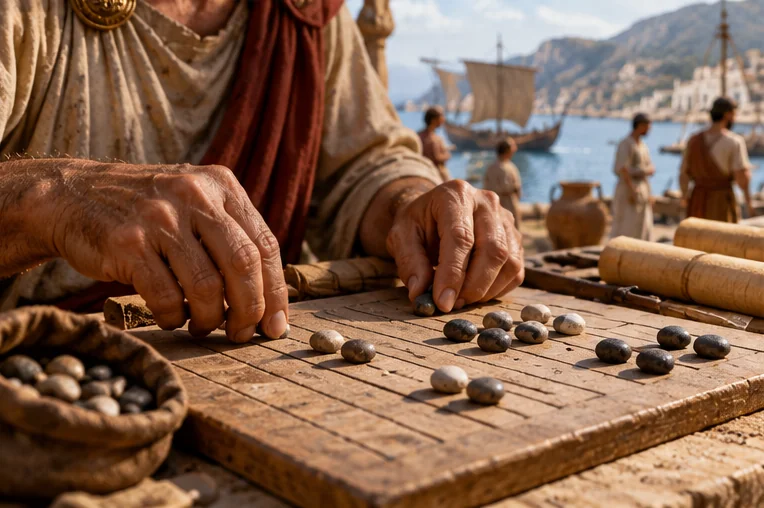
On a table marked with lines, a small stone can be more than a stone. Place it in one position and it stands for a quantity. Move it to another and its value changes. The object itself has not changed; the rule governing its place has. That simple arrangement reveals a remarkable development in human problem-solving: numbers no longer had to live entirely inside the head.
In an ancient marketplace, that mattered. Buying, selling, distributing and checking goods all required calculations. Mental arithmetic was useful, but merchants and officials also benefited from methods that could be inspected, repeated and corrected.
A board, a set of rules, a calculation
Counting boards took different forms across places and centuries. Marks might be made in sand or on a flat surface; counters might be stones, discs or other small objects. The Smithsonian’s National Museum of American History explains that the abacus belongs to a broad family of devices in which beads, pebbles or discs are moved along lines, rods or wires.
One celebrated artefact is the counting table found on the Greek island of Salamis. The Smithsonian holds a replica of this marked stone slab, with its sets of parallel lines. Scholars have debated aspects of ancient calculating practice, so a reconstruction of precisely how a particular merchant used the board needs caution. But the general idea is clear: a physical arrangement can represent and manipulate numerical values.
The English words calculate and calculus have roots connected with small stones. That linguistic trace preserves the relationship between arithmetic and tangible objects.
Why position is powerful
Put five pebbles in a row and they simply look like five pebbles. Give different rows or columns different values and the arrangement becomes far more flexible. It can separate units from larger quantities and help a user carry out operations step by step.
The power lies partly in relieving working memory. A trader no longer has to hold every intermediate result mentally. The arrangement on the board carries some of the burden. If a mistake is suspected, the user can go back through the positions and movements.
A modern calculator hides most of its operations behind a screen. A counting board exposes them in the movement of the operator’s hands. That visibility is useful in teaching as well as commerce. It also shows that calculation is not the same thing as electronics: it is a procedure for transforming representations according to agreed rules.
There was more than one abacus
The word abacus can invite a misleading image of a single familiar device. Ancient line-and-counter boards were not identical to later frames with sliding beads. Different cultures developed their own forms, and methods changed over time. Chinese and Japanese abaci, for example, have histories that should not be simply projected backwards onto a Greek stone table.
This diversity is a reminder that numerical tools were solutions to practical needs, not stages in a single worldwide relay race. A technique could thrive in one setting, disappear in another or evolve into a distinctly local tradition.
The hidden importance of a pebble
A stone does not know what it represents. The user supplies the meaning and follows the rules. That is precisely why it can stand in for something else: quantities of grain, money, distance or time.
This idea—using a physical thing to represent an abstract value—became a foundation of mathematical instruments and, much later, electronic computation. But there is no direct uninterrupted lineage from a counting board to every modern computer. What survived across different technologies was the usefulness of representing a problem outside the mind.
From pebbles and lines, the story moves to another stubborn quantity humans sought to measure: the passing of time itself.