BEFORE AI · EDITORIAL FEATURE
The Day Humans Learned to Store Ideas
The earliest written records were often accounts of grain and goods. Out of administration grew a way for ideas to outlive their makers.
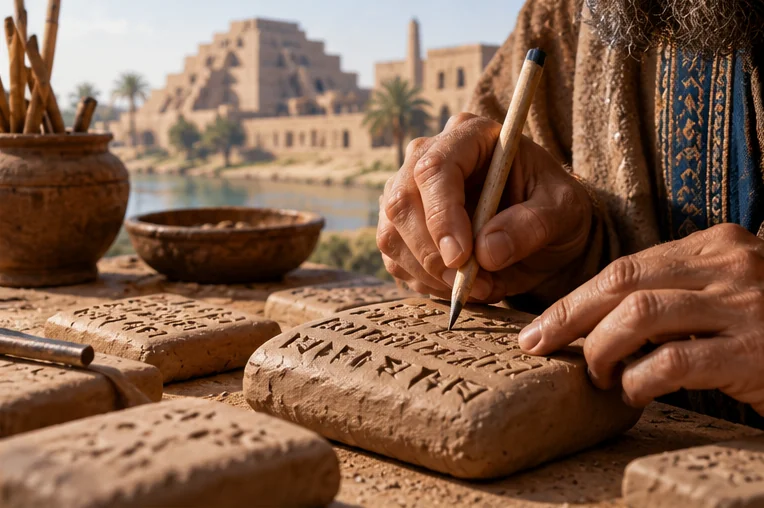
There is something disarmingly ordinary about the earliest records from Mesopotamia. They do not read like grand declarations of philosophy. Many concern barley, goods, workers and allocations. The birth of writing, one of the defining events in human history, was closely bound to the practical business of keeping track.
Imagine an administrator in an expanding settlement. Supplies arrive from farms. Food must be distributed, labour accounted for and obligations remembered. Memory, testimony and physical counters can help. But as transactions multiply, another system becomes valuable: marks that can outlast the conversation in which they were made.
A city needed a memory
By around 3200 BCE, Uruk in southern Mesopotamia was a remarkable urban centre. Administrative systems grew alongside its buildings, workshops and institutions. Early tablets contained pictures and numerical impressions used to record goods and distributions. The Metropolitan Museum of Art dates the emergence of proto-cuneiform writing in southern Mesopotamia to the late fourth millennium BCE.
These early signs were not yet literature in the modern sense. A tablet might identify a commodity and an amount without the grammar needed to record a full sentence. That distinction matters. Writing did not appear fully formed; it evolved as people adapted signs to express increasingly complex information.
Over time, pictures became more abstract. A reed stylus pressed into soft clay left the wedge-shaped marks we call cuneiform. Signs could represent words, syllables and sounds. This enabled scribes to record more than quantities: names, laws, accounts, astronomical observations, stories and poetry.
The breakthrough was outside the human mind
Spoken language had long allowed people to exchange knowledge. Written signs offered something new: information could remain available when the speaker was absent. A message could be checked, copied, challenged, carried and consulted again.
The consequences were enormous, though not automatically democratic. Literacy was often concentrated among trained specialists and powerful institutions. Written records could strengthen rulers, temples and merchants by helping them organise resources. They could also preserve voices and ideas that otherwise would have disappeared.
The material itself was an unlikely ally. Clay was widely available in Mesopotamia. It could be shaped when wet and hardened by drying or firing. Some tablets survived accidentally because heat baked them during fires. What was once everyday paperwork is now extraordinary historical evidence.
There was no single universal invention
It would be misleading to say that all the world’s writing systems originated in one city. Writing developed independently in more than one part of the world, and the history of some scripts remains debated. Egyptian writing also appeared in antiquity, while later systems arose elsewhere through distinct cultural processes.
Even in Mesopotamia, scholars distinguish between the first administrative marks and the later ability to represent spoken language fully. A symbol showing barley is not equivalent to a modern written paragraph. The transformation unfolded over generations.
What the story reveals is a recurring pattern in the history of technology. An invention often starts by solving a local, unglamorous problem. Its wider implications appear only after many people adapt it for purposes its earliest users could scarcely have imagined.
The first external information system
Modern computers store data electronically. Clay tablets stored information physically. The resemblance ends quickly if we try to equate the two, but the deeper question connects them: how can a society make information reliable beyond the limits of an individual memory?
Writing gave humans a durable medium for records and ideas. It allowed knowledge to accumulate rather than starting anew with every generation. The written word did not replace human thought; it extended what groups could organise, preserve and debate.
Next came another kind of abstraction. Once goods and obligations could be recorded, people also needed increasingly capable ways to count and calculate them.