BEFORE AI · EDITORIAL FEATURE
The Metal That Changed Civilisation
The Bronze Age was not simply a stronger set of tools. It reshaped materials, trade networks and the organisation of expertise.
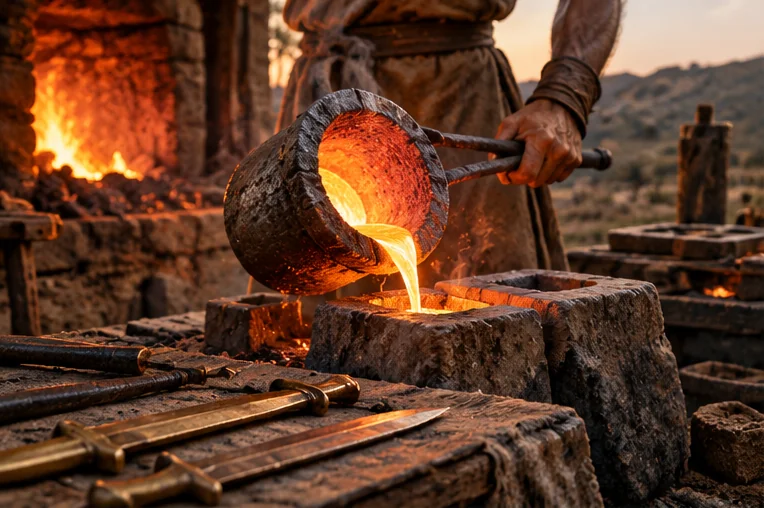
Picture a craftsperson leaning over a crucible, watching metal glow orange in the heat. This scene could belong to many places and centuries, but it captures one of humanity’s most consequential discoveries: different metals could be combined to create a material with properties neither supplied on its own.
Bronze—typically an alloy of copper and tin—was more than a tougher alternative to stone. It could be cast into detailed moulds, worked into repeatable shapes and repaired or remelted. The material helped communities make tools, weapons, ornaments and objects of religious or political significance. Its arrival is often presented as a clean dividing line in history. The reality was messier, more inventive and far more interesting.
A recipe, not a single eureka moment
People worked copper long before bronze became widespread. In the ancient Near East, evidence of early metalworking reaches back thousands of years before the period usually labelled the Bronze Age. Craftspeople learned to hammer native copper, heat it, pour molten metal into moulds and alter its properties through repeated heating and shaping. Alloying was another advance in that long experiment.
Tin bronze was not the only type of bronze. Early metalworkers used different copper-based alloys, and recipes varied by region and period. A mixture successful for a blade might not suit a decorative vessel. Controlling temperatures, materials and moulds took experience that could be passed between workshops and generations.
What mattered was not that one inventor found the perfect formula. It was that specialists increasingly understood a powerful principle: the material of an object could be engineered, not merely found.
The metal that demanded a network
Copper and tin are not always found together. In places where one or both were scarce, producing bronze on a significant scale meant obtaining raw materials from elsewhere. Archaeology points to complicated exchange networks stretching across regions. Metal ingots, finished objects, techniques and ideas moved along routes that linked communities with very different landscapes and resources.
That trade made metalworking social and political as well as technical. Access to ore, fuel, skilled craftspeople and transport could shape who controlled production. A richly decorated bronze object might display authority; an axe or tool might change how work was organised. Neither outcome was automatic, and stone, wood and bone remained useful throughout the period.
The name Bronze Age can also conceal enormous variation. Communities did not all begin using bronze at the same time, and historians use different chronological boundaries in different parts of the world. Metal never swept uniformly across the planet like a software update.
Precision before machines
Consider the extraordinary sequence behind a cast object. Someone must select materials, judge their proportions, prepare a mould, heat the metal, pour at the right moment and finish the result. The craft depends on measured expectations—even when measurement is not expressed in modern numbers. Makers compare outcomes and adjust their process. A reliable workshop accumulates a practical memory of what works.
That is a useful way to understand early technology. Civilisation did not leap from stone tools to computers in a straight line. Instead, people built systems of expertise: techniques that could be recorded informally, taught, refined and reproduced. The capacity to make an object consistently became as important as the object itself.
Why this story belongs in Before AI
Bronze is not an ancestor of artificial intelligence in any literal engineering sense. A bronze sword does not contain an algorithm. But metallurgy demonstrates an enduring habit of human invention: break a complex task into controlled steps, learn from the result and create something the natural world does not provide ready-made.
The Bronze Age was as much about skilled people and connected societies as gleaming metal. Its legacy is the idea that matter could be transformed through knowledge—and that knowledge, shared across distance and generations, could transform societies in return.
The next chapter begins with a different challenge: how to preserve an idea when the person who had it is no longer there.