The 1843 Machine That Tried to Send a Page Through a Wire
The fax machine now feels like a relic of the office age, remembered for curled paper and irritating tones. Its central idea, however, belongs to a far earlier world. In 1843 Alexander Bain, a Scottish inventor and clockmaker, patented a device that pointed toward sending the shape of a document through electrical signals.
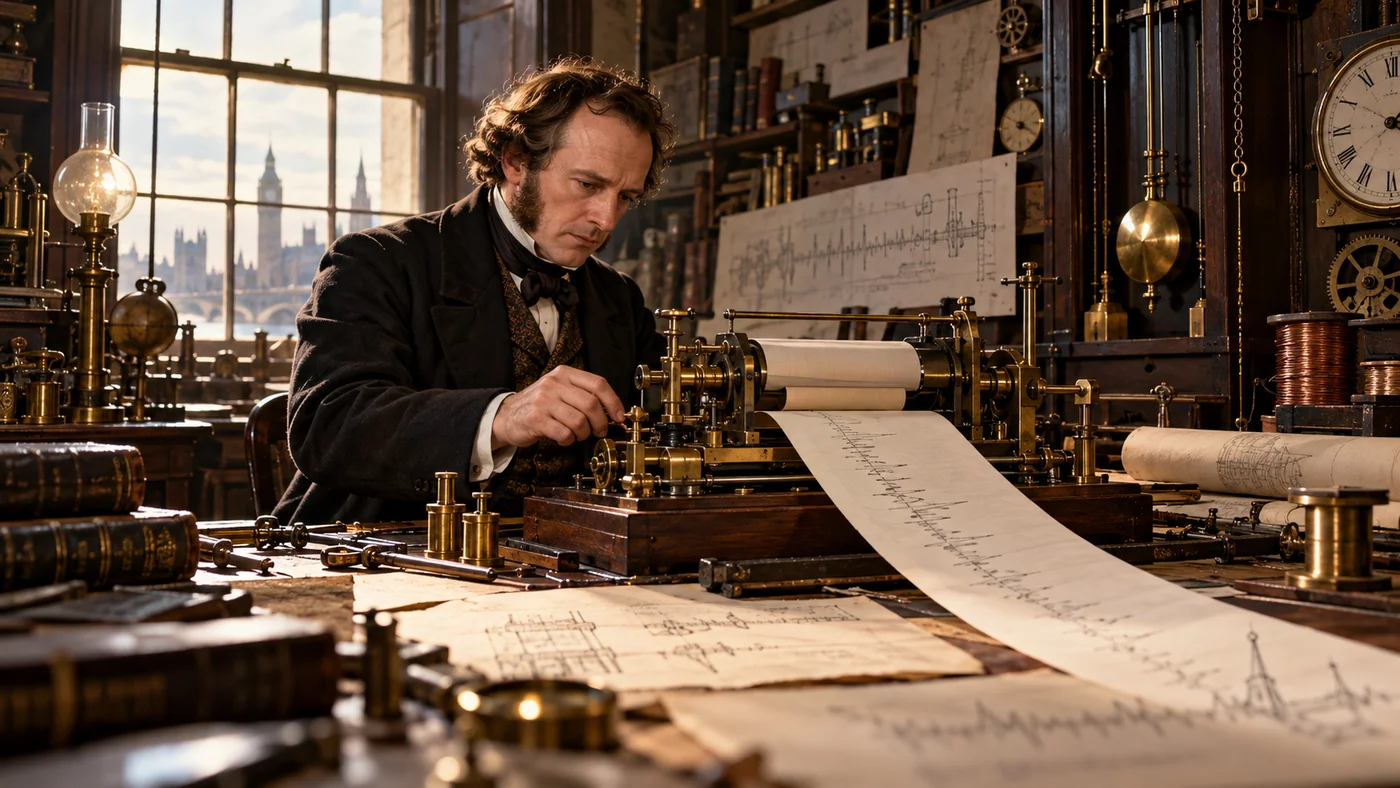
When a message travelled faster than a messenger
For most of human history, written information travelled no faster than the person, horse or ship carrying it. The electrical telegraph changed that relationship. A signal could move along a wire almost instantly compared with a journey on the road. But the message still had to be converted into agreed symbols, interpreted at the other end and often copied out by an operator.
Alexander Bain asked a different question. What if the machine could send not only a coded description of the message, but a physical copy of its marks? Imagine transferring a written name, a printed symbol or a small drawing without asking someone at the receiving station to reproduce the shape by hand.
Bain was unusually prepared to think about the problem. His training was in clocks, where precisely controlled and repeated movement is everything. In London he worked amid the fast-developing worlds of electrical timekeeping and telegraph engineering. Research published in Scottish Local History shows how those two areas fed directly into his ideas for the copying telegraph [1].
A patent in 1843, not a modern fax on a desk
Bain’s British patent of 27 May 1843 described an early facsimile principle, developed as part of a wider body of work on electrical clocks and telegraphy. It would be misleading to picture a machine that could accept any office document, dial a number and produce a neat sheet at the other end. The original scheme was experimental, depended on specially arranged material and relied on mechanical precision [1][2].
The first design envisaged a document represented by raised conductive characters or other suitable surfaces. A moving contact could encounter those surfaces as it travelled across the original, causing an electrical change. A matching mechanism at the distant receiving apparatus could make a corresponding mark on prepared paper. Each pass captured a tiny portion of the pattern.
In 1848 Bain obtained a United States patent for improvements in copying surfaces by electricity. The patent explicitly referred back to the British grant of 1843 and described keeping two distant pendulums in synchrony. Its surviving drawings and wording offer a rare direct view into what the inventor was actually trying to build [2].
The leap was conceptual: turn a surface into a sequence of signals, then reconstruct it somewhere else.
Why a clockmaker was the right person to try
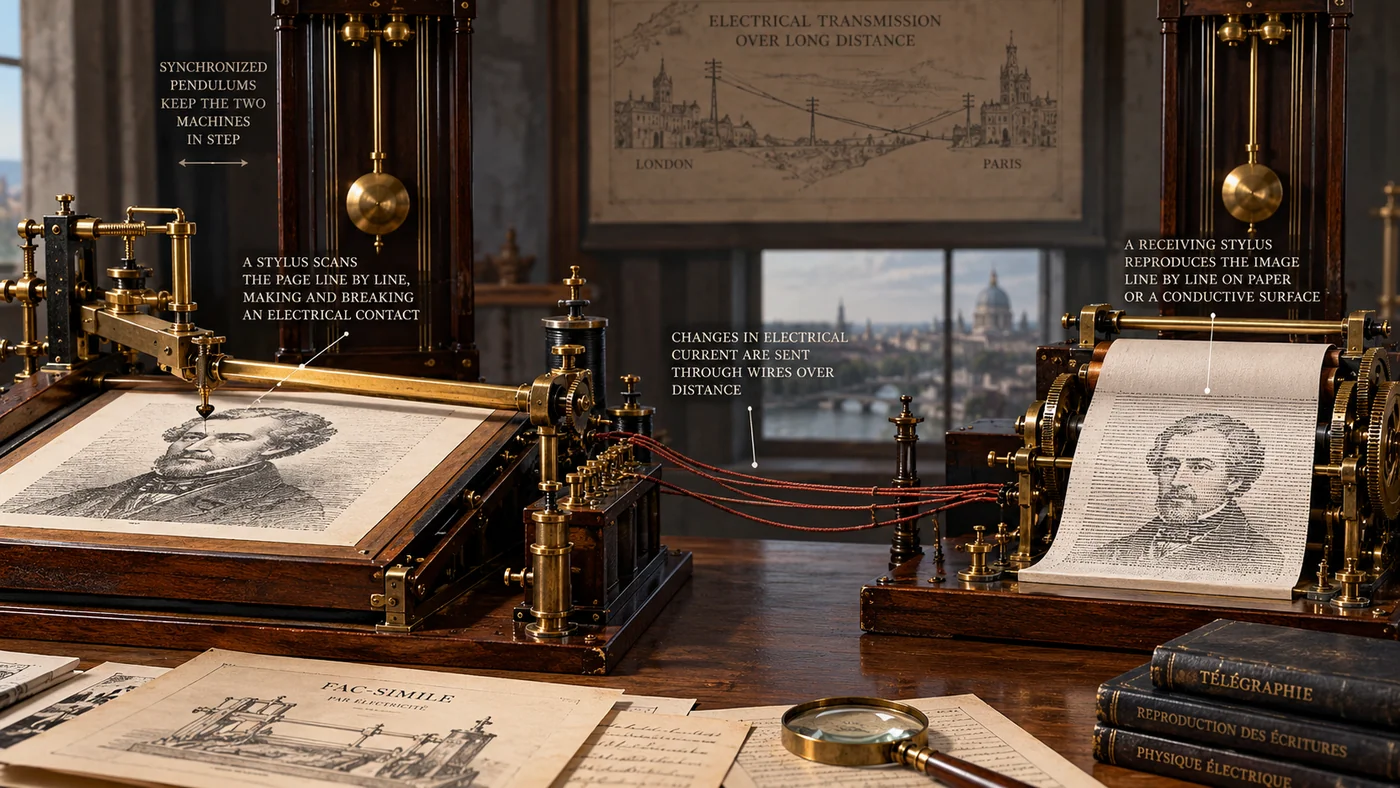
Imagine two people drawing the same picture line by line, one in London and another in a different city. If one moves the pen faster than the other, the resulting image stretches. If their lines start at different moments, the picture slips out of alignment. A facsimile system has exactly this challenge: the scanning movement at the sender and the recording movement at the receiver must remain in step.
Bain’s answer was mechanical synchronisation. His designs used swinging pendulums with styluses. The sending stylus moved across the source surface and produced changes in the electrical circuit. At the receiving end, a corresponding stylus marked chemically treated paper. After a sweep, the material advanced slightly so the next line could be sampled and copied [1].
To a modern reader this resembles the logic of raster scanning: inspect a surface in an orderly sequence, communicate what was found and rebuild the pattern in the same order elsewhere. Bain did not invent digital pixels or the modern camera sensor. But he approached an information problem that would become central to image transmission in later technologies.
From surfaces to signals - the hidden breakthrough
What exactly travelled along the wire? Not a miniature picture. The wire carried changes in electrical current. Those changes stood for the contact made by the scanning probe at a particular point of the source. The remote machine translated the changing signal back into visible marks. The image was reconstructed by repetition, not transported as a physical object.
The distinction is easy to miss because modern technology hides this transformation so effectively. We send pictures with a tap, but every electronic transmission depends on representing something visible as information that a receiving device can interpret. Digital systems use binary data, compression, error correction and electronic sensors; Bain’s method used much simpler electrical contacts and mechanical motion.
The resemblance is therefore a useful conceptual connection, not a claim of direct technical identity. From analogue facsimile to today’s image networks, engineers repeatedly face the same basic questions: what do we measure, in what order do we transmit it, and how do we know that the receiver reconstructs it correctly?
A brilliant mechanism can still fail as a product
An experimental copy is not a reliable communications service. The moving components had to stay aligned. The prepared paper and electrical contacts introduced practical difficulties. The network was expensive, and customers had to see enough value in image transmission to pay for special equipment. The limitations were not trivial engineering details; they were the difference between a working demonstration and a business.
Other inventors pursued related systems. Frederick Bakewell patented a copying telegraph in 1848 and demonstrated his machine publicly. At London’s Great Exhibition of 1851, both Bakewell and Bain showed copying technology. According to Ivan S. Ruddock’s historical study, Bain promoted an improved apparatus capable of transmitting handwriting and diagrams, rather than being limited to the raised type envisaged in the earlier design [1].
These demonstrations made a striking claim: ordinary visual information might travel across distances by electricity. Yet neither of those early machines became the ubiquitous office fax. Real adoption would take further inventions, dependable services, infrastructure and much more time.
1865: the idea finally meets paying customers
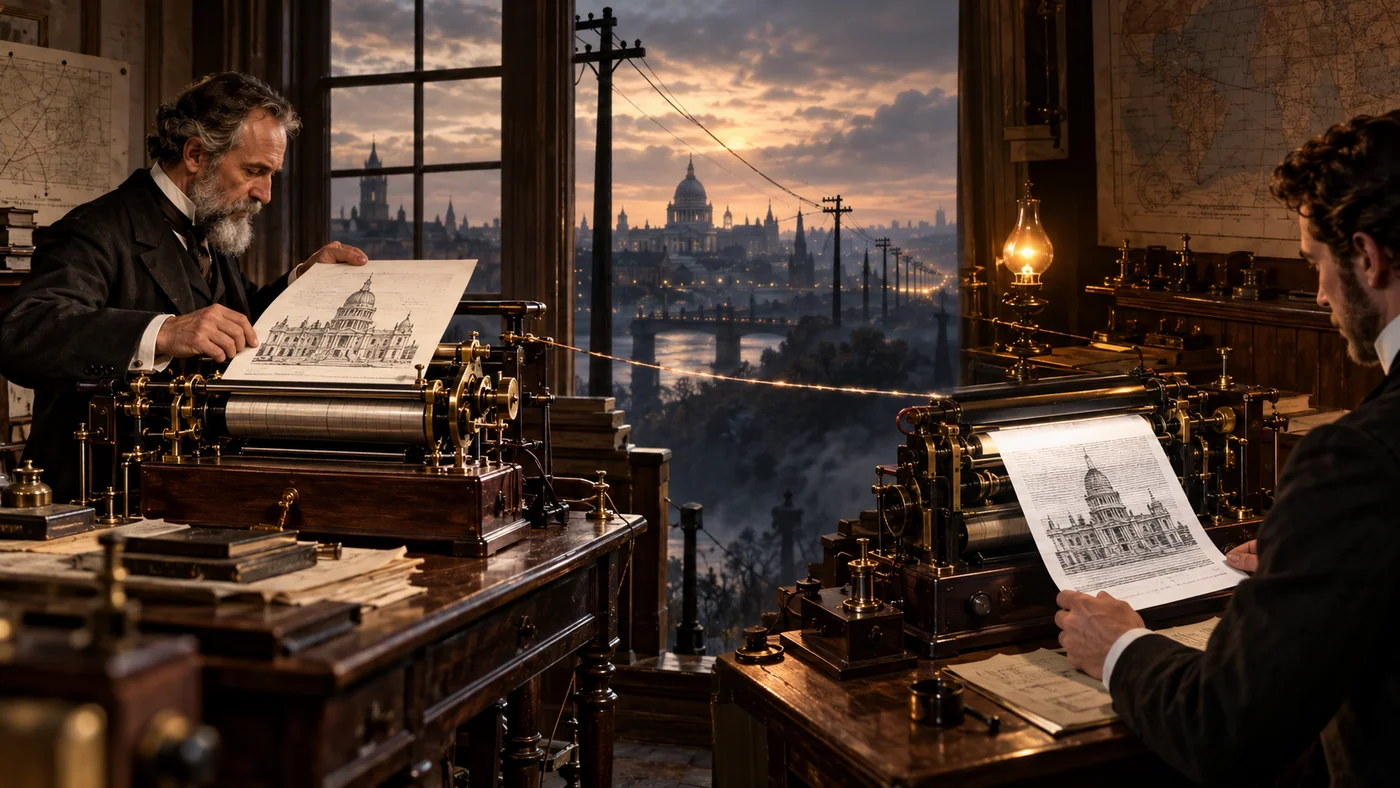
One of the milestones came through Giovanni Caselli, whose pantelegraph system entered commercial use between Paris and Lyon in 1865. It too depended on mechanical scanning, synchronisation and electrically reproduced marks. Histories of facsimile technology distinguish this commercial service from Bain’s earlier patent because being first to propose a principle is not the same thing as putting a service into operation [3].
By then the telephone had still not arrived as a commercial technology. The chronology overturns the familiar assumption that fax must be younger than voice communication. The early history of sending marks along a wire began before the telephone became established, even though fax machines later seemed technologically old-fashioned beside it.
The process kept evolving through subsequent decades, leading to better recording and transmission methods. The office fax used in the late twentieth century was the result of many separate improvements, not merely Bain’s apparatus reproduced at a larger scale.
The less glamorous story: rivals and patents
The history of technology is not only a series of clever inventions. It is also a story of financing, competition and legal rights. Bain was involved in disputes with other major figures in electrical communication, including Charles Wheatstone and Samuel Morse. His technical work brought recognition, but commercial success proved difficult to sustain [1][4].
The Hagley Museum and Library describes an especially telling find: a surviving Bain patent model rediscovered in its collection. Research into the model showed that the American patent was associated with several different pieces of apparatus. Physical objects like these are valuable because the history of a technology is often more complicated than the neat diagram reproduced in a schoolbook [4].
Bain’s background helps explain his inventive leap, but it did not guarantee wealth or widespread adoption. A strong technical idea can arrive before the manufacturing, business model or social need required to turn it into a lasting service.
The real legacy is a way of thinking
It is tempting to call Bain the “father of the fax” and end the story there. The more interesting explanation asks what his invention made possible to imagine. Once a machine could translate a visible pattern into a sequence of electrical changes, communication no longer had to mean typing or decoding a symbol by hand at each end.
The idea did not produce a digital network overnight. Modern cameras, scanners, internet protocols and image formats follow vastly different designs. Their common challenge is nonetheless recognisable: represent an image, send or store that representation and reconstruct the result so that another person can see it.
There are several birthdays in the history of an invention: the first idea, the patent, the workable demonstration, the commercial service and the moment the technology becomes ordinary. Bain’s 1843 patent deserves its place near the beginning of that story, while Caselli’s service in 1865 marks another important step. Neither milestone should erase the people and developments between them.
How historians separate the invention from the legend
The surviving evidence has limits. A patent tells us what an inventor claimed and how the proposal was described, not necessarily how reliably every part worked in practice. A demonstration shows an apparatus could produce an effect under particular conditions; it is not the same as a commercial system working day after day. That is why histories of facsimile distinguish Bain’s proposal in 1843 from the later service introduced by Caselli in 1865 [1][3].
There is also a difference between a photograph of a museum object and a modern reconstruction. The images accompanying this article are imaginative visualisations, designed to help explain the concept and atmosphere rather than prove the precise appearance of Bain’s original apparatus. For the mechanical details, the historical study, patent drawings and museum collection provide stronger evidence than any cinematic illustration.
What an old fax can teach a new world
Bain’s apparatus required expertise in clocks, electricity and mechanical movement. None of those was enough alone. The breakthrough came from combining them into a process that answered a new question. Much of technological progress works this way: a mature technique in one field becomes the missing piece of another.
When an image appears instantly on a modern screen, the steps are almost impossible to see. There is a measurement, a representation, a journey, a sequence and a reconstruction. The machines have changed beyond recognition, but the underlying problem remains familiar.
So the next time you see an old fax machine, look past the paper tray. Behind it is a nineteenth-century question as bold as anything asked in the digital age: can a page leave one room as electricity and reappear somewhere else as a recognisable image? Alexander Bain helped turn that extraordinary question into a technical possibility.
Sources & Further Reading
- Ivan S. Ruddock, Alexander Bain: The Real Father of Television?, Scottish Local History (2012) (https://www.slhf.org/sites/default/files/publications/slhf12_alexanderbain.pdf)
- Alexander Bain, US Patent 5957A: Improvement in Copying Surfaces by Electricity (1848) (https://patents.google.com/patent/US5957A/en)
- Engineering and Technology History Wiki, Fax Machines (IEEE history project) (https://ethw.org/Fax_Machines)
- Hagley Museum and Library, Bain in the USA: The FAX Behind a Rediscovered Patent Model (2023) (https://www.hagley.org/librarynews/bain-usa-fax-behind-rediscovered-telecommunications-patent-model)
Related stories
Editorial transparency: All illustrations for this feature were generated with AI and are presented as concepts, not documentary photographs or verified historical reconstructions.